Home > Press > Physicist Says Nanoparticle Assembly Is Like Building with LEGOs
 |
| Image courtesy of Chris Knorowski/Iowa State University/Ames Laboratory
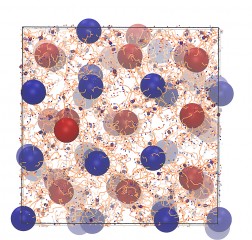
This image shows a crystal of nanoparticles (the red and blue spheres) held together by DNA strands (the orange lines) via the hybridization of complementary sequences (the blue and red rings). |
Abstract:
New processes that allow nanoparticles to assemble themselves into designer materials could solve some of today's technology challenges, Alex Travesset of Iowa State University and the Ames Laboratory reports in the Oct. 14 issue of the journal Science.
Physicist Says Nanoparticle Assembly Is Like Building with LEGOs
Ames, IA | Posted on October 14th, 2011Travesset, an associate professor of physics and astronomy and an associate of the U.S. Department of Energy's Ames Laboratory, writes in the journal's Perspectives section that the controlled self-assembly of nanoparticles could help researchers create new materials with unique electrical, optical, mechanical or transport properties.
"Nanoparticle self-assembly has entered the LEGO era," Travesset said. "You can really work with nanoparticles in the same way you can work with LEGOs. This represents a breakthrough in the way we can manipulate matter. Really revolutionary applications will come."
In his commentary, Travesset reports on the ramifications of a scientific paper also published in the Oct. 14 issue of Science. Lead authors of the scientific paper are Chad Mirkin, director of the International Institute for Nanotechnology at Northwestern University in Evanston, Ill., and George Schatz, a professor of chemistry at Northwestern. Their research team describes new technologies that use complementary DNA strands to link nanoparticles and control how the particles precisely assemble into target structures.
Nanoparticles are so small - just billionths of a meter - that it is practically impossible to assemble real materials particle by particle. Past attempts to induce their self-assembly have been successful in only a handful of systems and in very restrictive conditions.
The developments by the Mirkin and Schatz research team are "likely to elevate DNA-programmed self-assembly into a technique for the design of nanoparticle structures a la carte," Travesset wrote.
Travesset's research program includes theoretical studies of the assembly of nanoparticles and how they can be uniformly mixed with polymers. A research paper describing some of his findings was published in the May 27 issue of the journal Physical Review Letters (Dynamics and Statics of DNA-Programmable Nanoparticle Self-Assembly and Crystallization).
With the development of efficient self-assembly technologies, Travesset said there's tremendous potential for nanoparticle science.
"Being able to assemble nanoparticles with such control represents a major accomplishment in our quest to manipulate matter," he wrote in Science. "There are immediate important applications related to catalysis, medical sensing, new optical materials or metamaterials, and others that will follow from these studies.
"Most likely, however, many other applications will arise as we dig deeper, understand better, expand further, and tinker with the opportunities provided by these materials."
####
For more information, please click here
Contacts:
Alex Travesset
Physics and Astronomy
Ames Laboratory
515-294-7191
Mike Krapfl
News Service
515-294-4917
Copyright © Newswise
If you have a comment, please Contact us.Issuers of news releases, not 7th Wave, Inc. or Nanotechnology Now, are solely responsible for the accuracy of the content.
Bookmark:


| Related News Press |
News and information
 Quantum computer improves AI predictions April 17th, 2026
Flexible sensor gains sensitivity under pressure April 17th, 2026
A reusable chip for particulate matter sensing April 17th, 2026
Detecting vibrational quantum beating in the predissociation dynamics of SF6 using time-resolved photoelectron spectroscopy April 17th, 2026
Chemistry
Projecting light to dispense liquids: A new route to ultra-precise microdroplets January 30th, 2026
From sensors to smart systems: the rise of AI-driven photonic noses January 30th, 2026
"Nanoreactor" cage uses visible light for catalytic and ultra-selective cross-cycloadditions October 3rd, 2025
Cambridge chemists discover simple way to build bigger molecules – one carbon at a time June 6th, 2025
Self Assembly
Diamond glitter: A play of colors with artificial DNA crystals May 17th, 2024
Liquid crystal templated chiral nanomaterials October 14th, 2022
Nanoclusters self-organize into centimeter-scale hierarchical assemblies April 22nd, 2022
Atom by atom: building precise smaller nanoparticles with templates March 4th, 2022
Nanomedicine
A fundamentally new therapeutic approach to cystic fibrosis: Nanobody repairs cellular defect April 17th, 2026
New molecular technology targets tumors and simultaneously silences two ‘undruggable’ cancer genes August 8th, 2025
New imaging approach transforms study of bacterial biofilms August 8th, 2025
Electrifying results shed light on graphene foam as a potential material for lab grown cartilage June 6th, 2025
Sensors
Flexible sensor gains sensitivity under pressure April 17th, 2026
Tiny nanosheets, big leap: A new sensor detects ethanol at ultra-low levels January 30th, 2026
From sensors to smart systems: the rise of AI-driven photonic noses January 30th, 2026
Sensors innovations for smart lithium-based batteries: advancements, opportunities, and potential challenges August 8th, 2025
Discoveries
Quantum computer improves AI predictions April 17th, 2026
Flexible sensor gains sensitivity under pressure April 17th, 2026
A reusable chip for particulate matter sensing April 17th, 2026
Detecting vibrational quantum beating in the predissociation dynamics of SF6 using time-resolved photoelectron spectroscopy April 17th, 2026
Materials/Metamaterials/Magnetoresistance
First real-time observation of two-dimensional melting process: Researchers at Mainz University unveil new insights into magnetic vortex structures August 8th, 2025
Researchers unveil a groundbreaking clay-based solution to capture carbon dioxide and combat climate change June 6th, 2025
A 1960s idea inspires NBI researchers to study hitherto inaccessible quantum states June 6th, 2025
Institute for Nanoscience hosts annual proposal planning meeting May 16th, 2025
Announcements
A fundamentally new therapeutic approach to cystic fibrosis: Nanobody repairs cellular defect April 17th, 2026
UC Irvine physicists discover method to reverse ‘quantum scrambling’ : The work addresses the problem of information loss in quantum computing system April 17th, 2026
Nanobiotechnology
A fundamentally new therapeutic approach to cystic fibrosis: Nanobody repairs cellular defect April 17th, 2026
New molecular technology targets tumors and simultaneously silences two ‘undruggable’ cancer genes August 8th, 2025
New imaging approach transforms study of bacterial biofilms August 8th, 2025
Electrifying results shed light on graphene foam as a potential material for lab grown cartilage June 6th, 2025
Photonics/Optics/Lasers
Metasurfaces smooth light to boost magnetic sensing precision January 30th, 2026
From sensors to smart systems: the rise of AI-driven photonic noses January 30th, 2026
 |
||
 |
||
| The latest news from around the world, FREE | ||
 |
||
|
|
||
| Premium Products | ||
 |
||
|
Only the news you want to read!
Learn More |
||
 |
||
|
Full-service, expert consulting
Learn More |
||
|
|
||