Home > Press > Peering into the never before seen
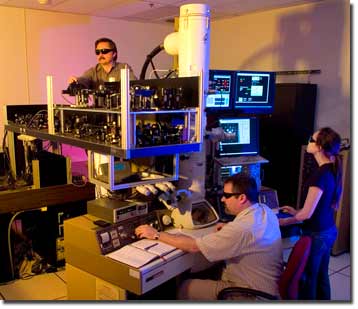 |
| Making adjustments to the dynamic transmission electron microscope. From left: Curtis Brown, Thomas LaGrange and Judy Kim. |
Abstract:
Scientists can now peer into the inner workings of catalyst nanoparticles 3,000 times smaller than a human hair within nanoseconds.
Peering into the never before seen
Livermore, CA | Posted on June 17th, 2010The findings point the way toward future work that could greatly improve catalyst efficiency in a variety of processes that are crucial to the world's energy security, such as petroleum catalysis and catalyst-based nanomaterial growth for next-generation rechargeable batteries. The work was performed in a collaborative effort by Lawrence Livermore National Laboratory and the University of California at Davis.
Using a new imaging technique on Lawrence Livermore's Dynamic Transmission Electron Microscope (DTEM), researchers have achieved unprecedented spatial and temporal resolution in single-shot images of nanoparticulate catalysts.
The DTEM uses a laser-driven photocathode to produce short pulses of electrons capable of recording electron micrographs with 15-nanosecond (one billionth of a second) exposure time. The recent addition of an annular dark field (ADF) aperture to the instrument has greatly improved its ability to time-resolve images of nanoparticles as small as 30 nanometers in diameter.
"Nanoparticles in this size range are of crucial importance to a wide variety of catalytic process of keen interest to energy and nanotechnology researchers," said UC Davis' Dan Masiel, formerly of LLNL and lead author of a paper appearing in the journal, ChemPhys Chem. "Time-resolved imaging of such materials will allow for unprecedented insight into the dynamics of their behavior."
Previously, particles smaller than 50 nanometers could not be resolved in the 15-nanosecond exposure because of the limited signal and low contrast without ADF aperature. But by using DTEM's ADF, almost every 50-nanometer particle and many 30-nanometer ones became clearly visible because of the fast time resolution and high contrast.
"The stark difference between these two images clearly demonstrates the efficacy of annual dark field imaging when imaging samples with feature sizes near the resolution limit of DTEM," Masiel said.
The new technique makes it easier to discern significant features when compared to bright field pulsed imaging. It allows for vastly improved contrast for smaller particles, widening the range of catalyst systems that can be studied using DTEM.
DTEM can record images with six orders of magnitude higher temporal resolution than conventional TEM and can provide important insights into processes such as phase transformations, chemical reactions and nanowire and nanotube growth.
Co-authors include LLNL's Bryan Reed, Thomas LaGrange, Geoffrey Campbell, Ting Guo and Nigel Browning. The work was funded by the Department of Energy's Office of Science, Office of Basic Energy Sciences, Materials Sciences and Engineering Division.
The article appears in the May 27 online edition of ChemPhys Chem.
####
About Lawrence Livermore National Laboratory
Founded in 1952, Lawrence Livermore National Laboratory is a national security laboratory, with a mission to ensure national security and apply science and technology to the important issues of our time. Lawrence Livermore National Laboratory is managed by Lawrence Livermore National Security, LLC for the U.S. Department of Energy's National Nuclear Security Administration.
For more information, please click here
Contacts:
Anne M. Stark
Phone: (925) 422-9799
Copyright © Lawrence Livermore National Laboratory
If you have a comment, please Contact us.Issuers of news releases, not 7th Wave, Inc. or Nanotechnology Now, are solely responsible for the accuracy of the content.
Bookmark:


| Related News Press |
News and information
 Quantum computer improves AI predictions April 17th, 2026
Flexible sensor gains sensitivity under pressure April 17th, 2026
A reusable chip for particulate matter sensing April 17th, 2026
Detecting vibrational quantum beating in the predissociation dynamics of SF6 using time-resolved photoelectron spectroscopy April 17th, 2026
Chemistry
Projecting light to dispense liquids: A new route to ultra-precise microdroplets January 30th, 2026
From sensors to smart systems: the rise of AI-driven photonic noses January 30th, 2026
"Nanoreactor" cage uses visible light for catalytic and ultra-selective cross-cycloadditions October 3rd, 2025
Cambridge chemists discover simple way to build bigger molecules – one carbon at a time June 6th, 2025
Single-atom catalysts change spin state when boosted by a magnetic field June 4th, 2025
Videos/Movies
ICFO researchers overcome long-standing bottleneck in single photon detection with twisted 2D materials August 8th, 2025
New X-ray imaging technique to study the transient phases of quantum materials December 29th, 2022
Possible Futures
A fundamentally new therapeutic approach to cystic fibrosis: Nanobody repairs cellular defect April 17th, 2026
UC Irvine physicists discover method to reverse ‘quantum scrambling’ : The work addresses the problem of information loss in quantum computing system April 17th, 2026
Academic/Education
Rice University launches Rice Synthetic Biology Institute to improve lives January 12th, 2024
Multi-institution, $4.6 million NSF grant to fund nanotechnology training September 9th, 2022
Nanotubes/Buckyballs/Fullerenes/Nanorods/Nanostrings/Nanosheets
Tiny nanosheets, big leap: A new sensor detects ethanol at ultra-low levels January 30th, 2026
Enhancing power factor of p- and n-type single-walled carbon nanotubes April 25th, 2025
Chainmail-like material could be the future of armor: First 2D mechanically interlocked polymer exhibits exceptional flexibility and strength January 17th, 2025
Innovative biomimetic superhydrophobic coating combines repair and buffering properties for superior anti-erosion December 13th, 2024
Discoveries
Quantum computer improves AI predictions April 17th, 2026
Flexible sensor gains sensitivity under pressure April 17th, 2026
A reusable chip for particulate matter sensing April 17th, 2026
Detecting vibrational quantum beating in the predissociation dynamics of SF6 using time-resolved photoelectron spectroscopy April 17th, 2026
Announcements
A fundamentally new therapeutic approach to cystic fibrosis: Nanobody repairs cellular defect April 17th, 2026
UC Irvine physicists discover method to reverse ‘quantum scrambling’ : The work addresses the problem of information loss in quantum computing system April 17th, 2026
Energy
Sensors innovations for smart lithium-based batteries: advancements, opportunities, and potential challenges August 8th, 2025
Simple algorithm paired with standard imaging tool could predict failure in lithium metal batteries August 8th, 2025
Battery Technology/Capacitors/Generators/Piezoelectrics/Thermoelectrics/Energy storage
Decoding hydrogen‑bond network of electrolyte for cryogenic durable aqueous zinc‑ion batteries January 30th, 2026
COF scaffold membrane with gate‑lane nanostructure for efficient Li+/Mg2+ separation January 30th, 2026
MXene nanomaterials enter a new dimension Multilayer nanomaterial: MXene flakes created at Drexel University show new promise as 1D scrolls January 30th, 2026
 |
||
 |
||
| The latest news from around the world, FREE | ||
 |
||
|
|
||
| Premium Products | ||
 |
||
|
Only the news you want to read!
Learn More |
||
 |
||
|
Full-service, expert consulting
Learn More |
||
|
|
||