Home > Press > Self-Assembling Devices
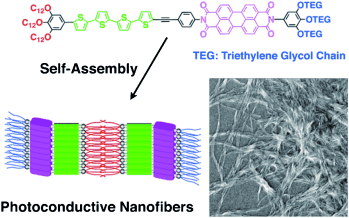 |
| Custom fit: Organic p/n heterojunctions with molecular-level precision have been tailored. An oligothiophene-perylenediimide dyad, when modified with triethylene glycol side chains at one terminus and dodecyl side chains at the other, self-assembles into a photoconducting nanofiber with a well-defined morphology. |
Abstract:
Design and synthesis of organic devices
Self-Assembling Devices
Tokyo | Posted on June 14th, 2010Organic devices have greatly benefited from the remarkable advances in synthetic organic chemistry that have allowed for the synthesis of a wide variety of ð-conjugated molecules with attractive electronic functions. In Chemistry—An Asian Journal, Wei-Shi Li, Takanori Fukushima, Takuzo Aida, and co-workers, based at the Shanghai Institute of Organic Chemistry (China), Riken (Saitama, Japan), and the Japan Science and Technology Agency (Tokyo) describe the rational design strategy using side-chain incompatibility of a covalently connected donor-acceptor (D-A) dyad to synthesize organic p/n heterojunctions with molecular-level precision.
Although organic devices can be easily designed, without proper molecular design that allows for long-range ordering of ð-conjugated molecules, the resulting devices will rarely show the expected performances. Thin-film organic photovoltaic devices require electron-donor (D) and -acceptor (A) molecules to assemble homotropically to form a heterojunction. Additionally, to achieve a highly efficient photoinduced charge separation, the resultant p- and n-type semiconducting domains must be connected over a long distance. However, D and A components tend to assemble together by means of a charge-transfer (CT) interaction, unfavorable for photoelectric conversion.
Oligothiophene (OT) and perylenediimide (PDI) have been synthesized to form covalently linked D-A dyads, which bear at their termini either incompatible or compatible side chains. The dyads with the incompatible side chains intrinsically self-assemble into nanofibrous structures, whilst the dyad containing the compatible side chains resulted in ill-defined microfibers. Flash-photolysis time-resolved microwave conductivity measurements, in conjunction with transient absorption spectroscopy, clearly shows that the assembly with the incompatible side chains exhibits a much greater photoconducting output than that with compatible side chains.
This design strategy with "side-chain incompatibility" provides promise for the realization of p/n heterojunctions from covalently connected D-A dyads. Furthermore, this design strategy can give rise to long-range structural integrity that is essential for excellent device performances. Aida writes "elaboration of side-chain-incompatible D-A dyads in terms of absorption range and carrier transport properties is a subject worthy of further investigations for developing molecularly engineered photovoltaic devices."
Author: Takuzo Aida, National Museum of Emerging Science and Innovation, Tokyo (Japan), macro.chem.t.u-tokyo.ac.jp/
Title: Use of Side-Chain Incompatibility for Tailoring Long-Range p/n Heterojunctions: Photoconductive Nanofibers Formed by Self-Assembly of an Amphiphilic Donor-Acceptor Dyad Consisting of Oligothiophene and Perylenediimide
Chemistry - An Asian Journal, Permalink to the article: dx.doi.org/10.1002/asia.201000111
####
For more information, please click here
Copyright © Chemistry - An Asian Journal
If you have a comment, please Contact us.Issuers of news releases, not 7th Wave, Inc. or Nanotechnology Now, are solely responsible for the accuracy of the content.
Bookmark:


| Related News Press |
News and information
 Quantum computer improves AI predictions April 17th, 2026
Flexible sensor gains sensitivity under pressure April 17th, 2026
A reusable chip for particulate matter sensing April 17th, 2026
Detecting vibrational quantum beating in the predissociation dynamics of SF6 using time-resolved photoelectron spectroscopy April 17th, 2026
Thin films
Tiny nanosheets, big leap: A new sensor detects ethanol at ultra-low levels January 30th, 2026
Utilizing palladium for addressing contact issues of buried oxide thin film transistors April 5th, 2024
Understanding the mechanism of non-uniform formation of diamond film on tools: Paving the way to a dry process with less environmental impact March 24th, 2023
New study introduces the best graphite films: The work by Distinguished Professor Feng Ding at UNIST has been published in the October 2022 issue of Nature Nanotechnology November 4th, 2022
Academic/Education
Rice University launches Rice Synthetic Biology Institute to improve lives January 12th, 2024
Multi-institution, $4.6 million NSF grant to fund nanotechnology training September 9th, 2022
Self Assembly
Diamond glitter: A play of colors with artificial DNA crystals May 17th, 2024
Liquid crystal templated chiral nanomaterials October 14th, 2022
Nanoclusters self-organize into centimeter-scale hierarchical assemblies April 22nd, 2022
Atom by atom: building precise smaller nanoparticles with templates March 4th, 2022
Announcements
A fundamentally new therapeutic approach to cystic fibrosis: Nanobody repairs cellular defect April 17th, 2026
UC Irvine physicists discover method to reverse ‘quantum scrambling’ : The work addresses the problem of information loss in quantum computing system April 17th, 2026
Energy
Sensors innovations for smart lithium-based batteries: advancements, opportunities, and potential challenges August 8th, 2025
Simple algorithm paired with standard imaging tool could predict failure in lithium metal batteries August 8th, 2025
Solar/Photovoltaic
Spinel-type sulfide semiconductors to operate the next-generation LEDs and solar cells For solar-cell absorbers and green-LED source October 3rd, 2025
KAIST researchers introduce new and improved, next-generation perovskite solar cell November 8th, 2024
Groundbreaking precision in single-molecule optoelectronics August 16th, 2024
Development of zinc oxide nanopagoda array photoelectrode: photoelectrochemical water-splitting hydrogen production January 12th, 2024
 |
||
 |
||
| The latest news from around the world, FREE | ||
 |
||
|
|
||
| Premium Products | ||
 |
||
|
Only the news you want to read!
Learn More |
||
 |
||
|
Full-service, expert consulting
Learn More |
||
|
|
||