Home > Press > New catalyst provides boost to next-generation EV batteries
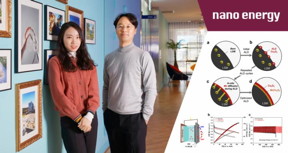 |
| Professor Guntae Kim (right) and Arim Seong (left) in the School of Energy and Chemical Engineering at UNIST. CREDIT UNIST |
Abstract:
Metal-Air Batteries (MABs), which use oxygen from ambient air as recourses to store and convert energy, have received considerable attention for their potential use in electric vehicles (EVs) owing to their large storage capacity, lightweight, and affordability. A research team, affiliated with UNIST has announced that a new catalyst that could boost MAB performance, such as discharge and charge efficiency, was developed recently.
New catalyst provides boost to next-generation EV batteries
Ulsan, Korea | Posted on March 13th, 2020A research team, led by Professor Guntae Kim in the School of Energy and Chemical Engineering at UNIST, has unveiled a new composite catalyst that could efficiently enhance the charg-discharge performances when applied to MABs. It is a form of very thin layer of metal oxide films deposited on a surface of perovskite catalysts, and thus the interface naturally formed between the two catalysts enhances the overall performance and stability of the new catalyst.
Metal-air batteries (MABs), in which oxygen from the atmosphere reacts with metals to generate electricity, are one of the lightest and most compact types of batteries. They are equipped with anodes made up of pure metals (i.e. Lithium, Zinc, Magnesium, and Aluminum) and an air cathode that is connected to an inexhaustible source of air. Due to their high theoretical energy density, MABs have been considered a strong cadidate for the next-generation electric vehicles. The currently existing MABs use rare and expensive metal catalysts for their air electrodes, such as platinum (Pt). This has hindered its further commercialization into the marketplace. As an alternative, perovskite catalysts that exhibit excellent catalyic performance has been proposed, yet there exists low activation barriers.
Professor Kim has solved this issue with a new composite catalyst combining two types of catalysts, each of which showed excellent performance in charge and discharge reactions. The metal catalyst (cobalt oxide), which performs well in charging, is deposited on a very thin layer on top of the manganese-based perovskite catalyst (LSM), which performs well in discharge. As a result, the synergistic effect of the two catalysts became optimal when the deposition process was repeated 20 times.
"During the repeated deposition and oxidation cycles of atomic layer deposition (ALD) process, the Mn cations diffuse into Co3O4 from LSM, and therefore, the LSM-20-Co catalyst is composed of LSM encapsulated with the self-reconstructedspinel interlayer (Co3O4/MnCo32O4/LSM)," says Arim Seong (Combined M.S/Ph.D. of Energy and Chemical Engineering, UNIST), the first author of the study. "And this has enhanced the catalytic activitiy of the hybrid catalyst, LSM-20-Co, leading to superior bifunctional electrochemical performances for the ORR and the OER in alkaline solutions."
"To the best of our knowledge, this is the first study to investigate the self-reconstructed interlayer induced by the in-situ cation diffusion during ALD process for designing an efficient and stable bifunctional catalyst for alkaline zinc-air batteries," according to the research team.
"Our findings provide the rational design strategy of self-reconstructed interlayer for efficient electro-catalyst," says Professor Kim. "Therefore, this work can provide insight into the rational design strategy of metal oxide with perovskite materials."
###
This research has been carried out in collaboration with Professor Raymond J. Gorte (University of Pennsylvania), Professor John M. Vohs (University of Pennsylvania), and Professor Hu Young Jeong (UNIST). The findings of this research have been published in the online version of Nano Energy on February 3, 2020. This work has been supported by Global Ph.D. Fellowship Program of NRF Grant funded by the Korean Ministry of Science and ICT (MSIT). Also, it has been supported by the Korea Institute of Energy Technology Evaluation and Planning (KETEP) and the Korean Ministry of Trade, Industry & Energy (MOTIE).
####
For more information, please click here
Contacts:
JooHyeon Heo
82-522-171-223
Copyright © UNIST
If you have a comment, please Contact us.Issuers of news releases, not 7th Wave, Inc. or Nanotechnology Now, are solely responsible for the accuracy of the content.
Bookmark:


| Related Links |
| Related News Press |
News and information
 Quantum computer improves AI predictions April 17th, 2026
Flexible sensor gains sensitivity under pressure April 17th, 2026
A reusable chip for particulate matter sensing April 17th, 2026
Detecting vibrational quantum beating in the predissociation dynamics of SF6 using time-resolved photoelectron spectroscopy April 17th, 2026
Chemistry
Projecting light to dispense liquids: A new route to ultra-precise microdroplets January 30th, 2026
From sensors to smart systems: the rise of AI-driven photonic noses January 30th, 2026
"Nanoreactor" cage uses visible light for catalytic and ultra-selective cross-cycloadditions October 3rd, 2025
Cambridge chemists discover simple way to build bigger molecules – one carbon at a time June 6th, 2025
Govt.-Legislation/Regulation/Funding/Policy
Quantum computer improves AI predictions April 17th, 2026
Metasurfaces smooth light to boost magnetic sensing precision January 30th, 2026
New imaging approach transforms study of bacterial biofilms August 8th, 2025
Possible Futures
A fundamentally new therapeutic approach to cystic fibrosis: Nanobody repairs cellular defect April 17th, 2026
UC Irvine physicists discover method to reverse ‘quantum scrambling’ : The work addresses the problem of information loss in quantum computing system April 17th, 2026
Materials/Metamaterials/Magnetoresistance
First real-time observation of two-dimensional melting process: Researchers at Mainz University unveil new insights into magnetic vortex structures August 8th, 2025
Researchers unveil a groundbreaking clay-based solution to capture carbon dioxide and combat climate change June 6th, 2025
A 1960s idea inspires NBI researchers to study hitherto inaccessible quantum states June 6th, 2025
Institute for Nanoscience hosts annual proposal planning meeting May 16th, 2025
Announcements
A fundamentally new therapeutic approach to cystic fibrosis: Nanobody repairs cellular defect April 17th, 2026
UC Irvine physicists discover method to reverse ‘quantum scrambling’ : The work addresses the problem of information loss in quantum computing system April 17th, 2026
Interviews/Book Reviews/Essays/Reports/Podcasts/Journals/White papers/Posters
A fundamentally new therapeutic approach to cystic fibrosis: Nanobody repairs cellular defect April 17th, 2026
UC Irvine physicists discover method to reverse ‘quantum scrambling’ : The work addresses the problem of information loss in quantum computing system April 17th, 2026
Automotive/Transportation
Decoding hydrogen‑bond network of electrolyte for cryogenic durable aqueous zinc‑ion batteries January 30th, 2026
Sensors innovations for smart lithium-based batteries: advancements, opportunities, and potential challenges August 8th, 2025
Simple algorithm paired with standard imaging tool could predict failure in lithium metal batteries August 8th, 2025
Battery Technology/Capacitors/Generators/Piezoelectrics/Thermoelectrics/Energy storage
Decoding hydrogen‑bond network of electrolyte for cryogenic durable aqueous zinc‑ion batteries January 30th, 2026
COF scaffold membrane with gate‑lane nanostructure for efficient Li+/Mg2+ separation January 30th, 2026
MXene nanomaterials enter a new dimension Multilayer nanomaterial: MXene flakes created at Drexel University show new promise as 1D scrolls January 30th, 2026
Grants/Sponsored Research/Awards/Scholarships/Gifts/Contests/Honors/Records
Quantum computer improves AI predictions April 17th, 2026
Detecting vibrational quantum beating in the predissociation dynamics of SF6 using time-resolved photoelectron spectroscopy April 17th, 2026
Metasurfaces smooth light to boost magnetic sensing precision January 30th, 2026
Research partnerships
Lab to industry: InSe wafer-scale breakthrough for future electronics August 8th, 2025
HKU physicists uncover hidden order in the quantum world through deconfined quantum critical points April 25th, 2025
 |
||
 |
||
| The latest news from around the world, FREE | ||
 |
||
|
|
||
| Premium Products | ||
 |
||
|
Only the news you want to read!
Learn More |
||
 |
||
|
Full-service, expert consulting
Learn More |
||
|
|
||