Home > Press > NUS scientists create world’s first monolayer amorphous film
 |
Abstract:
Researchers from the National University of Singapore (NUS) have synthesised the world’s first one-atom-thick amorphous material. Previously thought to be impossible, the discovery of monolayer amorphous carbon (MAC) could finally settle a decades-old debate of exactly how atoms are arranged in amorphous solids, and open up potential applications.
NUS scientists create world’s first monolayer amorphous film
Singapore | Posted on January 9th, 2020This major research breakthrough was led by Professor Barbaros Özyilmaz, Head of the NUS Department of Materials Science and Engineering. The results were published in the prestigious scientific journal Nature on 8 January 2020.
The NUS team grew the material and studied its properties and potential areas of application. In addition, atomic resolution imaging was performed by the group of Professor Kazu Suenaga from the National Institute of Advanced Industrial Science and Technology (AIST), Japan, and Professor Junhao Lin from Southern University of Science and Technology (SUSTECH), China. Furthermore, theoretical simulations were carried out by the group of Professor Sokrates Pantelides from Vanderbilt University, USA.
“With MAC, we have shown for the first time that fully amorphous materials can be stable and free-standing in single atomic layers. Amorphous materials are of great technological importance, but surprisingly, they remain poorly understood from a basic science point of view. This breakthrough allows for direct imaging to reveal how atoms are arranged in amorphous materials, and could be of commercial value for batteries, semiconductors, membranes and many more applications,” said Prof Özyilmaz, who is also from the NUS Department of Physics and the NUS Centre for Advanced 2D Materials.
The structure and synthesis of monolayer amorphous carbon
In the study of amorphous materials, there are two opposing groups. One says that it is possible for materials to have a fully-disordered, completely random structure. The other, says there is always nanometre-sized order, of tiny crystallites, that is surrounded by random disorder.
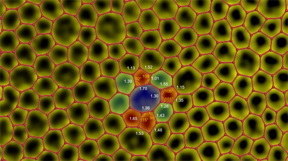
The newly synthesised MAC films show the latter arrangement. The researchers see nanometre-sized patches of strained and distorted hexagonal carbon rings, but there is random disorder between these patches. Hence, the MAC films also contain 5-, 7-, and 8-membered rings too.
These atomically-thin sheets of amorphous carbon are synthesised by using a laser vaporising a carbon-containing pre-cursor gas into an atomically fine mist. This turns the carbon precursors into highly reactive, energetic species which immediately form a MAC film when they hit the surface of almost any substrate.
The revolutionary properties of monolayer amorphous carbon
Despite having a disordered atomic structure, MAC is capable of some truly incredible behaviour. Dr Toh Chee Tat, the first author of the paper, said, “What is amazing about MAC is that it exhibits some properties that are totally different from traditional monolayer materials.”
One such exceptional property is that MAC films can be ‘plastically deformed’. This means that they can be stretched into irregular shapes, and stay conformed to that position. There is no other single-layer material in existence that displays significant plastic deformation.
The fact that MAC behaves this way, compared to nanometre-thick crystalline materials which would easily snap when stretched, significantly expands the number of industrial applications it could be suitable for.
Holes can even be punched into the material, or it can be torn, and yet the film will retain its key properties. Also, MAC can be grown on many different substrates including copper, gold and stainless steel. “Everything that is understood from atomically thin crystals — in terms of their properties and how they are analysed — does not apply here. It is a completely new material that we are studying,” shared Dr Toh.
Industrial applications of monolayer amorphous carbon
“MAC is much more hardy and cheaper to make than conventional crystalline two-dimensional films. The laser-assisted deposition process through which MAC is synthesised is already commonly used in industry. Hence, we can grow a large-area, defect-free, monolayer film on a wide variety of substrates with high throughput and at low temperature,” explained Prof Özyilmaz. This makes MAC a potential low-cost material to address industry needs, and for some applications, it may be an alternative to two-dimensional crystals such as graphene.
For example, ultrathin barrier films are sorely needed in many industries — for next-generation magnetic recording devices, copper interconnects, flexible displays, fuel cells, batteries and other electronic devices. However, the performance of conventional amorphous thin films is poor when made very thin, and other atomically-thin films cannot be produced according to stringent industry standards without compromising their qualities.
“Our monolayer amorphous films not only achieve the ultimate thickness limit, but also do not compromise on uniformity and reliability, and are generally considered viable for industry,” said Prof Özyilmaz.
Next steps
Prof Özyilmaz is the lead Principle Investigator of a multidisciplinary team that was recently awarded a grant under the National Research Foundation Singapore’s Competitive Research Programme to investigate the properties of monolayer amorphous materials. The research team will be studying the many possible applications of this material and will be collaborating with industrial partners to accelerate the commercialisation of monolayer amorphous materials such as MAC.
####
About National University of Singapore
The National University of Singapore (NUS) is Singapore’s flagship university, which offers a global approach to education, research and entrepreneurship, with a focus on Asian perspectives and expertise. We have 17 faculties across three campuses in Singapore, as well as 12 NUS Overseas Colleges across the world. Close to 40,000 students from 100 countries enrich our vibrant and diverse campus community.
Our multidisciplinary and real-world approach to education, research and entrepreneurship enables us to work closely with industry, governments and academia to address crucial and complex issues relevant to Asia and the world. Researchers in our faculties, 29 university-level research institutes, research centres of excellence and corporate labs focus on themes that include energy, environmental and urban sustainability; treatment and prevention of diseases common among Asians; active ageing; advanced materials; as well as risk management and resilience of financial systems. Our latest research focus is on the use of data science, operations research and cybersecurity to support Singapore's Smart Nation initiative.
For more information, please click here
Contacts:
Carolyn FONG
Senior Associate Director, Media Relations
Office of University Communications
National University of Singapore
DID: +65 6516-5399
Copyright © National University of Singapore
If you have a comment, please Contact us.Issuers of news releases, not 7th Wave, Inc. or Nanotechnology Now, are solely responsible for the accuracy of the content.
Bookmark:


| Related News Press |
News and information
 Quantum computer improves AI predictions April 17th, 2026
Flexible sensor gains sensitivity under pressure April 17th, 2026
A reusable chip for particulate matter sensing April 17th, 2026
Detecting vibrational quantum beating in the predissociation dynamics of SF6 using time-resolved photoelectron spectroscopy April 17th, 2026
2 Dimensional Materials
Flexible sensor gains sensitivity under pressure April 17th, 2026
MXene nanomaterials enter a new dimension Multilayer nanomaterial: MXene flakes created at Drexel University show new promise as 1D scrolls January 30th, 2026
ICFO researchers overcome long-standing bottleneck in single photon detection with twisted 2D materials August 8th, 2025
First real-time observation of two-dimensional melting process: Researchers at Mainz University unveil new insights into magnetic vortex structures August 8th, 2025
Thin films
Tiny nanosheets, big leap: A new sensor detects ethanol at ultra-low levels January 30th, 2026
Possible Futures
A fundamentally new therapeutic approach to cystic fibrosis: Nanobody repairs cellular defect April 17th, 2026
UC Irvine physicists discover method to reverse ‘quantum scrambling’ : The work addresses the problem of information loss in quantum computing system April 17th, 2026
Chip Technology
A reusable chip for particulate matter sensing April 17th, 2026
Metasurfaces smooth light to boost magnetic sensing precision January 30th, 2026
Discoveries
Quantum computer improves AI predictions April 17th, 2026
Flexible sensor gains sensitivity under pressure April 17th, 2026
A reusable chip for particulate matter sensing April 17th, 2026
Detecting vibrational quantum beating in the predissociation dynamics of SF6 using time-resolved photoelectron spectroscopy April 17th, 2026
Announcements
A fundamentally new therapeutic approach to cystic fibrosis: Nanobody repairs cellular defect April 17th, 2026
UC Irvine physicists discover method to reverse ‘quantum scrambling’ : The work addresses the problem of information loss in quantum computing system April 17th, 2026
Interviews/Book Reviews/Essays/Reports/Podcasts/Journals/White papers/Posters
A fundamentally new therapeutic approach to cystic fibrosis: Nanobody repairs cellular defect April 17th, 2026
UC Irvine physicists discover method to reverse ‘quantum scrambling’ : The work addresses the problem of information loss in quantum computing system April 17th, 2026
Battery Technology/Capacitors/Generators/Piezoelectrics/Thermoelectrics/Energy storage
Decoding hydrogen‑bond network of electrolyte for cryogenic durable aqueous zinc‑ion batteries January 30th, 2026
COF scaffold membrane with gate‑lane nanostructure for efficient Li+/Mg2+ separation January 30th, 2026
MXene nanomaterials enter a new dimension Multilayer nanomaterial: MXene flakes created at Drexel University show new promise as 1D scrolls January 30th, 2026
 |
||
 |
||
| The latest news from around the world, FREE | ||
 |
||
|
|
||
| Premium Products | ||
 |
||
|
Only the news you want to read!
Learn More |
||
 |
||
|
Full-service, expert consulting
Learn More |
||
|
|
||