Home > Press > CCNY physicists score double hit in LED research
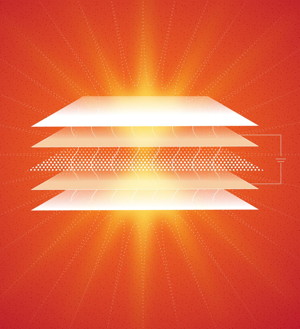 |
| Schematic of a half-light- half-matter quasiparticle based LED developed in Vinod Menon's group using atomically thin materials. CREDIT: Visakh Menon |
Abstract:
In two breakthroughs in the realm of photonics, City College of New York graduate researchers are reporting the successful demonstration of an LED (light-emitting diode) based on half-light half-matter quasiparticles in atomically thin materials. This is also the first successful test of an electrically driven light emitter using atomically thin semiconductors embedded in a light trapping structure (optical cavity).
CCNY physicists score double hit in LED research
New York, NY | Posted on September 27th, 2019The research is led by graduate physics student Jie Gu and post-doctoral fellow Biswanath Chakraborty, in collaboration with another graduate student, Mandeep Khatoniyar.
According to Vinod Menon, chair of physics in City College's Division of Science and the research team's mentor, their double feat, reported in the journal "Nature Nanotechnology," marks an important milestone in the field of 2D materials and, more broadly, LEDs.
While such LEDs have been realized in other materials at low temperatures, this device operates at room temperature and is fabricated using the now well known "scotch tape" based technique.
"The fact that this device is fabricated using stacks of atomically thin materials and operates at room temperature makes it an important first step towards a technologically relevant device demonstration," noted Menon, adding: "One potential application of such hybrid LEDs is the speed of operation - which can translate to using them for LED based communication systems including LiFi."
LiFi is a wireless optical networking technology that uses LEDs for data transmission. Benefits of LiFi include higher speeds than Wi-Fi.
The device was fabricated at the CCNY-based CUNY Advanced Science Research Center's nanofabrication facility and tested in Menon's lab. In follow- up research, the CCNY team is attempting to realize quantum emitters (single photon emitters) using similar architecture.
###
The work is funded by the National Science Foundation and the Army Research Office.
####
For more information, please click here
Contacts:
Jay Mwamba
212-650-7580
Copyright © City College of New York
If you have a comment, please Contact us.Issuers of news releases, not 7th Wave, Inc. or Nanotechnology Now, are solely responsible for the accuracy of the content.
Bookmark:


| Related Links |
| Related News Press |
News and information
 Quantum computer improves AI predictions April 17th, 2026
Flexible sensor gains sensitivity under pressure April 17th, 2026
A reusable chip for particulate matter sensing April 17th, 2026
Detecting vibrational quantum beating in the predissociation dynamics of SF6 using time-resolved photoelectron spectroscopy April 17th, 2026
Thin films
Tiny nanosheets, big leap: A new sensor detects ethanol at ultra-low levels January 30th, 2026
Display technology/LEDs/SS Lighting/OLEDs
Spinel-type sulfide semiconductors to operate the next-generation LEDs and solar cells For solar-cell absorbers and green-LED source October 3rd, 2025
Wireless/telecommunications/RF/Antennas/Microwaves
Researchers develop molecular qubits that communicate at telecom frequencies October 3rd, 2025
Nanofabrication
Self-propelled protein-based nanomotors for enhanced cancer therapy by inducing ferroptosis June 6th, 2025
Multiphoton polymerization: A promising technology for precision medicine February 28th, 2025
Govt.-Legislation/Regulation/Funding/Policy
Quantum computer improves AI predictions April 17th, 2026
Metasurfaces smooth light to boost magnetic sensing precision January 30th, 2026
New imaging approach transforms study of bacterial biofilms August 8th, 2025
Possible Futures
A fundamentally new therapeutic approach to cystic fibrosis: Nanobody repairs cellular defect April 17th, 2026
UC Irvine physicists discover method to reverse ‘quantum scrambling’ : The work addresses the problem of information loss in quantum computing system April 17th, 2026
Discoveries
Quantum computer improves AI predictions April 17th, 2026
Flexible sensor gains sensitivity under pressure April 17th, 2026
A reusable chip for particulate matter sensing April 17th, 2026
Detecting vibrational quantum beating in the predissociation dynamics of SF6 using time-resolved photoelectron spectroscopy April 17th, 2026
Announcements
A fundamentally new therapeutic approach to cystic fibrosis: Nanobody repairs cellular defect April 17th, 2026
UC Irvine physicists discover method to reverse ‘quantum scrambling’ : The work addresses the problem of information loss in quantum computing system April 17th, 2026
Interviews/Book Reviews/Essays/Reports/Podcasts/Journals/White papers/Posters
A fundamentally new therapeutic approach to cystic fibrosis: Nanobody repairs cellular defect April 17th, 2026
UC Irvine physicists discover method to reverse ‘quantum scrambling’ : The work addresses the problem of information loss in quantum computing system April 17th, 2026
Military
Quantum engineers ‘squeeze’ laser frequency combs to make more sensitive gas sensors January 17th, 2025
Chainmail-like material could be the future of armor: First 2D mechanically interlocked polymer exhibits exceptional flexibility and strength January 17th, 2025
Single atoms show their true color July 5th, 2024
NRL charters Navy’s quantum inertial navigation path to reduce drift April 5th, 2024
Quantum nanoscience
Beyond silicon: Electronics at the scale of a single molecule January 30th, 2026
MXene nanomaterials enter a new dimension Multilayer nanomaterial: MXene flakes created at Drexel University show new promise as 1D scrolls January 30th, 2026
ICFO researchers overcome long-standing bottleneck in single photon detection with twisted 2D materials August 8th, 2025
 |
||
 |
||
| The latest news from around the world, FREE | ||
 |
||
|
|
||
| Premium Products | ||
 |
||
|
Only the news you want to read!
Learn More |
||
 |
||
|
Full-service, expert consulting
Learn More |
||
|
|
||