Home > Press > Save time using maths: Analytical tool designs corkscrew-shaped nano-antennae
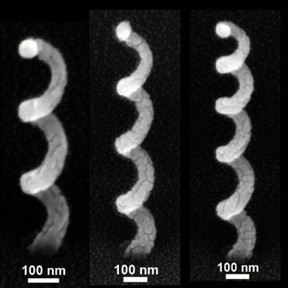 |
| The nano-antennae werde produced in an electron microscope by direct electron-beam writing. CREDIT HZB |
Abstract:
The nanostructures from Katja Höflich's HZB team are shaped like corkscrews and made of silver. Mathematically, such a nano antenna can be regarded as an one-dimensional line that forms a helix, characterized by parameters such as diameter, length, number of turns per unit length, and handedness.
Save time using maths: Analytical tool designs corkscrew-shaped nano-antennae
Berlin, Germany | Posted on August 23rd, 2019The nano corkscrews are highly sensitive to light: depending on frequency and polarisation, they can strongly enhance it. Because helical antennas have a handedness, they can select light quanta according to their handedness, i.e. their spin. This results in novel applications in information technology based on the spin quantum number of light. Another application may lay in sensor technology in detecting chiral molecular species down to the single molecule level.
Usually, the interaction of such nano-antennas with an electromagnetic field is determined using numerical methods. Each helix geometry, however, requires a new numerically expensive calculation.
For the first time, Höflich and her team have now derived an analytically exact solution of the problem. "We now have a formula that tells us how a nano-antenna with specific parameters responds to light", says Höflich. This analytical description can be used as a design tool, as it specifies the required geometrical parameters of a nano-helix to amplify electromagnetic fields of desired frequencies or polarisation.
The HZB researchers were able to fabricate nano-antennae in an electron microscope by using direct electron-beam writing. The electron beam first writes a helix-shaped carbon structure one point at a time. This structure is subsequently coated with silver. The actual measurements of the optical properties for these silver nano-antennae are in good agreement with the calculated properties predicted by the analytical model.
####
For more information, please click here
Contacts:
Katja Höflich
49-308-062-42165
Copyright © Helmholtz-Zentrum Berlin für Materialien und Energie
If you have a comment, please Contact us.Issuers of news releases, not 7th Wave, Inc. or Nanotechnology Now, are solely responsible for the accuracy of the content.
Bookmark:


| Related Links |
| Related News Press |
News and information
 Quantum computer improves AI predictions April 17th, 2026
Flexible sensor gains sensitivity under pressure April 17th, 2026
A reusable chip for particulate matter sensing April 17th, 2026
Detecting vibrational quantum beating in the predissociation dynamics of SF6 using time-resolved photoelectron spectroscopy April 17th, 2026
Wireless/telecommunications/RF/Antennas/Microwaves
Researchers develop molecular qubits that communicate at telecom frequencies October 3rd, 2025
HKUST researchers develop new integration technique for efficient coupling of III-V and silicon February 16th, 2024
Possible Futures
A fundamentally new therapeutic approach to cystic fibrosis: Nanobody repairs cellular defect April 17th, 2026
UC Irvine physicists discover method to reverse ‘quantum scrambling’ : The work addresses the problem of information loss in quantum computing system April 17th, 2026
Chip Technology
A reusable chip for particulate matter sensing April 17th, 2026
Metasurfaces smooth light to boost magnetic sensing precision January 30th, 2026
Quantum Computing
Quantum computer improves AI predictions April 17th, 2026
UC Irvine physicists discover method to reverse ‘quantum scrambling’ : The work addresses the problem of information loss in quantum computing system April 17th, 2026
Researchers develop molecular qubits that communicate at telecom frequencies October 3rd, 2025
Optical computing/Photonic computing
ICFO researchers overcome long-standing bottleneck in single photon detection with twisted 2D materials August 8th, 2025
Programmable electron-induced color router array May 14th, 2025
Sensors
Flexible sensor gains sensitivity under pressure April 17th, 2026
Tiny nanosheets, big leap: A new sensor detects ethanol at ultra-low levels January 30th, 2026
From sensors to smart systems: the rise of AI-driven photonic noses January 30th, 2026
Sensors innovations for smart lithium-based batteries: advancements, opportunities, and potential challenges August 8th, 2025
Discoveries
Quantum computer improves AI predictions April 17th, 2026
Flexible sensor gains sensitivity under pressure April 17th, 2026
A reusable chip for particulate matter sensing April 17th, 2026
Detecting vibrational quantum beating in the predissociation dynamics of SF6 using time-resolved photoelectron spectroscopy April 17th, 2026
Announcements
A fundamentally new therapeutic approach to cystic fibrosis: Nanobody repairs cellular defect April 17th, 2026
UC Irvine physicists discover method to reverse ‘quantum scrambling’ : The work addresses the problem of information loss in quantum computing system April 17th, 2026
Interviews/Book Reviews/Essays/Reports/Podcasts/Journals/White papers/Posters
A fundamentally new therapeutic approach to cystic fibrosis: Nanobody repairs cellular defect April 17th, 2026
UC Irvine physicists discover method to reverse ‘quantum scrambling’ : The work addresses the problem of information loss in quantum computing system April 17th, 2026
Tools
Metasurfaces smooth light to boost magnetic sensing precision January 30th, 2026
From sensors to smart systems: the rise of AI-driven photonic noses January 30th, 2026
Japan launches fully domestically produced quantum computer: Expo visitors to experience quantum computing firsthand August 8th, 2025
Photonics/Optics/Lasers
Metasurfaces smooth light to boost magnetic sensing precision January 30th, 2026
From sensors to smart systems: the rise of AI-driven photonic noses January 30th, 2026
 |
||
 |
||
| The latest news from around the world, FREE | ||
 |
||
|
|
||
| Premium Products | ||
 |
||
|
Only the news you want to read!
Learn More |
||
 |
||
|
Full-service, expert consulting
Learn More |
||
|
|
||