Home > Press > Multistep self-assembly opens door to new reconfigurable materials
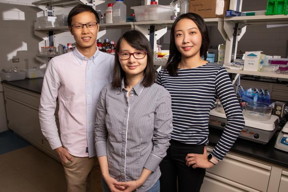 |
| Materials science and engineering professor Qian Chen, center, and graduate students Binbin Luo, left, and Ahyoung Kim find inspiration in biology to help investigate how order emerges from self-assembling building blocks of varying size and shape. CREDIT Photo by L. Brian Stauffer |
Abstract:
Self-assembling synthetic materials come together when tiny, uniform building blocks interact and form a structure. However, nature lets materials like proteins of varying size and shape assemble, allowing for complex architectures that can handle multiple tasks.
Multistep self-assembly opens door to new reconfigurable materials
Champaign, IL | Posted on April 19th, 2019University of Illinois engineers took a closer look at how nonuniform synthetic particles assemble and were surprised to find that it happens in multiples phases, opening the door for new reconfigurable materials for use in technologies such as solar cells and catalysis.
The findings are reported in the journal Nature Communications.
"Traditional self-assembly can be thought of like a grocery store stacking apples for a display in the produce section," said Qian Chen, a professor of materials science and engineering and lead author of the new study. "They would need to work with similarly sized and shaped apples - or particles in the case of self-assembly - to make the structure sturdy."
In the new study, Chen's group observed the behavior of microscale silver plates of varied size and nanoscale thickness in liquids. Because the particles used in self-assembling materials are so small, they behave like atoms and molecules, which allow researchers to use classical chemistry and physics theories to understand their behavior, the researchers said.
The nonuniform particles repel and attract according to laws of nature in plain, deionized water. However, when the researchers add salt to the water, changing electrostatic forces trigger a multistep assembly process. The nonuniform particles begin to assemble to form columns of stacked silver plates and further assemble into increasingly complex, ordered 3D hexagonal lattices, the team found.
"We can actually witness the particles assemble in this hierarchy using a light microscope," said Binbin Luo, a materials science and engineering graduate student and study co-author. "This way, we can track particle motions one by one and study the assembly dynamics in real time."
"The findings of this study may allow for the development of reconfigurable self-assembly materials," said Ahyoung Kim, a materials science and engineering graduate student and study co-author. "These materials can change from one type of solid crystal to another type with different properties for a variety of applications."
"Another benefit of this finding is that it can be generalized to other types of systems," Chen said. "If you have another type of nanoparticle, be it magnetic or semiconducting, this hierarchal assembly principal still applies, allowing for even more types of reconfigurable materials."
###
Graduate students John W. Smith and Zihao Ou, former postdoctoral researcher Juyeong Kim, and undergraduate student Zixuan Wu also contributed to this study.
The National Science Foundation supported this research.
####
For more information, please click here
Contacts:
Lois Yoksoulian
217-244-2788
Copyright © University of Illinois at Urbana-Champaign
If you have a comment, please Contact us.Issuers of news releases, not 7th Wave, Inc. or Nanotechnology Now, are solely responsible for the accuracy of the content.
Bookmark:


| Related Links |
| Related News Press |
News and information
 Quantum computer improves AI predictions April 17th, 2026
Flexible sensor gains sensitivity under pressure April 17th, 2026
A reusable chip for particulate matter sensing April 17th, 2026
Detecting vibrational quantum beating in the predissociation dynamics of SF6 using time-resolved photoelectron spectroscopy April 17th, 2026
Magnetism/Magnons
Metasurfaces smooth light to boost magnetic sensing precision January 30th, 2026
Researchers develop molecular qubits that communicate at telecom frequencies October 3rd, 2025
Chemistry
Projecting light to dispense liquids: A new route to ultra-precise microdroplets January 30th, 2026
From sensors to smart systems: the rise of AI-driven photonic noses January 30th, 2026
"Nanoreactor" cage uses visible light for catalytic and ultra-selective cross-cycloadditions October 3rd, 2025
Possible Futures
A fundamentally new therapeutic approach to cystic fibrosis: Nanobody repairs cellular defect April 17th, 2026
UC Irvine physicists discover method to reverse ‘quantum scrambling’ : The work addresses the problem of information loss in quantum computing system April 17th, 2026
Self Assembly
Diamond glitter: A play of colors with artificial DNA crystals May 17th, 2024
Liquid crystal templated chiral nanomaterials October 14th, 2022
Nanoclusters self-organize into centimeter-scale hierarchical assemblies April 22nd, 2022
Atom by atom: building precise smaller nanoparticles with templates March 4th, 2022
Discoveries
Quantum computer improves AI predictions April 17th, 2026
Flexible sensor gains sensitivity under pressure April 17th, 2026
A reusable chip for particulate matter sensing April 17th, 2026
Detecting vibrational quantum beating in the predissociation dynamics of SF6 using time-resolved photoelectron spectroscopy April 17th, 2026
Materials/Metamaterials/Magnetoresistance
First real-time observation of two-dimensional melting process: Researchers at Mainz University unveil new insights into magnetic vortex structures August 8th, 2025
Researchers unveil a groundbreaking clay-based solution to capture carbon dioxide and combat climate change June 6th, 2025
A 1960s idea inspires NBI researchers to study hitherto inaccessible quantum states June 6th, 2025
Institute for Nanoscience hosts annual proposal planning meeting May 16th, 2025
Announcements
A fundamentally new therapeutic approach to cystic fibrosis: Nanobody repairs cellular defect April 17th, 2026
UC Irvine physicists discover method to reverse ‘quantum scrambling’ : The work addresses the problem of information loss in quantum computing system April 17th, 2026
Interviews/Book Reviews/Essays/Reports/Podcasts/Journals/White papers/Posters
A fundamentally new therapeutic approach to cystic fibrosis: Nanobody repairs cellular defect April 17th, 2026
UC Irvine physicists discover method to reverse ‘quantum scrambling’ : The work addresses the problem of information loss in quantum computing system April 17th, 2026
Energy
Sensors innovations for smart lithium-based batteries: advancements, opportunities, and potential challenges August 8th, 2025
Simple algorithm paired with standard imaging tool could predict failure in lithium metal batteries August 8th, 2025
Solar/Photovoltaic
Spinel-type sulfide semiconductors to operate the next-generation LEDs and solar cells For solar-cell absorbers and green-LED source October 3rd, 2025
KAIST researchers introduce new and improved, next-generation perovskite solar cell November 8th, 2024
Groundbreaking precision in single-molecule optoelectronics August 16th, 2024
Development of zinc oxide nanopagoda array photoelectrode: photoelectrochemical water-splitting hydrogen production January 12th, 2024
 |
||
 |
||
| The latest news from around the world, FREE | ||
 |
||
|
|
||
| Premium Products | ||
 |
||
|
Only the news you want to read!
Learn More |
||
 |
||
|
Full-service, expert consulting
Learn More |
||
|
|
||