Home > Press > New blueprint for understanding, predicting and optimizing complex nanoparticles: Guidelines have the potential to transform the fields of optoelectronics, bio-imaging and energy harvesting
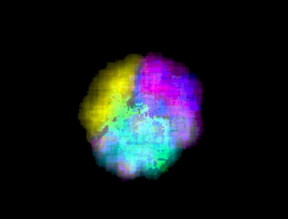 |
| Tetraphase heterostructure nanoparticle with six interphases CREDIT Northwestern University |
Abstract:
IMAGE
IMAGE: TETRAPHASE HETEROSTRUCTURE NANOPARTICLE WITH SIX INTERPHASES view more
CREDIT: NORTHWESTERN UNIVERSITY
Northwestern University researchers have developed a blueprint for understanding and predicting the properties and behavior of complex nanoparticles and optimizing their use for a broad range of scientific applications. These include catalysis, optoelectronics, transistors, bio-imaging, and energy storage and conversion.
New blueprint for understanding, predicting and optimizing complex nanoparticles: Guidelines have the potential to transform the fields of optoelectronics, bio-imaging and energy harvesting
Evanston, IL | Posted on March 1st, 2019Recent research findings have successfully enabled the synthesis, or creation, of a wide variety of polyelemental nanoparticles -- structures with as many as eight different elements. However, there is still a limited understanding of how the arrangement of phases within these structures impact their properties and how specific interfaces (the common surface between bound structures, called heterostructures) can be optimally designed and synthesized.
"As the combinatorial space of mixtures is nearly infinite, with billions of possibilities, predicting and understanding how specific classes of interfaces can be established in a single particle is crucial for designing new and functional nanostructures and, ultimately, optimizing their properties for various scientific applications," said Chad A. Mirkin, the George B. Rathmann Professor of Chemistry in the Weinberg College of Arts and Sciences and the director of the International Institute for Nanotechnology at Northwestern, who led the research.
In the study, the researchers utilized scanning probe block copolymer lithography (SPBCL), invented and developed at Northwestern by Mirkin, to construct a new library of polyelemental heterostructured nanoparticles containing up to seven different metals.
The research will be published in the March 1 issue of the journal Science.
"We used computational tools, such as density functional theory, to compute interfacial energies between phases, as well as surface energies, and combined these into an overall nanoparticle energy," said Chris Wolverton, the Jerome B. Cohen Professor of Materials Science and Engineering in Northwestern's McCormick School of Engineering. "What we found is that observed morphologies minimized calculated energies. As a result, we now have a tool to predict and understand these types of phase arrangements in nanoparticles."
Wolverton is a co-author of the study.
"Our contribution enables the synthesis of numerous types of interfaces, providing a vast playground to explore their properties and phenomena -- such as novel catalysts and light-emitting nanostructures -- for useful purposes," said co-author Vinayak Dravid. He is the Abraham Harris Professor of Materials Science and Engineering and the director of the Atomic and Nanoscale Characterization Experimental Center (NUANCE) at Northwestern.
####
For more information, please click here
Contacts:
Amanda Morris
847-467-6790
Copyright © Northwestern University
If you have a comment, please Contact us.Issuers of news releases, not 7th Wave, Inc. or Nanotechnology Now, are solely responsible for the accuracy of the content.
Bookmark:


| Related Links |
| Related News Press |
News and information
 Quantum computer improves AI predictions April 17th, 2026
Flexible sensor gains sensitivity under pressure April 17th, 2026
A reusable chip for particulate matter sensing April 17th, 2026
Detecting vibrational quantum beating in the predissociation dynamics of SF6 using time-resolved photoelectron spectroscopy April 17th, 2026
Imaging
Chemistry
Projecting light to dispense liquids: A new route to ultra-precise microdroplets January 30th, 2026
From sensors to smart systems: the rise of AI-driven photonic noses January 30th, 2026
"Nanoreactor" cage uses visible light for catalytic and ultra-selective cross-cycloadditions October 3rd, 2025
Govt.-Legislation/Regulation/Funding/Policy
Quantum computer improves AI predictions April 17th, 2026
Metasurfaces smooth light to boost magnetic sensing precision January 30th, 2026
New imaging approach transforms study of bacterial biofilms August 8th, 2025
Possible Futures
A fundamentally new therapeutic approach to cystic fibrosis: Nanobody repairs cellular defect April 17th, 2026
UC Irvine physicists discover method to reverse ‘quantum scrambling’ : The work addresses the problem of information loss in quantum computing system April 17th, 2026
Chip Technology
A reusable chip for particulate matter sensing April 17th, 2026
Metasurfaces smooth light to boost magnetic sensing precision January 30th, 2026
Optical computing/Photonic computing
ICFO researchers overcome long-standing bottleneck in single photon detection with twisted 2D materials August 8th, 2025
Programmable electron-induced color router array May 14th, 2025
Discoveries
Quantum computer improves AI predictions April 17th, 2026
Flexible sensor gains sensitivity under pressure April 17th, 2026
A reusable chip for particulate matter sensing April 17th, 2026
Detecting vibrational quantum beating in the predissociation dynamics of SF6 using time-resolved photoelectron spectroscopy April 17th, 2026
Announcements
A fundamentally new therapeutic approach to cystic fibrosis: Nanobody repairs cellular defect April 17th, 2026
UC Irvine physicists discover method to reverse ‘quantum scrambling’ : The work addresses the problem of information loss in quantum computing system April 17th, 2026
Interviews/Book Reviews/Essays/Reports/Podcasts/Journals/White papers/Posters
A fundamentally new therapeutic approach to cystic fibrosis: Nanobody repairs cellular defect April 17th, 2026
UC Irvine physicists discover method to reverse ‘quantum scrambling’ : The work addresses the problem of information loss in quantum computing system April 17th, 2026
Tools
Metasurfaces smooth light to boost magnetic sensing precision January 30th, 2026
From sensors to smart systems: the rise of AI-driven photonic noses January 30th, 2026
Japan launches fully domestically produced quantum computer: Expo visitors to experience quantum computing firsthand August 8th, 2025
Military
Quantum engineers ‘squeeze’ laser frequency combs to make more sensitive gas sensors January 17th, 2025
Chainmail-like material could be the future of armor: First 2D mechanically interlocked polymer exhibits exceptional flexibility and strength January 17th, 2025
Single atoms show their true color July 5th, 2024
NRL charters Navy’s quantum inertial navigation path to reduce drift April 5th, 2024
Energy
Sensors innovations for smart lithium-based batteries: advancements, opportunities, and potential challenges August 8th, 2025
Simple algorithm paired with standard imaging tool could predict failure in lithium metal batteries August 8th, 2025
Battery Technology/Capacitors/Generators/Piezoelectrics/Thermoelectrics/Energy storage
Decoding hydrogen‑bond network of electrolyte for cryogenic durable aqueous zinc‑ion batteries January 30th, 2026
COF scaffold membrane with gate‑lane nanostructure for efficient Li+/Mg2+ separation January 30th, 2026
MXene nanomaterials enter a new dimension Multilayer nanomaterial: MXene flakes created at Drexel University show new promise as 1D scrolls January 30th, 2026
Grants/Sponsored Research/Awards/Scholarships/Gifts/Contests/Honors/Records
Quantum computer improves AI predictions April 17th, 2026
Detecting vibrational quantum beating in the predissociation dynamics of SF6 using time-resolved photoelectron spectroscopy April 17th, 2026
Metasurfaces smooth light to boost magnetic sensing precision January 30th, 2026
Photonics/Optics/Lasers
Metasurfaces smooth light to boost magnetic sensing precision January 30th, 2026
From sensors to smart systems: the rise of AI-driven photonic noses January 30th, 2026
 |
||
 |
||
| The latest news from around the world, FREE | ||
 |
||
|
|
||
| Premium Products | ||
 |
||
|
Only the news you want to read!
Learn More |
||
 |
||
|
Full-service, expert consulting
Learn More |
||
|
|
||