Home > Press > Taking magnetism for a spin: Exploring the mysteries of skyrmions
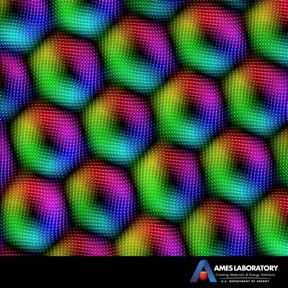 |
| Skyrmions are nanoscale whirls or vortices of magnetic poles that form lattices within a magnetic material, a type of quasiparticle that can zip across the material, pushed by electrical current. CREDIT Ames Laboratory, US Department of Energy |
Abstract:
Scientists at the U.S. Department of Energy's Ames Laboratory have discovered the relaxation dynamics of a zero-field state in skyrmions, a spinning magnetic phenomenon that has potential applications in data storage and spintronic devices.
Taking magnetism for a spin: Exploring the mysteries of skyrmions
Ames, IA | Posted on January 23rd, 2019Skyrmions are nanoscale whirls or vortices of magnetic poles that form lattices within a magnetic material, a type of quasiparticle that can zip across the material, pushed by electrical current. Those properties have captured the fascination of scientists, who think the phenomenon could lead to the next big advance in data storage, making digital technology even faster and smaller.
There are some big challenges to overcome, however. Until recently skyrmions were a phenomenon only observed at extreme low temperature. Also, external magnetic forces makes them currently impractical for applications.
"In order to be really useful in a device, these magnetic vortices need to be able to exist without the 'help' of an external magnetic field," said Lin Zhou, a scientist in the Ames Laboratory's Division of Materials Sciences and Engineering.
With that in mind, she and other researchers at Ames Laboratory investigated FeGe, an iron-germanium magnetic material that has demonstrated skyrmions in the highest temperature ranges to date in crystals with a similar, or B20 structure.
Ames Lab scientists with external collaborators were able to establish a skyrmion lattice in a sample through exposure to magnetic fields and supercooling with liquid nitrogen. With a high resolution microscopy method called Lorentz transmission electron microscopy (L-TEM), the team was able to observe the skyrmion lattice in zero magnetic field, and then observe the decay of the skyrmions as the temperature warmed. This direct observation yielded critical new information about how skyrmions behave and how they revert back to a 'normal' (what scientists call metastable) magnetic state.
"We've stabilized these skyrmions without a magnetic field, and our microscopy techniques allowed us to really see how the vortices change over time, temperature, and magnetic field; we think it provides a very solid foundation for theorists to better understand this phenomenon," Zhou said.
###
The research is further discussed in the paper, "Relaxation Dynamics of Zero-Field Skyrmions over a Wide Temperature Range," authored by Licong Peng, Ying Zhang, Liqin Ke, Tae-Hoon Kim, Qiang Zheng, Jiaqiang Yan, X.-G. Zhang, Yang Gao, Shouguo Wang, Jianwang Cai, Boagen Shen, Robert J. McQueeney, Adam Kaminski, Matthew J. Kramer, and Lin Zhou; and published in Nano Letters.
####
About Ames Laboratory
Ames Laboratory is a U.S. Department of Energy Office of Science national laboratory operated by Iowa State University. Ames Laboratory creates innovative materials, technologies and energy solutions. We use our expertise, unique capabilities and interdisciplinary collaborations to solve global problems.
DOE's Office of Science is the single largest supporter of basic research in the physical sciences in the United States, and is working to address some of the most pressing challenges of our time. For more information, please visit science.energy.gov.
For more information, please click here
Contacts:
Laura Millsaps
Copyright © Ames Laboratory
If you have a comment, please Contact us.Issuers of news releases, not 7th Wave, Inc. or Nanotechnology Now, are solely responsible for the accuracy of the content.
Bookmark:


| Related News Press |
News and information
 Quantum computer improves AI predictions April 17th, 2026
Flexible sensor gains sensitivity under pressure April 17th, 2026
A reusable chip for particulate matter sensing April 17th, 2026
Detecting vibrational quantum beating in the predissociation dynamics of SF6 using time-resolved photoelectron spectroscopy April 17th, 2026
Magnetism/Magnons
Metasurfaces smooth light to boost magnetic sensing precision January 30th, 2026
Researchers develop molecular qubits that communicate at telecom frequencies October 3rd, 2025
First real-time observation of two-dimensional melting process: Researchers at Mainz University unveil new insights into magnetic vortex structures August 8th, 2025
Magnetism in new exotic material opens the way for robust quantum computers June 4th, 2025
Laboratories
Researchers develop molecular qubits that communicate at telecom frequencies October 3rd, 2025
Skyrmions
First real-time observation of two-dimensional melting process: Researchers at Mainz University unveil new insights into magnetic vortex structures August 8th, 2025
Govt.-Legislation/Regulation/Funding/Policy
Quantum computer improves AI predictions April 17th, 2026
Metasurfaces smooth light to boost magnetic sensing precision January 30th, 2026
New imaging approach transforms study of bacterial biofilms August 8th, 2025
Possible Futures
A fundamentally new therapeutic approach to cystic fibrosis: Nanobody repairs cellular defect April 17th, 2026
UC Irvine physicists discover method to reverse ‘quantum scrambling’ : The work addresses the problem of information loss in quantum computing system April 17th, 2026
Spintronics
Quantum materials: Electron spin measured for the first time June 9th, 2023
Chip Technology
A reusable chip for particulate matter sensing April 17th, 2026
Metasurfaces smooth light to boost magnetic sensing precision January 30th, 2026
Discoveries
Quantum computer improves AI predictions April 17th, 2026
Flexible sensor gains sensitivity under pressure April 17th, 2026
A reusable chip for particulate matter sensing April 17th, 2026
Detecting vibrational quantum beating in the predissociation dynamics of SF6 using time-resolved photoelectron spectroscopy April 17th, 2026
Announcements
A fundamentally new therapeutic approach to cystic fibrosis: Nanobody repairs cellular defect April 17th, 2026
UC Irvine physicists discover method to reverse ‘quantum scrambling’ : The work addresses the problem of information loss in quantum computing system April 17th, 2026
 |
||
 |
||
| The latest news from around the world, FREE | ||
 |
||
|
|
||
| Premium Products | ||
 |
||
|
Only the news you want to read!
Learn More |
||
 |
||
|
Full-service, expert consulting
Learn More |
||
|
|
||