Home > Press > The materials engineers are developing environmentally friendly materials: The materials engineers are developing environmentally friendly materials for producing smart textiles
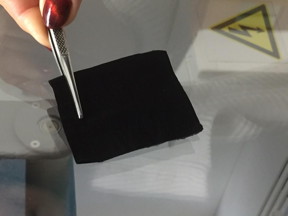 |
| Original raw material of smart fabric CREDIT TalTech University |
Abstract:
Recently the research article "A method for producing conductive graphene biopolymer nanofibrous fabrics by exploitation of an ionic liquid dispersant in electrospinning" written by the researchers of Tallinn University of Technology was published in a leading peer-reviewed journal Carbon.
The materials engineers are developing environmentally friendly materials: The materials engineers are developing environmentally friendly materials for producing smart textiles
Tartu, Estonia | Posted on November 2nd, 2018The article introduces nanofibers, a material produced by the electrospinning device at the Laboratory of Polymers and Textile Technology in Tallinn University of Technology, and their expanding range of applications. It is not possible to produce fibers with a diameter smaller than a micrometer by using conventional fiber spinning methods. Therefore, electrospinning technology is introduced, by which nanofibers are created by applying high voltage to polymer solution. The beginning of the 20th century can be considered to be the starting point of electrospinning as a scientific discipline, the quest for industrial applications started 50 years ago. In recent years, there has been a surge of interest in electrospinning. One of the co-authors of the research article, Head of the Laboratory of Polymers and Textile Technology of Tallinn University of Technology, Professor Andres Krumme says, "The electrospun carbon nanomaterial can also be called smart fabric. The nanofibers forming the material are 100 times thinner in diameter than hair, being however extremely strong, tough, flexible and due to carbon content also conductive. The material allows efficient energy storage owing to its high speci?c surface area."
The specific properties of nanofibers render it a promising material for future applications:
In environmental protection the non-woven fabric made of nanofibers can be used to clean contaminated air or water from fine particulate matter and heavy metals. In agriculture the smart fabric can be used e.g. as a shade cloth for plants to keep away insect pests (which is, of course, more effective than the existing shade cloths).
In medicine the nanofabric can, due to the environment similar to the natural environment of a human body, be used to grow cells and produce antibacterial plasters and bandages. Nanofibers can be used to create cell culture media (stem cells are seeded on a biopolymer mat) and the grown stem cells can then be transplanted e.g. to damaged human skin.
In clothing industry nanofibrous materials can be used to produce special protective clothing containing energy saving and collecting fibers (the collected energy can be used e.g. to charge a mobile phone). Nanofibrous electrodes with enhanced mechanical properties can be used as components of smart clothing to monitor and affect the health condition of the wearer. Garment sensors provide information about the wearer's needs as well as potential emergency situations (rescuers, fishermen, etc.).
"Cellulose used as the original raw material of smart fabric is very acceptable for human body due to its properties, i.e. the raw material used in polymer fabric is bio-based and supports the natural carbon cycle," Andres Krumme says.
####
For more information, please click here
Contacts:
Andres Krumme
372-527-5143
Copyright © Estonian Research Council
If you have a comment, please Contact us.Issuers of news releases, not 7th Wave, Inc. or Nanotechnology Now, are solely responsible for the accuracy of the content.
Bookmark:


| Related Links |
| Related News Press |
News and information
 Quantum computer improves AI predictions April 17th, 2026
Flexible sensor gains sensitivity under pressure April 17th, 2026
A reusable chip for particulate matter sensing April 17th, 2026
Detecting vibrational quantum beating in the predissociation dynamics of SF6 using time-resolved photoelectron spectroscopy April 17th, 2026
Possible Futures
A fundamentally new therapeutic approach to cystic fibrosis: Nanobody repairs cellular defect April 17th, 2026
UC Irvine physicists discover method to reverse ‘quantum scrambling’ : The work addresses the problem of information loss in quantum computing system April 17th, 2026
Nanomedicine
A fundamentally new therapeutic approach to cystic fibrosis: Nanobody repairs cellular defect April 17th, 2026
New molecular technology targets tumors and simultaneously silences two ‘undruggable’ cancer genes August 8th, 2025
New imaging approach transforms study of bacterial biofilms August 8th, 2025
Electrifying results shed light on graphene foam as a potential material for lab grown cartilage June 6th, 2025
Sensors
Flexible sensor gains sensitivity under pressure April 17th, 2026
Tiny nanosheets, big leap: A new sensor detects ethanol at ultra-low levels January 30th, 2026
From sensors to smart systems: the rise of AI-driven photonic noses January 30th, 2026
Sensors innovations for smart lithium-based batteries: advancements, opportunities, and potential challenges August 8th, 2025
Discoveries
Quantum computer improves AI predictions April 17th, 2026
Flexible sensor gains sensitivity under pressure April 17th, 2026
A reusable chip for particulate matter sensing April 17th, 2026
Detecting vibrational quantum beating in the predissociation dynamics of SF6 using time-resolved photoelectron spectroscopy April 17th, 2026
Announcements
A fundamentally new therapeutic approach to cystic fibrosis: Nanobody repairs cellular defect April 17th, 2026
UC Irvine physicists discover method to reverse ‘quantum scrambling’ : The work addresses the problem of information loss in quantum computing system April 17th, 2026
Interviews/Book Reviews/Essays/Reports/Podcasts/Journals/White papers/Posters
A fundamentally new therapeutic approach to cystic fibrosis: Nanobody repairs cellular defect April 17th, 2026
UC Irvine physicists discover method to reverse ‘quantum scrambling’ : The work addresses the problem of information loss in quantum computing system April 17th, 2026
Food/Agriculture/Supplements
New imaging approach transforms study of bacterial biofilms August 8th, 2025
SMART researchers pioneer first-of-its-kind nanosensor for real-time iron detection in plants February 28th, 2025
Environment
A reusable chip for particulate matter sensing April 17th, 2026
Researchers unveil a groundbreaking clay-based solution to capture carbon dioxide and combat climate change June 6th, 2025
Textiles/Clothing
Protective equipment with graphene nanotubes meets the strictest ESD safety standards March 25th, 2022
Polymer fibers with graphene nanotubes make it possible to heat hard-to-reach, complex-shaped items February 11th, 2022
Flexible material shows potential for use in fabrics to heat, cool July 3rd, 2020
Nanobiotechnology
A fundamentally new therapeutic approach to cystic fibrosis: Nanobody repairs cellular defect April 17th, 2026
New molecular technology targets tumors and simultaneously silences two ‘undruggable’ cancer genes August 8th, 2025
New imaging approach transforms study of bacterial biofilms August 8th, 2025
Electrifying results shed light on graphene foam as a potential material for lab grown cartilage June 6th, 2025
 |
||
 |
||
| The latest news from around the world, FREE | ||
 |
||
|
|
||
| Premium Products | ||
 |
||
|
Only the news you want to read!
Learn More |
||
 |
||
|
Full-service, expert consulting
Learn More |
||
|
|
||