Home > Press > How swarms of nanomachines could improve the efficiency of any machine
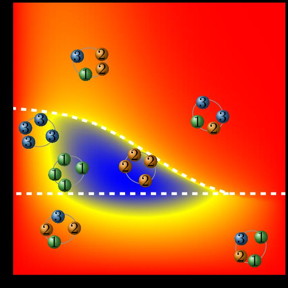 |
| Density plot of the power output of an energy-converting network that consists of interacting nano-machines illustrated by the spheres. The power increases from red to blue color, thus in the synchronization phase corresponding to the area enclosed by the white dashed lines, the output of the network is maximized. CREDIT University of Luxembourg |
Abstract:
All machines convert one form of energy into another form - for example a car engine turns the energy stored in fuel into motion energy. Those processes of energy conversion, described by the theory called thermodynamics, don't only take place on the macro-level of big machines, but also at the micro-level of molecular machines that drive muscles or metabolic processes and even on the atomic level. The research team of Prof. Massimiliano Esposito of the University of Luxembourg studies the thermodynamics of small nanomachines only consisting of a few atoms. In a paper published in the prestigious scientific journal Physical Review X, they outline how these small machines behave in concert. Their insights could be used to improve the energy efficiency of all kinds of machines, big or small.
How swarms of nanomachines could improve the efficiency of any machine
Luxembourg | Posted on September 28th, 2018Recent progress in nanotechnology has enabled researchers to understand the world in ever-smaller scales and even allows for the design and manufacture of extremely small artificial machines. "There is evidence that these machines are far more efficient than large machines, such as cars. Yet in absolute terms, the output is low compared to the needs we have in daily life applications," explains Tim Herpich, PhD student at Esposito's research group and main author of the paper. "That is why we studied how the nanomachines interact with each other and looked at how ensembles of those small machines behave. We wanted to see if there are synergies when they act in concert."
The researchers found that the nanomachines under certain conditions start to arrange in "swarms" and synchronise their movements. "We could show that the synchronisation of the machines triggers significant synergy effects, so that the overall energy output of the ensemble is far greater than the sum of the individual outputs," said Prof. Esposito. While this is basic research, the principles outlined in the paper could potentially be used to improve the efficiency of any machine in the future, the researcher explains.
In order to simulate and study the energetic behaviour of swarms of nanomachines, the scientists created mathematical models that are based on existing literature and outcomes of experimental research.
####
For more information, please click here
Contacts:
Thomas Klein
352-466-644-5148
Copyright © University of Luxembourg
If you have a comment, please Contact us.Issuers of news releases, not 7th Wave, Inc. or Nanotechnology Now, are solely responsible for the accuracy of the content.
Bookmark:


| Related Links |
| Related News Press |
News and information
 Quantum computer improves AI predictions April 17th, 2026
Flexible sensor gains sensitivity under pressure April 17th, 2026
A reusable chip for particulate matter sensing April 17th, 2026
Detecting vibrational quantum beating in the predissociation dynamics of SF6 using time-resolved photoelectron spectroscopy April 17th, 2026
Possible Futures
A fundamentally new therapeutic approach to cystic fibrosis: Nanobody repairs cellular defect April 17th, 2026
UC Irvine physicists discover method to reverse ‘quantum scrambling’ : The work addresses the problem of information loss in quantum computing system April 17th, 2026
Molecular Machines
First electric nanomotor made from DNA material: Synthetic rotary motors at the nanoscale perform mechanical work July 22nd, 2022
Nanotech scientists create world's smallest origami bird March 17th, 2021
Giant nanomachine aids the immune system: Theoretical chemistry August 28th, 2020
Molecular Nanotechnology
Quantum pumping in molecular junctions August 16th, 2024
Scientists push the boundaries of manipulating light at the submicroscopic level March 3rd, 2023
First electric nanomotor made from DNA material: Synthetic rotary motors at the nanoscale perform mechanical work July 22nd, 2022
Discoveries
Quantum computer improves AI predictions April 17th, 2026
Flexible sensor gains sensitivity under pressure April 17th, 2026
A reusable chip for particulate matter sensing April 17th, 2026
Detecting vibrational quantum beating in the predissociation dynamics of SF6 using time-resolved photoelectron spectroscopy April 17th, 2026
Announcements
A fundamentally new therapeutic approach to cystic fibrosis: Nanobody repairs cellular defect April 17th, 2026
UC Irvine physicists discover method to reverse ‘quantum scrambling’ : The work addresses the problem of information loss in quantum computing system April 17th, 2026
Interviews/Book Reviews/Essays/Reports/Podcasts/Journals/White papers/Posters
A fundamentally new therapeutic approach to cystic fibrosis: Nanobody repairs cellular defect April 17th, 2026
UC Irvine physicists discover method to reverse ‘quantum scrambling’ : The work addresses the problem of information loss in quantum computing system April 17th, 2026
 |
||
 |
||
| The latest news from around the world, FREE | ||
 |
||
|
|
||
| Premium Products | ||
 |
||
|
Only the news you want to read!
Learn More |
||
 |
||
|
Full-service, expert consulting
Learn More |
||
|
|
||