Home > Press > Individual impurity atoms detectable in graphene
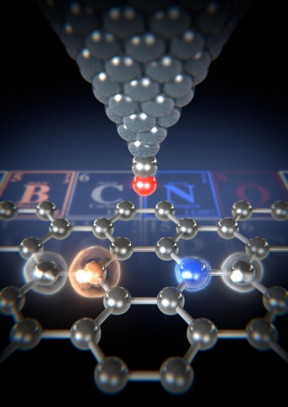 |
| Using the atomic force microscope's carbon monoxide functionalized tip (red/silver), the forces between the tip and the various atoms in the graphene ribbon can be measured. CREDIT Image: University of Basel, Department of Physics |
Abstract:
A team including physicists from the University of Basel has succeeded in using atomic force microscopy to clearly obtain images of individual impurity atoms in graphene ribbons. Thanks to the forces measured in the graphene's two-dimensional carbon lattice, they were able to identify boron and nitrogen for the first time, as the researchers report in the journal Science Advances.
Individual impurity atoms detectable in graphene
Basel, Switzerland | Posted on April 18th, 2018Graphene is made of a two-dimensional layer of carbon atoms arranged in a hexagonal lattice. The strong bonds between the carbon atoms make graphene extremely stable yet flexible. It is also an excellent electrical conductor through which electricity can flow with almost no loss.
Graphene's distinctive properties can be further expanded by incorporating impurity atoms in a process known as "doping". The impurity atoms cause local changes of the conduction that, for example, allow graphene to be used as a tiny transistor and enable the construction of circuits.
Targeted incorporation
In a collaboration between scientists from the University of Basel and the National Institute for Material Science in Tsukuba in Japan, Kanazawa University and Kwansei Gakuin University in Japan, and Aalto University in Finland, the researchers specifically created and examined graphene ribbons containing impurity atoms.
They replaced particular carbon atoms in the hexagonal lattice with boron and nitrogen atoms using surface chemistry, by placing suitable organic precursor compounds on a gold surface. Under heat exposure up to 400°C, tiny graphene ribbons formed on the gold surface from the precursors, including impurity atoms at specific sites.
Measuring the strength of the atoms
Scientists from the team led by Professor Ernst Meyer from the Swiss Nanoscience Institute and the University of Basel's Department of Physics examined these graphene ribbons using atomic force microscopy (AFM). They used a carbon monoxide functionalized tip and measured the tiny forces that act between the tip and the individual atoms.
This method allows even the smallest differences in forces to be detected. By looking at the different forces, the researchers were able to map and identify the different atoms. "The forces measured for nitrogen atoms are greater than for a carbon atom," explains Dr. Shigeki Kawai, lead author of the study and former postdoc in Meyer's team. "We measured the smallest forces for the boron atoms." The different forces can be explained by the different proportion of repulsive forces, which is due to the different atomic radii.
Computer simulations confirmed the readings, proving that AFM technology is well-suited to conducting chemical analyses of impurity atoms in the promising two-dimensional carbon compounds.
####
For more information, please click here
Contacts:
Iris Mickein
41-061-207-2425
Copyright © University of Basel
If you have a comment, please Contact us.Issuers of news releases, not 7th Wave, Inc. or Nanotechnology Now, are solely responsible for the accuracy of the content.
Bookmark:


| Related Links |
| Related News Press |
News and information
 Quantum computer improves AI predictions April 17th, 2026
Flexible sensor gains sensitivity under pressure April 17th, 2026
A reusable chip for particulate matter sensing April 17th, 2026
Detecting vibrational quantum beating in the predissociation dynamics of SF6 using time-resolved photoelectron spectroscopy April 17th, 2026
2 Dimensional Materials
Flexible sensor gains sensitivity under pressure April 17th, 2026
MXene nanomaterials enter a new dimension Multilayer nanomaterial: MXene flakes created at Drexel University show new promise as 1D scrolls January 30th, 2026
Imaging
Graphene/ Graphite
Electrifying results shed light on graphene foam as a potential material for lab grown cartilage June 6th, 2025
Breakthrough in proton barrier films using pore-free graphene oxide: Kumamoto University researchers achieve new milestone in advanced coating technologies September 13th, 2024
Possible Futures
A fundamentally new therapeutic approach to cystic fibrosis: Nanobody repairs cellular defect April 17th, 2026
UC Irvine physicists discover method to reverse ‘quantum scrambling’ : The work addresses the problem of information loss in quantum computing system April 17th, 2026
Discoveries
Quantum computer improves AI predictions April 17th, 2026
Flexible sensor gains sensitivity under pressure April 17th, 2026
A reusable chip for particulate matter sensing April 17th, 2026
Detecting vibrational quantum beating in the predissociation dynamics of SF6 using time-resolved photoelectron spectroscopy April 17th, 2026
Materials/Metamaterials/Magnetoresistance
First real-time observation of two-dimensional melting process: Researchers at Mainz University unveil new insights into magnetic vortex structures August 8th, 2025
Researchers unveil a groundbreaking clay-based solution to capture carbon dioxide and combat climate change June 6th, 2025
A 1960s idea inspires NBI researchers to study hitherto inaccessible quantum states June 6th, 2025
Institute for Nanoscience hosts annual proposal planning meeting May 16th, 2025
Announcements
A fundamentally new therapeutic approach to cystic fibrosis: Nanobody repairs cellular defect April 17th, 2026
UC Irvine physicists discover method to reverse ‘quantum scrambling’ : The work addresses the problem of information loss in quantum computing system April 17th, 2026
Interviews/Book Reviews/Essays/Reports/Podcasts/Journals/White papers/Posters
A fundamentally new therapeutic approach to cystic fibrosis: Nanobody repairs cellular defect April 17th, 2026
UC Irvine physicists discover method to reverse ‘quantum scrambling’ : The work addresses the problem of information loss in quantum computing system April 17th, 2026
Tools
Metasurfaces smooth light to boost magnetic sensing precision January 30th, 2026
From sensors to smart systems: the rise of AI-driven photonic noses January 30th, 2026
Japan launches fully domestically produced quantum computer: Expo visitors to experience quantum computing firsthand August 8th, 2025
 |
||
 |
||
| The latest news from around the world, FREE | ||
 |
||
|
|
||
| Premium Products | ||
 |
||
|
Only the news you want to read!
Learn More |
||
 |
||
|
Full-service, expert consulting
Learn More |
||
|
|
||