Home > Press > Ultra-efficient removal of carbon monoxide using gold nanoparticles on a molecular support: New method and mechanism for state-of-the-art gas purification
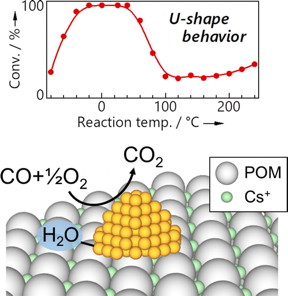 |
| New catalyst consisting of gold nanoparticles supported on a Keggin-type polyoxometalate (POM) with a cesium salt. The structure showed high activity and stability for CO oxidation; trace amounts of water were found to be essential to the function of the material. Catalytic activity showed a unique, U-shaped dependence on temperature. CREDIT Toru Murayama |
Abstract:
Researchers from Tokyo Metropolitan University have developed a way to mount gold nanoparticles on a molecular support known as a polyoxometalate (POM). They successfully applied this to realize nearly 100% conversion of carbon monoxide (CO) over a wide temperature range, demonstrating stable performance over long periods of time. They showed how traces of water uniquely contribute to the catalyst's function, promising insight into catalysis and potential application to exhaust gas and room air purification.
Ultra-efficient removal of carbon monoxide using gold nanoparticles on a molecular support: New method and mechanism for state-of-the-art gas purification
Tokyo, Japan | Posted on February 9th, 2018Gas purification is an extremely important industrial process, whether in factories, catalytic converters for vehicle exhausts, or the domestic air purifier. Recently, research has focused on using nanometer-sized gold particles, prized for their ability to speed up ("catalyze") chemical reactions, even at very small (<5 nm) sizes. These often need to be mounted on a solid "support".
The research group of Toru Murayama (Project Professor) and Masatake Haruta (Professor) have successfully combined gold nanoparticles with polyoxometalates (POMs), a promising support material which has already attracted considerable attention in catalysis, medicine, surface and material sciences. POMs and their salts, molecular ion species of metallic oxides, are yet to see widespread use for the stabilization of gold particles. By mounting gold particles down to a size of 2 nm using a sol immobilization method, they successfully applied it to a low-temperature carbon monoxide (CO) gas purifier. Their new gold-POM catalyst not only showed efficient conversion at -50°C, top class performance even for a gold nanoparticle catalyst, but also demonstrated stable, 100% removal of a 1%vol concentration of CO over a span of 35 days at 0°C, with no degradation of the material. They found that smaller particle sizes led to better performance, and that the conversion efficiency of the material showed a unique dependence on temperature. This led to the discovery that trace amounts of water were essential to the function of the material, the first unique mechanism proposed for catalysis in gold/POM catalysts. The technique and newly discovered mechanism not only promise a greater understanding of catalysis, but also potential application to industrial filtration, both for gases and liquids.
###
This study was supported by the "Nanotechnology Platform" Program of the Ministry of Education, Culture, Sports, Science and Technology (MEXT), Japan. The manuscript reporting this finding has been published online in Angewandte Chemie, International Edition.
####
For more information, please click here
Contacts:
Go Totsukawa
81-426-772-759
Copyright © Tokyo Metropolitan University
If you have a comment, please Contact us.Issuers of news releases, not 7th Wave, Inc. or Nanotechnology Now, are solely responsible for the accuracy of the content.
Bookmark:


| Related Links |
| Related News Press |
News and information
 Quantum computer improves AI predictions April 17th, 2026
Flexible sensor gains sensitivity under pressure April 17th, 2026
A reusable chip for particulate matter sensing April 17th, 2026
Detecting vibrational quantum beating in the predissociation dynamics of SF6 using time-resolved photoelectron spectroscopy April 17th, 2026
Chemistry
Projecting light to dispense liquids: A new route to ultra-precise microdroplets January 30th, 2026
From sensors to smart systems: the rise of AI-driven photonic noses January 30th, 2026
"Nanoreactor" cage uses visible light for catalytic and ultra-selective cross-cycloadditions October 3rd, 2025
Cambridge chemists discover simple way to build bigger molecules – one carbon at a time June 6th, 2025
Govt.-Legislation/Regulation/Funding/Policy
Quantum computer improves AI predictions April 17th, 2026
Metasurfaces smooth light to boost magnetic sensing precision January 30th, 2026
New imaging approach transforms study of bacterial biofilms August 8th, 2025
Discoveries
Quantum computer improves AI predictions April 17th, 2026
Flexible sensor gains sensitivity under pressure April 17th, 2026
A reusable chip for particulate matter sensing April 17th, 2026
Detecting vibrational quantum beating in the predissociation dynamics of SF6 using time-resolved photoelectron spectroscopy April 17th, 2026
Announcements
A fundamentally new therapeutic approach to cystic fibrosis: Nanobody repairs cellular defect April 17th, 2026
UC Irvine physicists discover method to reverse ‘quantum scrambling’ : The work addresses the problem of information loss in quantum computing system April 17th, 2026
Interviews/Book Reviews/Essays/Reports/Podcasts/Journals/White papers/Posters
A fundamentally new therapeutic approach to cystic fibrosis: Nanobody repairs cellular defect April 17th, 2026
UC Irvine physicists discover method to reverse ‘quantum scrambling’ : The work addresses the problem of information loss in quantum computing system April 17th, 2026
Environment
A reusable chip for particulate matter sensing April 17th, 2026
Researchers unveil a groundbreaking clay-based solution to capture carbon dioxide and combat climate change June 6th, 2025
Automotive/Transportation
Decoding hydrogen‑bond network of electrolyte for cryogenic durable aqueous zinc‑ion batteries January 30th, 2026
Sensors innovations for smart lithium-based batteries: advancements, opportunities, and potential challenges August 8th, 2025
Simple algorithm paired with standard imaging tool could predict failure in lithium metal batteries August 8th, 2025
Industrial
Tiny nanosheets, big leap: A new sensor detects ethanol at ultra-low levels January 30th, 2026
Quantum interference in molecule-surface collisions February 28th, 2025
Boron nitride nanotube fibers get real: Rice lab creates first heat-tolerant, stable fibers from wet-spinning process June 24th, 2022
 |
||
 |
||
| The latest news from around the world, FREE | ||
 |
||
|
|
||
| Premium Products | ||
 |
||
|
Only the news you want to read!
Learn More |
||
 |
||
|
Full-service, expert consulting
Learn More |
||
|
|
||