Home > Press > Creation of coherent states in molecules by incoherent electrons
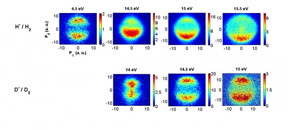 |
| Momentum images of H from H2 and D from D2 at different electron energies. The one at 4 eV for H is symmetric, while those above 14 eV are strongly asymmetric. The asymmetry in D is less pronounced and appear to change direction with change in electron energy. CREDIT E. Krishnakumar et al, Nature Physics |
Abstract:
In a breakthrough experiment using a novel negative ion momentum imaging technique, researchers from Tata Institute of Fundamental Research, Mumbai India and Open University, Milton Kyenes, UK have shown -- for the first time -- that incoherent electrons displaying their quantum mechanical nature, can induce coherence in molecular systems on attachment. Their latest results published in the Journal, Nature Physics (DOI: 10.1038/nphys4289), show that the coherence induced by the capture of single electron by H2 molecule results in the ejection of H? ion in preferentially backward direction with respect to the incoming electron beam. The other product of the dissociation is the H-atom in its excited state. In other words, this coherence induced in the molecule segregates the charge and excess energy in the system in a preferred manner. Similar measurements in the isotopomer of H2 namely D2 does not show such a strong asymmetry in ejection of the fragment ion but shows the reversal of the asymmetry as a function of incoming electron energy.
Creation of coherent states in molecules by incoherent electrons
Mumbai, India | Posted on October 21st, 2017So far researchers have used such coherence induced by laser beams to control molecular dissociation and have considered it as the basis for possible control of chemical reactions using photons. But in that case, the coherence in the resulting excited molecular entity is understood to stem from the absorbed laser radiation. By demonstrating the presence of such coherence resulting from a capture of an incoherent electron, Prof. Krishnakumar and co-workers have shown that such coherence can also stem from the transfer of more than one value of angular momentum quanta.
On the capture of a low energy electron, a relatively unstable molecular negative ion is formed. Subsequently, this negative ion decays by ejecting the extra electron. However, if the ion survives against the electron ejection, it undergoes dissociation. This is known as dissociative attachment. According to Prof. Krishnakumar, dissociative attachment is traditionally linked with transfer of multiple values of angular momentum quanta in the molecular system. However, it is for the first time such a quantum coherent response has been observed from a molecule.
Low energy electrons are ubiquitous and are known to play important role in variety of phenomena relevant to astrochemistry (where they participate in synthesis of new molecules), in radiation biology (where they cause chemical changes in living cell, plasma chemistry), atmospheric chemistry, radioactive waste management and nanolithography -- to name but a few. In all these cases, dissociative attachment plays a critical role. The unstable excited molecular negative ion states are at the core of this process. However, due to very short lifetime of these species very little is known about them at present.
The group led by Prof. Krishnakumar and Dr. Prabhudesai in TIFR has pioneered research on several aspects of low energy electron interactions with molecules in gas and condensed phase with particular emphasis on the possibility of controlling chemical reactions using low energy electrons. These new results point to rich unexplored dynamics of excited molecular negative ions that might open up new possibilities in inducing chemical control. They also pose a challenge to theoreticians to come up with a detailed model for the negative ion chemistry that is associated with low energy free electron scattering.
These measurements were carried out by Prof. Krishnakumar using an experiment built by him at the Open University in UK, where he was on invitation as a Marie Curie Professor to help build a novel electron scattering experiment for the European scientists, similar to the one he had conceived and built at TIFR. Dr. Prabhudesai and Prof. Krishnakumar provided the interpretation of the data along with the model.
####
For more information, please click here
Contacts:
E. Krishnakumar
91-986-901-3407
Copyright © Tata Institute of Fundamental Research
If you have a comment, please Contact us.Issuers of news releases, not 7th Wave, Inc. or Nanotechnology Now, are solely responsible for the accuracy of the content.
Bookmark:


| Related Links |
| Related News Press |
News and information
 Quantum computer improves AI predictions April 17th, 2026
Flexible sensor gains sensitivity under pressure April 17th, 2026
A reusable chip for particulate matter sensing April 17th, 2026
Detecting vibrational quantum beating in the predissociation dynamics of SF6 using time-resolved photoelectron spectroscopy April 17th, 2026
Imaging
Chemistry
Projecting light to dispense liquids: A new route to ultra-precise microdroplets January 30th, 2026
From sensors to smart systems: the rise of AI-driven photonic noses January 30th, 2026
"Nanoreactor" cage uses visible light for catalytic and ultra-selective cross-cycloadditions October 3rd, 2025
Discoveries
Quantum computer improves AI predictions April 17th, 2026
Flexible sensor gains sensitivity under pressure April 17th, 2026
A reusable chip for particulate matter sensing April 17th, 2026
Detecting vibrational quantum beating in the predissociation dynamics of SF6 using time-resolved photoelectron spectroscopy April 17th, 2026
Announcements
A fundamentally new therapeutic approach to cystic fibrosis: Nanobody repairs cellular defect April 17th, 2026
UC Irvine physicists discover method to reverse ‘quantum scrambling’ : The work addresses the problem of information loss in quantum computing system April 17th, 2026
Interviews/Book Reviews/Essays/Reports/Podcasts/Journals/White papers/Posters
A fundamentally new therapeutic approach to cystic fibrosis: Nanobody repairs cellular defect April 17th, 2026
UC Irvine physicists discover method to reverse ‘quantum scrambling’ : The work addresses the problem of information loss in quantum computing system April 17th, 2026
Tools
Metasurfaces smooth light to boost magnetic sensing precision January 30th, 2026
From sensors to smart systems: the rise of AI-driven photonic noses January 30th, 2026
Japan launches fully domestically produced quantum computer: Expo visitors to experience quantum computing firsthand August 8th, 2025
Photonics/Optics/Lasers
Metasurfaces smooth light to boost magnetic sensing precision January 30th, 2026
From sensors to smart systems: the rise of AI-driven photonic noses January 30th, 2026
Printing/Lithography/Inkjet/Inks/Bio-printing/Dyes
Presenting: Ultrasound-based printing of 3D materials—potentially inside the body December 8th, 2023
Simple ballpoint pen can write custom LEDs August 11th, 2023
Disposable electronics on a simple sheet of paper October 7th, 2022
 |
||
 |
||
| The latest news from around the world, FREE | ||
 |
||
|
|
||
| Premium Products | ||
 |
||
|
Only the news you want to read!
Learn More |
||
 |
||
|
Full-service, expert consulting
Learn More |
||
|
|
||