Home > Press > Assembly of nanoparticles proceeds like a zipper: Viruses and nanoparticles can be assembled into processable superlattice wires according to scientists from Aalto University Finland
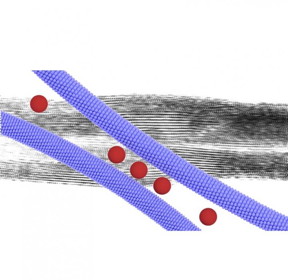 |
| Zipper-like assembly of nanocomposite leads to superlattice wires that are characterized by a well-defined periodic internal structure. CREDIT Dr. Nonappa and Ville Liljeström |
Abstract:
It has always been the Holy Grail of materials science to describe and control the material's structure-function relationship. Nanoparticles are an attractive class of components to be used in functional materials because they exhibit size-dependent properties, such as superparamagnetism and plasmonic absorption of light. Furthermore, controlling the arrangement of nanoparticles can result in unforeseen properties, but such studies are hard to carry out due to limited efficient approaches to produce well-defined three-dimensional nanostructures.
Assembly of nanoparticles proceeds like a zipper: Viruses and nanoparticles can be assembled into processable superlattice wires according to scientists from Aalto University Finland
Aalto, Finland | Posted on September 25th, 2017According to scientists from the Biohybrid Materials Group of Aalto University Finland led by Prof. Mauri Kostiainen, nature's own charged nanoparticles -- protein cages and viruses -- can be utilized to determine the structure of composite nanomaterials.
Viruses and proteins are ideal model particles to be used in materials science, as they are genetically encoded and have an atomically precise structure. These well-defined biological particles can be used to guide the arrangement of other nanoparticles in an aqueous solution. In the present study, the researchers show that combining native Tobacco Mosaic Virus with gold nanoparticles in a controlled manner leads to metal-protein superlattice wires.
"We initially studied geometrical aspects of nanoparticle superlattice engineering. We hypothesized that the size-ratio of oppositely charged nanorods (TMV viruses) and nanospheres (gold nanoparticles) could efficiently be used to control the two-dimensional superlattice geometry. We were actually able to demonstrate this. Even more interestingly, our structural characterization revealed details about the cooperative assembly mechanisms that proceeds in a zipper-like manner, leading to high-aspect-ratio superlattice wires," Kostiainen says. "Controlling the macroscopic habit of self-assembled nanomaterials is far from trivial," he adds.
Wires potential to form new materials
The results showed that nanoscale interactions really controls the macroscopic habit of the formed superlattice wires. The researchers observed that the formed macroscopic wires undergo a right-handed helical twist that was explained by the electrostatic attraction between the asymmetrically patterned TMV virus and the oppositely charged spherical nanoparticles. As plasmonic nanostructures efficiently affect the propagation of light, the helical twisting resulted in asymmetric optical properties (plasmonic circular dichroism) of the material. "This result is ground breaking in the sense that it demonstrates that macroscopic structures and physical properties can be determined by the detailed nanostructure, i.e. the amino acid sequence of the virus particles. Genetical engineering routinely deals with designing the amino acid sequence of proteins, and it is a matter of time when similar or even more sophisticated macroscopic habit and structure-function properties are demonstrated for ab-initio designed protein cages," explains Dr. Ville Liljeström who worked on the project during three years of his doctoral studies.
The research group demonstrated a proof-of-concept showing that the superlattice wires can be used to form materials with physical properties controlled by external fields. By functionalizing the superlattice wires with magnetic nanoparticles, the wires could be aligned by a magnetic field. In this manner they produced plasmonic polarizing films. The purpose of the demonstration was to show that electrostatic self-assembly of nanoparticles can potentially be used to form processable materials for future applications.
####
For more information, please click here
Contacts:
Mauri Kostiainen
358-503-627-070
Copyright © Aalto University
If you have a comment, please Contact us.Issuers of news releases, not 7th Wave, Inc. or Nanotechnology Now, are solely responsible for the accuracy of the content.
Bookmark:


| Related Links |
| Related News Press |
News and information
 Quantum computer improves AI predictions April 17th, 2026
Flexible sensor gains sensitivity under pressure April 17th, 2026
A reusable chip for particulate matter sensing April 17th, 2026
Detecting vibrational quantum beating in the predissociation dynamics of SF6 using time-resolved photoelectron spectroscopy April 17th, 2026
Magnetism/Magnons
Metasurfaces smooth light to boost magnetic sensing precision January 30th, 2026
Researchers develop molecular qubits that communicate at telecom frequencies October 3rd, 2025
First real-time observation of two-dimensional melting process: Researchers at Mainz University unveil new insights into magnetic vortex structures August 8th, 2025
Magnetism in new exotic material opens the way for robust quantum computers June 4th, 2025
Possible Futures
A fundamentally new therapeutic approach to cystic fibrosis: Nanobody repairs cellular defect April 17th, 2026
UC Irvine physicists discover method to reverse ‘quantum scrambling’ : The work addresses the problem of information loss in quantum computing system April 17th, 2026
Molecular Nanotechnology
Quantum pumping in molecular junctions August 16th, 2024
Scientists push the boundaries of manipulating light at the submicroscopic level March 3rd, 2023
First electric nanomotor made from DNA material: Synthetic rotary motors at the nanoscale perform mechanical work July 22nd, 2022
Discoveries
Quantum computer improves AI predictions April 17th, 2026
Flexible sensor gains sensitivity under pressure April 17th, 2026
A reusable chip for particulate matter sensing April 17th, 2026
Detecting vibrational quantum beating in the predissociation dynamics of SF6 using time-resolved photoelectron spectroscopy April 17th, 2026
Materials/Metamaterials/Magnetoresistance
First real-time observation of two-dimensional melting process: Researchers at Mainz University unveil new insights into magnetic vortex structures August 8th, 2025
Researchers unveil a groundbreaking clay-based solution to capture carbon dioxide and combat climate change June 6th, 2025
A 1960s idea inspires NBI researchers to study hitherto inaccessible quantum states June 6th, 2025
Institute for Nanoscience hosts annual proposal planning meeting May 16th, 2025
Announcements
A fundamentally new therapeutic approach to cystic fibrosis: Nanobody repairs cellular defect April 17th, 2026
UC Irvine physicists discover method to reverse ‘quantum scrambling’ : The work addresses the problem of information loss in quantum computing system April 17th, 2026
Interviews/Book Reviews/Essays/Reports/Podcasts/Journals/White papers/Posters
A fundamentally new therapeutic approach to cystic fibrosis: Nanobody repairs cellular defect April 17th, 2026
UC Irvine physicists discover method to reverse ‘quantum scrambling’ : The work addresses the problem of information loss in quantum computing system April 17th, 2026
Nanobiotechnology
A fundamentally new therapeutic approach to cystic fibrosis: Nanobody repairs cellular defect April 17th, 2026
New molecular technology targets tumors and simultaneously silences two ‘undruggable’ cancer genes August 8th, 2025
New imaging approach transforms study of bacterial biofilms August 8th, 2025
Electrifying results shed light on graphene foam as a potential material for lab grown cartilage June 6th, 2025
 |
||
 |
||
| The latest news from around the world, FREE | ||
 |
||
|
|
||
| Premium Products | ||
 |
||
|
Only the news you want to read!
Learn More |
||
 |
||
|
Full-service, expert consulting
Learn More |
||
|
|
||