Home > Press > Research opens door to smaller, cheaper, more agile communications tech
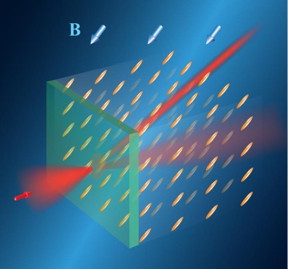 |
| Routing of light in a liquid crystal by a magnetic field (B). The orientation of the field determines the orientation of rod-shaped molecules of the liquid crystal and defines direction of the light trajectory. This trajectory can be rapidly changed by changing the orientation of the magnetic field. CREDIT ANU |
Abstract:
Research led by The Australian National University (ANU) on the use of magnets to steer light has opened the door to new communications systems which could be smaller, cheaper and more agile than fibre optics.
Research opens door to smaller, cheaper, more agile communications tech
Canberra, Australia | Posted on February 16th, 2017Group leader Professor Wieslaw Krolikowski from the ANU Research School of Physics and Engineering (RSPE) said the team's breakthrough would be crucial for developing tiny components to process huge amounts of data.
"This technology is also expected to be applicable in sensors, data storage and liquid crystal displays," said Professor Krolikowski.
Today's communication technologies aim to maximise data transmission rates and require the ability to precisely direct information channels. These technologies use electronic components for signal processing such as switching, which is not as fast as light-based technology including fibre optics.
Professor Krolikowski said the team used a magnetic field to stimulate liquid crystals and steer light beams carrying data, which enables an innovative approach to data processing and switching.
"Our discovery could lead to communications technology that could power a new generation of efficient devices such as compact and fast optical switches, routers and modulators," he said.
Co-researcher Dr Vladlen Shvedov from RSPE said the team's innovation, based on liquid crystals with properties modified by light, promised a much more agile system than fibre optics.
"This touch-free magneto-optical system is so flexible that you can remotely transfer the tiny optical signal in any desired direction in real time," Dr Shvedov said.
Co-researcher Dr Yana Izdebskaya from RSPE said while the innovation was in the early stages, it was highly promising for future communications technology.
"In the liquid crystal the light creates a temporary channel to guide itself along, called a soliton, which is about one tenth the diameter of a human hair. That's about 25 times thinner than fibre optics," Dr Izdebskaya said.
"Developing efficient strategies to achieve the robust control and steering of solitons is one of the major challenges in light-based technologies."
Dr Izdebskaya said controlling solitons in liquid crystals had only been achieved by applying voltage from inflexible electrodes.
"Such systems have been restricted by the configuration of electrodes in a thin liquid crystal layer. Our new approach doesn't have this limitation and opens a way to full 3D manipulations of light signals carried by solitons," Dr Izdebskaya said.
####
For more information, please click here
Contacts:
Will Wright
61-261-257-979
Copyright © Australian National University
If you have a comment, please Contact us.Issuers of news releases, not 7th Wave, Inc. or Nanotechnology Now, are solely responsible for the accuracy of the content.
Bookmark:


| Related Links |
 The research is published in Nature Communications:
| Related News Press |
News and information
Quantum computer improves AI predictions April 17th, 2026
Flexible sensor gains sensitivity under pressure April 17th, 2026
A reusable chip for particulate matter sensing April 17th, 2026
Detecting vibrational quantum beating in the predissociation dynamics of SF6 using time-resolved photoelectron spectroscopy April 17th, 2026
Magnetism/Magnons
Metasurfaces smooth light to boost magnetic sensing precision January 30th, 2026
Researchers develop molecular qubits that communicate at telecom frequencies October 3rd, 2025
First real-time observation of two-dimensional melting process: Researchers at Mainz University unveil new insights into magnetic vortex structures August 8th, 2025
Magnetism in new exotic material opens the way for robust quantum computers June 4th, 2025
Display technology/LEDs/SS Lighting/OLEDs
Spinel-type sulfide semiconductors to operate the next-generation LEDs and solar cells For solar-cell absorbers and green-LED source October 3rd, 2025
Wireless/telecommunications/RF/Antennas/Microwaves
Researchers develop molecular qubits that communicate at telecom frequencies October 3rd, 2025
Possible Futures
A fundamentally new therapeutic approach to cystic fibrosis: Nanobody repairs cellular defect April 17th, 2026
UC Irvine physicists discover method to reverse ‘quantum scrambling’ : The work addresses the problem of information loss in quantum computing system April 17th, 2026
Chip Technology
A reusable chip for particulate matter sensing April 17th, 2026
Metasurfaces smooth light to boost magnetic sensing precision January 30th, 2026
Memory Technology
Researchers tackle the memory bottleneck stalling quantum computing October 3rd, 2025
First real-time observation of two-dimensional melting process: Researchers at Mainz University unveil new insights into magnetic vortex structures August 8th, 2025
Utilizing palladium for addressing contact issues of buried oxide thin film transistors April 5th, 2024
Optical computing/Photonic computing
ICFO researchers overcome long-standing bottleneck in single photon detection with twisted 2D materials August 8th, 2025
Programmable electron-induced color router array May 14th, 2025
Sensors
Flexible sensor gains sensitivity under pressure April 17th, 2026
Tiny nanosheets, big leap: A new sensor detects ethanol at ultra-low levels January 30th, 2026
From sensors to smart systems: the rise of AI-driven photonic noses January 30th, 2026
Sensors innovations for smart lithium-based batteries: advancements, opportunities, and potential challenges August 8th, 2025
Discoveries
Quantum computer improves AI predictions April 17th, 2026
Flexible sensor gains sensitivity under pressure April 17th, 2026
A reusable chip for particulate matter sensing April 17th, 2026
Detecting vibrational quantum beating in the predissociation dynamics of SF6 using time-resolved photoelectron spectroscopy April 17th, 2026
Announcements
A fundamentally new therapeutic approach to cystic fibrosis: Nanobody repairs cellular defect April 17th, 2026
UC Irvine physicists discover method to reverse ‘quantum scrambling’ : The work addresses the problem of information loss in quantum computing system April 17th, 2026
Interviews/Book Reviews/Essays/Reports/Podcasts/Journals/White papers/Posters
A fundamentally new therapeutic approach to cystic fibrosis: Nanobody repairs cellular defect April 17th, 2026
UC Irvine physicists discover method to reverse ‘quantum scrambling’ : The work addresses the problem of information loss in quantum computing system April 17th, 2026
Photonics/Optics/Lasers
Metasurfaces smooth light to boost magnetic sensing precision January 30th, 2026
From sensors to smart systems: the rise of AI-driven photonic noses January 30th, 2026
 |
||
 |
||
| The latest news from around the world, FREE | ||
 |
||
|
|
||
| Premium Products | ||
 |
||
|
Only the news you want to read!
Learn More |
||
 |
||
|
Full-service, expert consulting
Learn More |
||
|
|
||