Home > Press > NREL discovery creates future opportunity in quantum computing: Research into perovskites looks beyond material's usage for efficient solar cells
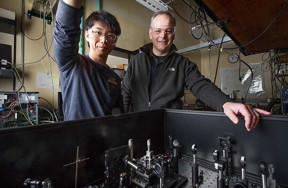 |
| NREL scientists Ye Yang and Matt Beard stand in front of a transient absorption spectrometer in their laser lab. |
Abstract:
Scientists at the Energy Department's National Renewable Energy Laboratory (NREL) discovered a use for perovskites that runs counter to the intended usage of the hybrid organic-inorganic material.
NREL discovery creates future opportunity in quantum computing: Research into perovskites looks beyond material's usage for efficient solar cells
Golden, CO | Posted on September 9th, 2016Considerable research at NREL and elsewhere has been conducted into the use of organic-inorganic hybrid perovskites as a solar cell. Perovskite systems have been shown to be highly efficient at converting sunlight to electricity. Experimenting on a lead-halide perovskite, NREL researchers found evidence the material could have great potential for optoelectronic applications beyond photovoltaics, including in the field of quantum computers.
Today, Nature Communications published the research, Large Polarization-Dependent Exciton Optical Stark Effect in Lead Iodide Perovskites. Authors of the paper are Ye Yang, Mengjin Yang, Kai Zhu, Justin Johnson, Joseph Berry, Jao van de Lagemaat, and Matthew Beard.
The discovery was made by accident, said Beard, and occurred while the researchers were investigating excitons in perovskites. The sample was illuminated with a short laser pulse whose wavelength was specifically tuned to avoid being absorbed by the sample. Instead, the exposure triggered a strong interaction of light with the perovskite, producing a shifted transition energy known as the optical Stark effect. The effect occurs in semiconductors, but typically can only be observed at extremely low temperatures in very high-quality, high-cost materials. NREL's scientists were able to observe the effect quite readily at room temperature in materials grown using solution processing.
The NREL researchers used the optical Stark effect to remove the degeneracy of the excitonic spin states within the perovskite sample. An electron can have either "up" or "down" spins, and electrons with opposite spins can occupy the same electronic state. Circularly polarized light can be used to only interact with one of the spin states, shifting its transition energy.
The optical Stark effect possesses promising applications, including the potential to be used as an ultrafast optical switch. In addition, the optical Stark effect can be used to control or address individual spin states, which is needed for spin-based quantum computing.
Additional research is needed. The researchers must demonstrate they can control the spin states and address whether the stability problems that have hampered the use of perovskites as solar cells also are a factor in this area.
Funds for the research came from the Energy Department's Office of Science.
####
About National Renewable Energy Laboratory
NREL is the U.S. Department of Energy's primary national laboratory for renewable energy and energy efficiency research and development. NREL is operated for the Energy Department by The Alliance for Sustainable Energy, LLC.
Visit NREL online at www.nrel.gov
For more information, please click here
Contacts:
David Glickson
303-275-4097
Copyright © National Renewable Energy Laboratory
If you have a comment, please Contact us.Issuers of news releases, not 7th Wave, Inc. or Nanotechnology Now, are solely responsible for the accuracy of the content.
Bookmark:


| Related Links |
| Related News Press |
News and information
 Quantum computer improves AI predictions April 17th, 2026
Flexible sensor gains sensitivity under pressure April 17th, 2026
A reusable chip for particulate matter sensing April 17th, 2026
Detecting vibrational quantum beating in the predissociation dynamics of SF6 using time-resolved photoelectron spectroscopy April 17th, 2026
Physics
UC Irvine physicists discover method to reverse ‘quantum scrambling’ : The work addresses the problem of information loss in quantum computing system April 17th, 2026
Quantum computers simulate fundamental physics: shedding light on the building blocks of nature June 6th, 2025
A 1960s idea inspires NBI researchers to study hitherto inaccessible quantum states June 6th, 2025
Laboratories
Researchers develop molecular qubits that communicate at telecom frequencies October 3rd, 2025
Govt.-Legislation/Regulation/Funding/Policy
Quantum computer improves AI predictions April 17th, 2026
Metasurfaces smooth light to boost magnetic sensing precision January 30th, 2026
New imaging approach transforms study of bacterial biofilms August 8th, 2025
Possible Futures
A fundamentally new therapeutic approach to cystic fibrosis: Nanobody repairs cellular defect April 17th, 2026
UC Irvine physicists discover method to reverse ‘quantum scrambling’ : The work addresses the problem of information loss in quantum computing system April 17th, 2026
Spintronics
Quantum materials: Electron spin measured for the first time June 9th, 2023
Chip Technology
A reusable chip for particulate matter sensing April 17th, 2026
Metasurfaces smooth light to boost magnetic sensing precision January 30th, 2026
Quantum Computing
Quantum computer improves AI predictions April 17th, 2026
UC Irvine physicists discover method to reverse ‘quantum scrambling’ : The work addresses the problem of information loss in quantum computing system April 17th, 2026
Researchers develop molecular qubits that communicate at telecom frequencies October 3rd, 2025
Discoveries
Quantum computer improves AI predictions April 17th, 2026
Flexible sensor gains sensitivity under pressure April 17th, 2026
A reusable chip for particulate matter sensing April 17th, 2026
Detecting vibrational quantum beating in the predissociation dynamics of SF6 using time-resolved photoelectron spectroscopy April 17th, 2026
Materials/Metamaterials/Magnetoresistance
First real-time observation of two-dimensional melting process: Researchers at Mainz University unveil new insights into magnetic vortex structures August 8th, 2025
Researchers unveil a groundbreaking clay-based solution to capture carbon dioxide and combat climate change June 6th, 2025
A 1960s idea inspires NBI researchers to study hitherto inaccessible quantum states June 6th, 2025
Institute for Nanoscience hosts annual proposal planning meeting May 16th, 2025
Announcements
A fundamentally new therapeutic approach to cystic fibrosis: Nanobody repairs cellular defect April 17th, 2026
UC Irvine physicists discover method to reverse ‘quantum scrambling’ : The work addresses the problem of information loss in quantum computing system April 17th, 2026
Interviews/Book Reviews/Essays/Reports/Podcasts/Journals/White papers/Posters
A fundamentally new therapeutic approach to cystic fibrosis: Nanobody repairs cellular defect April 17th, 2026
UC Irvine physicists discover method to reverse ‘quantum scrambling’ : The work addresses the problem of information loss in quantum computing system April 17th, 2026
Energy
Sensors innovations for smart lithium-based batteries: advancements, opportunities, and potential challenges August 8th, 2025
Simple algorithm paired with standard imaging tool could predict failure in lithium metal batteries August 8th, 2025
Solar/Photovoltaic
Spinel-type sulfide semiconductors to operate the next-generation LEDs and solar cells For solar-cell absorbers and green-LED source October 3rd, 2025
KAIST researchers introduce new and improved, next-generation perovskite solar cell November 8th, 2024
Groundbreaking precision in single-molecule optoelectronics August 16th, 2024
Development of zinc oxide nanopagoda array photoelectrode: photoelectrochemical water-splitting hydrogen production January 12th, 2024
 |
||
 |
||
| The latest news from around the world, FREE | ||
 |
||
|
|
||
| Premium Products | ||
 |
||
|
Only the news you want to read!
Learn More |
||
 |
||
|
Full-service, expert consulting
Learn More |
||
|
|
||