Home > Press > Beating the heat a challenge at the nanoscale: Rice University scientists detect thermal boundary that hinders ultracold experiments
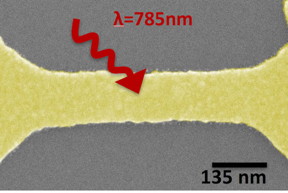 |
| Rice University scientists trying to measure the plasmonic properties of a gold nanowire (right) found the wire heated up a bit when illuminated by a laser at room temperature, but its temperature rose far more when illuminated in ultracold conditions. The effect called thermal boundary resistance (Rbd) blocks heat deposited in the gold (Q) from being dissipated by the substrate. Credit: Illustration by Pavlo Zolotavin/Rice University |
Abstract:
Rice University scientists who analyze the properties of materials as small as a single molecule have encountered a challenge that appears at very low temperatures.
Beating the heat a challenge at the nanoscale: Rice University scientists detect thermal boundary that hinders ultracold experiments
Houston, TX | Posted on July 28th, 2016In trying to measure the plasmonic properties of gold nanowires, the Rice lab of condensed matter physicist Douglas Natelson determined that at room temperature, the wire heated up a bit when illuminated by a laser; but confoundingly, at ultracold temperatures and under the same light, its temperature rose by far more.
This is an issue for scientists like Natelson whose experiments require ultracold materials to stay that way. Laser heating, while it may seem minimal, presents a thermal barrier to simultaneous inelastic electron tunneling spectroscopy and surface-enhanced optical spectroscopy, which measure a material's electrical and optical properties.
Their report on the phenomenon appears in the American Chemical Society journal ACS Nano.
"Over the years we've made nice progress doing electronic and optical measurements simultaneously on nanoscale junctions that contain one or a few molecules," Natelson said. "We could learn a lot more if we could extend those measurements to quite low temperatures; the features in the electronic conduction would sharpen up a lot."
But such optical measurements require lasers, which combine with the properties of the metal electrodes to focus optical energy down to scales below the diffraction limit of light. "The laser for the optical measurements tends to heat the system," he said. "This isn't too bad at moderately low temperatures, but as we show in the paper, direct optical heating can get much more severe when the sample, without the light on, is cooled down to a few kelvins."
In plasmonic materials, lasers excite the oscillating quasi-particles that ripple like waves in a pool when excited. Plasmonic materials are used to sense biological conditions and molecular interactions; they also are used as photodetectors and have been employed in cancer therapies to heat and destroy tumors.
For their experiments, Natelson and his colleagues placed bowtie-shaped gold nanowires on silicon, silicon oxide, sapphire or quartz surfaces with a 1-nanometer adhesive layer of titanium between. They fabricated and tested 90 such devices. At their narrowest, the wires were less than 100 nanometers wide, and the geometry was tuned to be appropriate for plasmonic excitation with near-infrared light at 785 nanometers.
The researchers took measurements for various laser strengths and surface temperatures. For the nanowire on silicon or silicon oxide, they found that as they decreased the temperature of the silicon from 60 kelvins (-351 degrees Fahrenheit) to 5 kelvins (-450 F), it became less able to dissipate heat from the nanowire. With no change in the strength of the laser, the temperature of the wire increased to 100 kelvins (-279 F).
Replacing the silicon with sapphire provided some relief, with a threefold decrease in the laser-driven temperature increase, they reported. This was a startling result as the thermal conductivity of sapphire is a thousand times higher than that of silicon oxide, said Pavlo Zolotavin, a Rice postdoctoral researcher and lead author of the paper. A comprehensive numerical model of the structure revealed thermal boundary resistance as a major source of the detrimental temperature increase, especially for the crystalline substrates.
"The big issue is in getting vibrational heat out of the metal and into the insulating substrate," he said. "It turns out that this thermal boundary resistance gets much worse at low temperatures. The consequence is that the local temperature can get jacked up a lot with a somewhat complicated dependence, which we can actually model well, on the incident light intensity."
Solving the problem is important to Natelson and his team, as they specialize in measuring the electrical and magnetic properties of single molecules by placing them in gaps cut into bowtie nanowires. If heat expands the nanowires, the gaps close and the experiments are ruined. Heating can also "smear out" features in the data, he said.
"What this all means is that we need to be clever about how we try to do simultaneous electronic and optical measurements, and that we need to think hard about what the temperature distribution looks like and how the heat really flows in these systems," Natelson said.
Co-authors are Rice postdoctoral researcher Alessandro Alabastri and Peter Nordlander, a Rice professor of physics and astronomy, of electrical and computer engineering and of materials science and nanoengineering. Natelson is a professor and chair of the Department of Physics and Astronomy and a professor of electrical and computer engineering and of materials science and nanoengineering.
The Robert A. Welch Foundation and the Air Force Office of Scientific Research supported the research.
####
About Rice University
Located on a 300-acre forested campus in Houston, Rice University is consistently ranked among the nation’s top 20 universities by U.S. News & World Report. Rice has highly respected schools of Architecture, Business, Continuing Studies, Engineering, Humanities, Music, Natural Sciences and Social Sciences and is home to the Baker Institute for Public Policy. With 3,910 undergraduates and 2,809 graduate students, Rice’s undergraduate student-to-faculty ratio is 6-to-1. Its residential college system builds close-knit communities and lifelong friendships, just one reason why Rice is ranked No. 1 for best quality of life and for lots of race/class interaction by the Princeton Review. Rice is also rated as a best value among private universities by Kiplinger’s Personal Finance. To read “What they’re saying about Rice,” go to tinyurl.com/RiceUniversityoverview.
Follow Rice News and Media Relations via Twitter @RiceUNews.
For more information, please click here
Contacts:
David Ruth
713-348-6327
Mike Williams
713-348-6728
Copyright © Rice University
If you have a comment, please Contact us.Issuers of news releases, not 7th Wave, Inc. or Nanotechnology Now, are solely responsible for the accuracy of the content.
Bookmark:


| Related Links |
 Nanoscale Views (Natelson blog):
Wiess School of Natural Sciences:
Nordlander Nanophotonics Group:
| Related News Press |
News and information
Quantum computer improves AI predictions April 17th, 2026
Flexible sensor gains sensitivity under pressure April 17th, 2026
A reusable chip for particulate matter sensing April 17th, 2026
Detecting vibrational quantum beating in the predissociation dynamics of SF6 using time-resolved photoelectron spectroscopy April 17th, 2026
Magnetism/Magnons
Metasurfaces smooth light to boost magnetic sensing precision January 30th, 2026
Researchers develop molecular qubits that communicate at telecom frequencies October 3rd, 2025
First real-time observation of two-dimensional melting process: Researchers at Mainz University unveil new insights into magnetic vortex structures August 8th, 2025
Magnetism in new exotic material opens the way for robust quantum computers June 4th, 2025
Govt.-Legislation/Regulation/Funding/Policy
Quantum computer improves AI predictions April 17th, 2026
Metasurfaces smooth light to boost magnetic sensing precision January 30th, 2026
New imaging approach transforms study of bacterial biofilms August 8th, 2025
Possible Futures
A fundamentally new therapeutic approach to cystic fibrosis: Nanobody repairs cellular defect April 17th, 2026
UC Irvine physicists discover method to reverse ‘quantum scrambling’ : The work addresses the problem of information loss in quantum computing system April 17th, 2026
Chip Technology
A reusable chip for particulate matter sensing April 17th, 2026
Metasurfaces smooth light to boost magnetic sensing precision January 30th, 2026
Nanoelectronics
Lab to industry: InSe wafer-scale breakthrough for future electronics August 8th, 2025
Interdisciplinary: Rice team tackles the future of semiconductors Multiferroics could be the key to ultralow-energy computing October 6th, 2023
Key element for a scalable quantum computer: Physicists from Forschungszentrum Jülich and RWTH Aachen University demonstrate electron transport on a quantum chip September 23rd, 2022
Reduced power consumption in semiconductor devices September 23rd, 2022
Discoveries
Quantum computer improves AI predictions April 17th, 2026
Flexible sensor gains sensitivity under pressure April 17th, 2026
A reusable chip for particulate matter sensing April 17th, 2026
Detecting vibrational quantum beating in the predissociation dynamics of SF6 using time-resolved photoelectron spectroscopy April 17th, 2026
Announcements
A fundamentally new therapeutic approach to cystic fibrosis: Nanobody repairs cellular defect April 17th, 2026
UC Irvine physicists discover method to reverse ‘quantum scrambling’ : The work addresses the problem of information loss in quantum computing system April 17th, 2026
Interviews/Book Reviews/Essays/Reports/Podcasts/Journals/White papers/Posters
A fundamentally new therapeutic approach to cystic fibrosis: Nanobody repairs cellular defect April 17th, 2026
UC Irvine physicists discover method to reverse ‘quantum scrambling’ : The work addresses the problem of information loss in quantum computing system April 17th, 2026
Military
Quantum engineers ‘squeeze’ laser frequency combs to make more sensitive gas sensors January 17th, 2025
Chainmail-like material could be the future of armor: First 2D mechanically interlocked polymer exhibits exceptional flexibility and strength January 17th, 2025
Single atoms show their true color July 5th, 2024
NRL charters Navy’s quantum inertial navigation path to reduce drift April 5th, 2024
Grants/Sponsored Research/Awards/Scholarships/Gifts/Contests/Honors/Records
Quantum computer improves AI predictions April 17th, 2026
Detecting vibrational quantum beating in the predissociation dynamics of SF6 using time-resolved photoelectron spectroscopy April 17th, 2026
Metasurfaces smooth light to boost magnetic sensing precision January 30th, 2026
Photonics/Optics/Lasers
Metasurfaces smooth light to boost magnetic sensing precision January 30th, 2026
From sensors to smart systems: the rise of AI-driven photonic noses January 30th, 2026
 |
||
 |
||
| The latest news from around the world, FREE | ||
 |
||
|
|
||
| Premium Products | ||
 |
||
|
Only the news you want to read!
Learn More |
||
 |
||
|
Full-service, expert consulting
Learn More |
||
|
|
||