Home > Press > Quantum drag:University of Iowa physicist says current in one iron magnetic sheet can create quantized spin waves in another, separate sheet
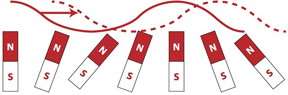 |
| This illustration shows how the magnetic fields of individual atoms, reimagined as bar magnets, change position like tiny compasses when heat or a current is applied to a solid material. The repositioning creates a spin wave, shown by the dotted line. These spin waves are being studied for potential use in microelectronics.
Illustration courtesy of Michael Flatté laboratory. |
Abstract:
Friction and drag are commonplace in nature. You experience these phenomena when riding in an airplane, pairing electrical wiring, or rubbing pieces of sandpaper together.
Quantum drag:University of Iowa physicist says current in one iron magnetic sheet can create quantized spin waves in another, separate sheet
Iowa City, IA | Posted on July 22nd, 2016Friction and drag also exist at the quantum level, the realm of atoms and molecules invisible to the naked eye. But how these forces interact across materials and energy sources remain in doubt.
In a new study, University of Iowa theoretical physicist Michael Flatté proposes that a magnetic current flowing through a magnetic iron sheet will cause a current in a second, nearby magnetic iron sheet, even though the sheets aren't connected. The movement is created, Flatté and his team say, when electrons whose magnetic spin is disturbed by the current on the first sheet exert a force, through electromagnetic radiation, to create magnetic spin in the second sheet.
The findings may prove beneficial in the emerging field of spintronics, which seeks to channel the energy from spin waves generated by electrons to create smaller, more energy-efficient computers and electronic devices.
"It means there are more ways to manipulate through magnetic currents than we thought, and that's a good thing," says Flatté, senior author and team leader on the paper published June 9 in the journal Physical Review Letters.
Flatté has been studying how currents in magnetic materials might be used to build electronic circuits at the nanoscale, where dimensions are measured in billionths of a meter, or roughly 1/50,000 the width of a human hair. Scientists knew that an electrical current introduced in a wire will drag a current in another nearby wire. Flatté's team reasoned that the same effects may hold true for magnetic currents in magnetic layers.
In a magnetic substance, such as iron, each atom acts as a small, individual magnet. These atomic magnets tend to point in the same direction, like an array of tiny compasses fixated on a common magnetic point. But the slightest disturbance to the direction of just one of these atomic magnets throws the entire group into disarray: The collective magnetic strength in the group decreases. The smallest individual disturbance is called a magnon.
Flatté and his team report that a steady magnon current introduced into one iron magnetic layer will produce a magnon current in a second layer -- in the same plane of the layer but at an angle to the introduced current. They propose that the electron spins disturbed in the layer where the current was introduced engage in a sort of "cross talk" with spins in the other layer, exerting a force that drags the spins along for the ride.
"What's exciting is you get this response (in the layer with no introduced current), even though there's no physical connection between the layers," says Flatté, professor in the physics department and director of the Optical Science and Technology Center at the UI. "This is a physical reaction through electromagnetic radiation."
How electrons in one layer communicate and dictate action to electrons in a separate layer is somewhat bizarre.
Take electricity: When an electrical current flows in one wire, a mutual friction drags current in a nearby wire. At the quantum level, the physical dynamics appear to be different. Imagine that each electron in a solid has an internal bar magnet, a tiny compass of sorts. In a magnetic material, those internal bar magnets are aligned. When heat or a current is applied to the solid, the electrons' compasses get repositioned, creating a magnetic spin wave that ripples through the solid. In the theoretical case studied by Flatté, the disturbance to the solid excites magnons in one layer that then exert influence on the other layer, creating a spin wave in the other layer, even though it is physically separate.
"It turns out there is the same effect with spin waves," Flatté says.
###
Contributing authors include Tianyu Liu with the physics and astronomy department at the UI and Giovanni Vignale at the University of Missouri, Columbia.
The U.S. National Science Foundation funded the research through grants to the Center for Emergent Materials.
####
For more information, please click here
Contacts:
Richard Lewis
319-384-0012
Copyright © University of Iowa
If you have a comment, please Contact us.Issuers of news releases, not 7th Wave, Inc. or Nanotechnology Now, are solely responsible for the accuracy of the content.
Bookmark:


| Related Links |
| Related News Press |
News and information
 Quantum computer improves AI predictions April 17th, 2026
Flexible sensor gains sensitivity under pressure April 17th, 2026
A reusable chip for particulate matter sensing April 17th, 2026
Detecting vibrational quantum beating in the predissociation dynamics of SF6 using time-resolved photoelectron spectroscopy April 17th, 2026
Quantum Physics
Detecting vibrational quantum beating in the predissociation dynamics of SF6 using time-resolved photoelectron spectroscopy April 17th, 2026
Beyond silicon: Electronics at the scale of a single molecule January 30th, 2026
MXene nanomaterials enter a new dimension Multilayer nanomaterial: MXene flakes created at Drexel University show new promise as 1D scrolls January 30th, 2026
Magnetism/Magnons
Metasurfaces smooth light to boost magnetic sensing precision January 30th, 2026
Researchers develop molecular qubits that communicate at telecom frequencies October 3rd, 2025
Govt.-Legislation/Regulation/Funding/Policy
Quantum computer improves AI predictions April 17th, 2026
Metasurfaces smooth light to boost magnetic sensing precision January 30th, 2026
New imaging approach transforms study of bacterial biofilms August 8th, 2025
Possible Futures
A fundamentally new therapeutic approach to cystic fibrosis: Nanobody repairs cellular defect April 17th, 2026
UC Irvine physicists discover method to reverse ‘quantum scrambling’ : The work addresses the problem of information loss in quantum computing system April 17th, 2026
Spintronics
Quantum materials: Electron spin measured for the first time June 9th, 2023
Chip Technology
A reusable chip for particulate matter sensing April 17th, 2026
Metasurfaces smooth light to boost magnetic sensing precision January 30th, 2026
Nanoelectronics
Lab to industry: InSe wafer-scale breakthrough for future electronics August 8th, 2025
Interdisciplinary: Rice team tackles the future of semiconductors Multiferroics could be the key to ultralow-energy computing October 6th, 2023
Key element for a scalable quantum computer: Physicists from Forschungszentrum Jülich and RWTH Aachen University demonstrate electron transport on a quantum chip September 23rd, 2022
Reduced power consumption in semiconductor devices September 23rd, 2022
Discoveries
Quantum computer improves AI predictions April 17th, 2026
Flexible sensor gains sensitivity under pressure April 17th, 2026
A reusable chip for particulate matter sensing April 17th, 2026
Detecting vibrational quantum beating in the predissociation dynamics of SF6 using time-resolved photoelectron spectroscopy April 17th, 2026
Announcements
A fundamentally new therapeutic approach to cystic fibrosis: Nanobody repairs cellular defect April 17th, 2026
UC Irvine physicists discover method to reverse ‘quantum scrambling’ : The work addresses the problem of information loss in quantum computing system April 17th, 2026
Interviews/Book Reviews/Essays/Reports/Podcasts/Journals/White papers/Posters
A fundamentally new therapeutic approach to cystic fibrosis: Nanobody repairs cellular defect April 17th, 2026
UC Irvine physicists discover method to reverse ‘quantum scrambling’ : The work addresses the problem of information loss in quantum computing system April 17th, 2026
Research partnerships
Lab to industry: InSe wafer-scale breakthrough for future electronics August 8th, 2025
HKU physicists uncover hidden order in the quantum world through deconfined quantum critical points April 25th, 2025
Quantum nanoscience
Beyond silicon: Electronics at the scale of a single molecule January 30th, 2026
MXene nanomaterials enter a new dimension Multilayer nanomaterial: MXene flakes created at Drexel University show new promise as 1D scrolls January 30th, 2026
ICFO researchers overcome long-standing bottleneck in single photon detection with twisted 2D materials August 8th, 2025
 |
||
 |
||
| The latest news from around the world, FREE | ||
 |
||
|
|
||
| Premium Products | ||
 |
||
|
Only the news you want to read!
Learn More |
||
 |
||
|
Full-service, expert consulting
Learn More |
||
|
|
||