Home > Press > Graphene photodetectors: Thinking outside the 2-D box
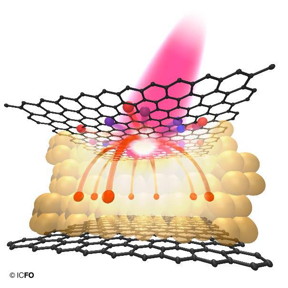 |
| Artistic view of the photo-thermionic effect in a graphene-WSe2-graphene heterostructure.
©ICFO| Fabien Vialla |
Abstract:
In a recent work published in Nature Communications, the research group led by ICREA Professor at ICFO Frank Koppens demonstrate a novel way to detect low-energy photons using vertical heterostructures made by stacking graphene and other 2D semiconducting materials. By studying the photoresponse of these atomically thin sandwiches, the researchers have shown that it is possible to generate a current by heating electrons in graphene with infrared light and extracting the hottest electrons over a vertical energy barrier.
Graphene photodetectors: Thinking outside the 2-D box
Barcelona, Spain | Posted on July 21st, 2016This ingenious mechanism, named photo-thermionic effect, takes advantage of the unique optical properties of graphene such as its broadband absorption, ultrafast response and gate-tunability. Moreover, owing to their vertical geometry, devices relying on this effect make use of the entire surface of graphene and can be potentially scaled up and integrated with flexible or rigid platforms.
More generally, this study reveals once again the amazing properties of these man-made heterostructures. According to Prof. Frank Koppens "this is just the tip of the iceberg, these 2D sandwiches still have a lot to reveal". ICFO researcher Mathieu Massicotte, first author of this study, emphasizes the new possibilities opened up by these new materials: "Everyone knows it is possible to detect light with graphene using in-plane geometries, but what about the out-of-plane direction? To answer, you need to think outside the 2D box!"
The results obtained from this study have shown that heterostructures made of 2D materials and graphene can be used to detect low-energy photons which could lead to new, fast and efficient optoelectronic applications, such as high-speed integrated communication systems and infrared energy harvesting. In addition, it demonstrates the compatibility of 2D materials with the digital chips currently utilized in cameras, paving the way for low cost infrared spectrometers and imaging systems.
###
Reference:
M. Massicotte, P. Schmidt,F. Vialla, K. Watanabe, T. Taniguchi, K. J. Tielrooij & F. H. L. Koppens, Photo-thermionic effect in vertical graphene heterostructures, Nature Communications 7, Article number: 12174 doi:10.1038/ncomms12174
####
About ICFO-The Institute of Photonic Sciences
ICFO-The Institute of Photonic Sciences was created in 2002 by the government of Catalonia and the Technical University of Catalonia as a centre of research excellence devoted to the science and technologies of light with a triple mission: to conduct frontier research, train the next generation of scientists, and provide knowledge and technology transfer. Today, it is one of the top research centres worldwide in its category as measured by international rankings.
Research at ICFO targets the forefront of science and technology based on light with programs directed at applications in Health, Renewable Energies, Information Technologies, Security and Industrial processes, among others. The institute hosts 300 professionals based in a dedicated building situated in the Mediterranean Technology Park in the metropolitan area of Barcelona.
ICFO participates in a large number of projects and international networks of excellence and is host to the NEST program which is financed by Fundación Privada Cellex Barcelona. Ground-breaking research in graphene is being carried out at ICFO and through key collaborative research partnerships such as the FET Graphene Flagship. ICREA Professor at ICFO and NEST Fellow Frank Koppens is the leader of the Optoelectonics work package within the Flagship program.
For more information, please click here
Contacts:
Alina Hirschmann
0034-935-542-246
Copyright © ICFO-The Institute of Photonic Sciences
If you have a comment, please Contact us.Issuers of news releases, not 7th Wave, Inc. or Nanotechnology Now, are solely responsible for the accuracy of the content.
Bookmark:


| Related Links |
 Research Group led by Prof Frank Koppens:
| Related News Press |
News and information
Quantum computer improves AI predictions April 17th, 2026
Flexible sensor gains sensitivity under pressure April 17th, 2026
A reusable chip for particulate matter sensing April 17th, 2026
Detecting vibrational quantum beating in the predissociation dynamics of SF6 using time-resolved photoelectron spectroscopy April 17th, 2026
2 Dimensional Materials
Flexible sensor gains sensitivity under pressure April 17th, 2026
MXene nanomaterials enter a new dimension Multilayer nanomaterial: MXene flakes created at Drexel University show new promise as 1D scrolls January 30th, 2026
ICFO researchers overcome long-standing bottleneck in single photon detection with twisted 2D materials August 8th, 2025
First real-time observation of two-dimensional melting process: Researchers at Mainz University unveil new insights into magnetic vortex structures August 8th, 2025
Imaging
Simple algorithm paired with standard imaging tool could predict failure in lithium metal batteries August 8th, 2025
Videos/Movies
ICFO researchers overcome long-standing bottleneck in single photon detection with twisted 2D materials August 8th, 2025
Graphene/ Graphite
Electrifying results shed light on graphene foam as a potential material for lab grown cartilage June 6th, 2025
Breakthrough in proton barrier films using pore-free graphene oxide: Kumamoto University researchers achieve new milestone in advanced coating technologies September 13th, 2024
Possible Futures
A fundamentally new therapeutic approach to cystic fibrosis: Nanobody repairs cellular defect April 17th, 2026
UC Irvine physicists discover method to reverse ‘quantum scrambling’ : The work addresses the problem of information loss in quantum computing system April 17th, 2026
Discoveries
Quantum computer improves AI predictions April 17th, 2026
Flexible sensor gains sensitivity under pressure April 17th, 2026
A reusable chip for particulate matter sensing April 17th, 2026
Detecting vibrational quantum beating in the predissociation dynamics of SF6 using time-resolved photoelectron spectroscopy April 17th, 2026
Materials/Metamaterials/Magnetoresistance
First real-time observation of two-dimensional melting process: Researchers at Mainz University unveil new insights into magnetic vortex structures August 8th, 2025
Researchers unveil a groundbreaking clay-based solution to capture carbon dioxide and combat climate change June 6th, 2025
A 1960s idea inspires NBI researchers to study hitherto inaccessible quantum states June 6th, 2025
Institute for Nanoscience hosts annual proposal planning meeting May 16th, 2025
Announcements
A fundamentally new therapeutic approach to cystic fibrosis: Nanobody repairs cellular defect April 17th, 2026
UC Irvine physicists discover method to reverse ‘quantum scrambling’ : The work addresses the problem of information loss in quantum computing system April 17th, 2026
Interviews/Book Reviews/Essays/Reports/Podcasts/Journals/White papers/Posters
A fundamentally new therapeutic approach to cystic fibrosis: Nanobody repairs cellular defect April 17th, 2026
UC Irvine physicists discover method to reverse ‘quantum scrambling’ : The work addresses the problem of information loss in quantum computing system April 17th, 2026
Photonics/Optics/Lasers
Metasurfaces smooth light to boost magnetic sensing precision January 30th, 2026
From sensors to smart systems: the rise of AI-driven photonic noses January 30th, 2026
 |
||
 |
||
| The latest news from around the world, FREE | ||
 |
||
|
|
||
| Premium Products | ||
 |
||
|
Only the news you want to read!
Learn More |
||
 |
||
|
Full-service, expert consulting
Learn More |
||
|
|
||