Home > Press > Harnessing solar and wind energy in one device could power the 'Internet of Things'
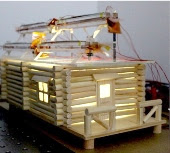 |
| Hybrid solar and wind harvesting cells on the top of this model house collect enough energy to light it up inside. Credit: American Chemical Society |
Abstract:
The "Internet of Things" could make cities "smarter" by connecting an extensive network of tiny communications devices to make life more efficient. But all these machines will require a lot of energy. Rather than adding to the global reliance on fossil fuels to power the network, researchers say they have a new solution. Their report on a single device that harvests wind and solar energy appears in the journal ACS Nano.
Harnessing solar and wind energy in one device could power the 'Internet of Things'
Washington, DC | Posted on May 26th, 2016Computer industry experts predict that tens of billions of gadgets will make up the Internet of Things within just five years, according to news reports. They'll be in homes, syncing coffee makers to alarm clocks. They'll be in buildings, managing lights and air temperature. But they'll also require energy to run. Sustainably generating more energy in cities close to where the devices will be used is challenging. Cities don't have much space for towering wind turbines, for example. Ya Yang, Zhong Lin Wang and colleagues wanted to find a better way to power smart cities.
For the first time, the researchers have integrated two energy harvesting technologies in one: a silicon solar cell and a nanogenerator that can convert wind energy into electrical output. The solar cell component of the system delivers 8 milliWatts of power output (1 milliWatt can light up 100 small LEDs). The wind harvesting component delivers up to 26 milliWatts. Together, under simulated sun and wind conditions, four devices on the roof of a model home could turn on the LEDs inside and power a temperature-humidity sensor. Installed in large numbers on real rooftops, the hybrid device could help enable smart cities.
###
The authors acknowledge funding from the Beijing Natural Science Foundation, the National Natural Science Foundation of China, External Cooperation Program of BIC, the Chinese Academy of Sciences, the 2015 Annual Beijing Talents Fund and China's Thousand Talents Program.
####
About American Chemical Society
The American Chemical Society is a nonprofit organization chartered by the U.S. Congress. With nearly 157,000 members, ACS is the world's largest scientific society and a global leader in providing access to chemistry-related research through its multiple databases, peer-reviewed journals and scientific conferences. Its main offices are in Washington, D.C., and Columbus, Ohio.
For more information, please click here
Contacts:
Michael Bernstein
202-872-6042
Ya Yang, Ph.D.
Beijing Institute of Nanoenergy and Nanosystems
Chinese Academy of Sciences
National Center for Nanoscience and Technology
Beijing, China
or
Zhong Lin Wang, Ph.D.
School of Materials Science and Engineering
Georgia Institute of Technology
Atlanta, GA 30332
Copyright © American Chemical Society
If you have a comment, please Contact us.Issuers of news releases, not 7th Wave, Inc. or Nanotechnology Now, are solely responsible for the accuracy of the content.
Bookmark:


| Related News Press |
News and information
 Quantum computer improves AI predictions April 17th, 2026
Flexible sensor gains sensitivity under pressure April 17th, 2026
A reusable chip for particulate matter sensing April 17th, 2026
Detecting vibrational quantum beating in the predissociation dynamics of SF6 using time-resolved photoelectron spectroscopy April 17th, 2026
Internet-of-Things
Nanofibrous metal oxide semiconductor for sensory face November 8th, 2024
New nanowire sensors are the next step in the Internet of Things January 6th, 2023
New chip ramps up AI computing efficiency August 19th, 2022
Lightening up the nanoscale long-wavelength optoelectronics May 13th, 2022
Govt.-Legislation/Regulation/Funding/Policy
Quantum computer improves AI predictions April 17th, 2026
Metasurfaces smooth light to boost magnetic sensing precision January 30th, 2026
New imaging approach transforms study of bacterial biofilms August 8th, 2025
Possible Futures
A fundamentally new therapeutic approach to cystic fibrosis: Nanobody repairs cellular defect April 17th, 2026
UC Irvine physicists discover method to reverse ‘quantum scrambling’ : The work addresses the problem of information loss in quantum computing system April 17th, 2026
Discoveries
Quantum computer improves AI predictions April 17th, 2026
Flexible sensor gains sensitivity under pressure April 17th, 2026
A reusable chip for particulate matter sensing April 17th, 2026
Detecting vibrational quantum beating in the predissociation dynamics of SF6 using time-resolved photoelectron spectroscopy April 17th, 2026
Announcements
A fundamentally new therapeutic approach to cystic fibrosis: Nanobody repairs cellular defect April 17th, 2026
UC Irvine physicists discover method to reverse ‘quantum scrambling’ : The work addresses the problem of information loss in quantum computing system April 17th, 2026
Interviews/Book Reviews/Essays/Reports/Podcasts/Journals/White papers/Posters
A fundamentally new therapeutic approach to cystic fibrosis: Nanobody repairs cellular defect April 17th, 2026
UC Irvine physicists discover method to reverse ‘quantum scrambling’ : The work addresses the problem of information loss in quantum computing system April 17th, 2026
Energy
Sensors innovations for smart lithium-based batteries: advancements, opportunities, and potential challenges August 8th, 2025
Simple algorithm paired with standard imaging tool could predict failure in lithium metal batteries August 8th, 2025
Solar/Photovoltaic
Spinel-type sulfide semiconductors to operate the next-generation LEDs and solar cells For solar-cell absorbers and green-LED source October 3rd, 2025
KAIST researchers introduce new and improved, next-generation perovskite solar cell November 8th, 2024
Groundbreaking precision in single-molecule optoelectronics August 16th, 2024
Development of zinc oxide nanopagoda array photoelectrode: photoelectrochemical water-splitting hydrogen production January 12th, 2024
 |
||
 |
||
| The latest news from around the world, FREE | ||
 |
||
|
|
||
| Premium Products | ||
 |
||
|
Only the news you want to read!
Learn More |
||
 |
||
|
Full-service, expert consulting
Learn More |
||
|
|
||