Home > Press > Self-healing, flexible electronic material restores functions after many breaks
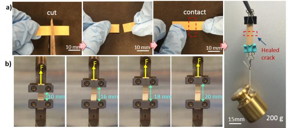 |
| Penn State researchers have developed a flexible electronic material that self-heals to restore many functions, even after multiple breaks. CREDIT: Qing Wang, Penn State |
Abstract:
Electronic materials have been a major stumbling block for the advance of flexible electronics because existing materials do not function well after breaking and healing. A new electronic material created by an international team, however, can heal all its functions automatically even after breaking multiple times. This material could improve the durability of wearable electronics.
Self-healing, flexible electronic material restores functions after many breaks
University Park, PA | Posted on May 17th, 2016"Wearable and bendable electronics are subject to mechanical deformation over time, which could destroy or break them," said Qing Wang, professor of materials science and engineering, Penn State. "We wanted to find an electronic material that would repair itself to restore all of its functionality, and do so after multiple breaks."
Self-healable materials are those that, after withstanding physical deformation such as being cut in half, naturally repair themselves with little to no external influence.
In the past, researchers have been able to create self-healable materials that can restore one function after breaking, but restoring a suite of functions is critical for creating effective wearable electronics. For example, if a dielectric material retains its electrical resistivity after self-healing but not its thermal conductivity, that could put electronics at risk of overheating.
The material that Wang and his team created restores all properties needed for use as a dielectric in wearable electronics -- mechanical strength, breakdown strength to protect against surges, electrical resistivity, thermal conductivity and dielectric, or insulating, properties. They published their findings online in Advanced Functional Materials.
Most self-healable materials are soft or "gum-like," said Wang, but the material he and his colleagues created is very tough in comparison. His team added boron nitride nanosheets to a base material of plastic polymer. Like graphene, boron nitride nanosheets are two dimensional, but instead of conducting electricity like graphene they resist and insulate against it.
"Most research into self-healable electronic materials has focused on electrical conductivity but dielectrics have been overlooked," said Wang. "We need conducting elements in circuits but we also need insulation and protection for microelectronics."
The material is able to self-heal because boron nitride nanosheets connect to one another with hydrogen bonding groups functionalized onto their surface. When two pieces are placed in close proximity, the electrostatic attraction naturally occurring between both bonding elements draws them close together. When the hydrogen bond is restored, the two pieces are "healed." Depending on the percentage of boron nitride nanosheets added to the polymer, this self-healing may require additional heat or pressure, but some forms of the new material can self-heal at room temperature when placed next to each other.
Unlike other healable materials that use hydrogen bonds, boron nitride nanosheets are impermeable to moisture. This means that devices using this dielectric material can operate effectively within high humidity contexts such as in a shower or at a beach. "This is the first time that a self-healable material has been created that can restore multiple properties over multiple breaks, and we see this being useful across many applications," said Wang.
###
Lixin Xing, Penn State and Harbin Institute of Technology; Qi Li, Guangzu Zhang, Xiaoshan Zhang and Feihua Liu, all at Penn State; and Li Liuand Yudong Huang, Harbin Institute of Technology, collaborated on this research.
The China Scholarship Council supported this research.
####
For more information, please click here
Contacts:
A'ndrea Elyse Messer
814-865-9481
Copyright © Penn State
If you have a comment, please Contact us.Issuers of news releases, not 7th Wave, Inc. or Nanotechnology Now, are solely responsible for the accuracy of the content.
Bookmark:


| Related News Press |
News and information
 Quantum computer improves AI predictions April 17th, 2026
Flexible sensor gains sensitivity under pressure April 17th, 2026
A reusable chip for particulate matter sensing April 17th, 2026
Detecting vibrational quantum beating in the predissociation dynamics of SF6 using time-resolved photoelectron spectroscopy April 17th, 2026
2 Dimensional Materials
Flexible sensor gains sensitivity under pressure April 17th, 2026
Flexible Electronics
Flexible sensor gains sensitivity under pressure April 17th, 2026
Hardware
The present and future of computing get a boost from new research July 21st, 2023
A Carbon Nanotube Microprocessor Mature Enough to Say Hello: Three new breakthroughs make commercial nanotube processors possible March 2nd, 2020
Powering the future: Smallest all-digital circuit opens doors to 5 nm next-gen semiconductor February 11th, 2020
Govt.-Legislation/Regulation/Funding/Policy
Quantum computer improves AI predictions April 17th, 2026
Metasurfaces smooth light to boost magnetic sensing precision January 30th, 2026
New imaging approach transforms study of bacterial biofilms August 8th, 2025
Possible Futures
A fundamentally new therapeutic approach to cystic fibrosis: Nanobody repairs cellular defect April 17th, 2026
UC Irvine physicists discover method to reverse ‘quantum scrambling’ : The work addresses the problem of information loss in quantum computing system April 17th, 2026
Chip Technology
A reusable chip for particulate matter sensing April 17th, 2026
Metasurfaces smooth light to boost magnetic sensing precision January 30th, 2026
Nanoelectronics
Lab to industry: InSe wafer-scale breakthrough for future electronics August 8th, 2025
Interdisciplinary: Rice team tackles the future of semiconductors Multiferroics could be the key to ultralow-energy computing October 6th, 2023
Key element for a scalable quantum computer: Physicists from Forschungszentrum Jülich and RWTH Aachen University demonstrate electron transport on a quantum chip September 23rd, 2022
Reduced power consumption in semiconductor devices September 23rd, 2022
Discoveries
Quantum computer improves AI predictions April 17th, 2026
Flexible sensor gains sensitivity under pressure April 17th, 2026
A reusable chip for particulate matter sensing April 17th, 2026
Detecting vibrational quantum beating in the predissociation dynamics of SF6 using time-resolved photoelectron spectroscopy April 17th, 2026
Announcements
A fundamentally new therapeutic approach to cystic fibrosis: Nanobody repairs cellular defect April 17th, 2026
UC Irvine physicists discover method to reverse ‘quantum scrambling’ : The work addresses the problem of information loss in quantum computing system April 17th, 2026
Interviews/Book Reviews/Essays/Reports/Podcasts/Journals/White papers/Posters
A fundamentally new therapeutic approach to cystic fibrosis: Nanobody repairs cellular defect April 17th, 2026
UC Irvine physicists discover method to reverse ‘quantum scrambling’ : The work addresses the problem of information loss in quantum computing system April 17th, 2026
 |
||
 |
||
| The latest news from around the world, FREE | ||
 |
||
|
|
||
| Premium Products | ||
 |
||
|
Only the news you want to read!
Learn More |
||
 |
||
|
Full-service, expert consulting
Learn More |
||
|
|
||