Home > Press > This 'nanocavity' may improve ultrathin solar panels, video cameras and more
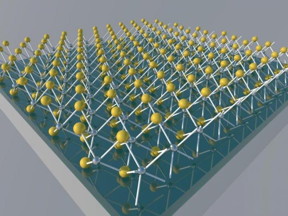 |
| This is an optical nanocavity made, from top to bottom, of molybdenum disulfide (MoS2), aluminum oxide and aluminum. CREDIT: University at Buffalo |
Abstract:
The future of movies and manufacturing may be in 3-D, but electronics and photonics are going 2-D; specifically, two-dimensional semiconducting materials.
This 'nanocavity' may improve ultrathin solar panels, video cameras and more
Buffalo, NY | Posted on May 16th, 2016One of the latest advancements in these fields centers on molybdenum disulfide (MoS2), a two-dimensional semiconductor that, while commonly used in lubricants and steel alloys, is still being explored in optoelectronics.
Recently, engineers placed a single layer of MoS2 molecules on top of a photonic structure called an optical nanocavity made of aluminum oxide and aluminum. (A nanocavity is an arrangement of mirrors that allows beams of light to circulate in closed paths. These cavities help us build things like lasers and optical fibers used for communications.)
The results, described in the paper "MoS2 monolayers on nanocavities: enhancement in light-matter interaction" published in April by the journal 2D Materials, are promising. The MoS2 nanocavity can increase the amount of light that ultrathin semiconducting materials absorb. In turn, this could help industry to continue manufacturing more powerful, efficient and flexible electronic devices.
"The nanocavity we have developed has many potential applications," says Qiaoqiang Gan, PhD, assistant professor of electrical engineering in the University at Buffalo's School of Engineering and Applied Sciences. "It could potentially be used to create more efficient and flexible solar panels, and faster photodetectors for video cameras and other devices. It may even be used to produce hydrogen fuel through water splitting more efficiently."
A single layer of MoS2 is advantageous because unlike another promising two-dimensional material, graphene, its bandgap structure is similar to semiconductors used in LEDs, lasers and solar cells.
"In experiments, the nanocavity was able to absorb nearly 70 percent of the laser we projected on it. Its ability to absorb light and convert that light into available energy could ultimately help industry continue to more energy-efficient electronic devices," said Haomin Song, a PhD candidate in Gan's lab and a co-lead researcher on the paper.
Industry has kept pace with the demand for smaller, thinner and more powerful optoelectronic devices, in part, by shrinking the size of the semiconductors used in these devices.
A problem for energy-harvesting optoelectronic devices, however, is that these ultrathin semiconductors do not absorb light as well as conventional bulk semiconductors. Therefore, there is an intrinsic tradeoff between the ultrathin semiconductors' optical absorption capacity and their thickness.
The nanocavity, described above, is a potential solution to this issue.
###
Zhiwen Liu, PhD, professor of electrical engineering at Penn State University Park, is the paper's other co-lead author. Additional authors include UB graduate students Haomin Song and Dengxin Ji; and Penn State University Park students Corey Janisch (also a co-lead researcher), Chanjing Zhou, Ana Laura Elias and Mauricio Terrones.
The research was supported by grants from the National Science Foundation, the U.S. Army Research Office and the U.S. Air Force Office of Scientific Research.
####
For more information, please click here
Contacts:
Cory Nealon
716-645-4614
Copyright © University at Buffalo
If you have a comment, please Contact us.Issuers of news releases, not 7th Wave, Inc. or Nanotechnology Now, are solely responsible for the accuracy of the content.
Bookmark:


| Related News Press |
News and information
 Quantum computer improves AI predictions April 17th, 2026
Flexible sensor gains sensitivity under pressure April 17th, 2026
A reusable chip for particulate matter sensing April 17th, 2026
Detecting vibrational quantum beating in the predissociation dynamics of SF6 using time-resolved photoelectron spectroscopy April 17th, 2026
2 Dimensional Materials
Flexible sensor gains sensitivity under pressure April 17th, 2026
ICFO researchers overcome long-standing bottleneck in single photon detection with twisted 2D materials August 8th, 2025
First real-time observation of two-dimensional melting process: Researchers at Mainz University unveil new insights into magnetic vortex structures August 8th, 2025
Lab to industry: InSe wafer-scale breakthrough for future electronics August 8th, 2025
Display technology/LEDs/SS Lighting/OLEDs
Spinel-type sulfide semiconductors to operate the next-generation LEDs and solar cells For solar-cell absorbers and green-LED source October 3rd, 2025
Graphene/ Graphite
Electrifying results shed light on graphene foam as a potential material for lab grown cartilage June 6th, 2025
Breakthrough in proton barrier films using pore-free graphene oxide: Kumamoto University researchers achieve new milestone in advanced coating technologies September 13th, 2024
Govt.-Legislation/Regulation/Funding/Policy
Quantum computer improves AI predictions April 17th, 2026
Metasurfaces smooth light to boost magnetic sensing precision January 30th, 2026
New imaging approach transforms study of bacterial biofilms August 8th, 2025
Possible Futures
A fundamentally new therapeutic approach to cystic fibrosis: Nanobody repairs cellular defect April 17th, 2026
UC Irvine physicists discover method to reverse ‘quantum scrambling’ : The work addresses the problem of information loss in quantum computing system April 17th, 2026
Discoveries
Quantum computer improves AI predictions April 17th, 2026
Flexible sensor gains sensitivity under pressure April 17th, 2026
A reusable chip for particulate matter sensing April 17th, 2026
Detecting vibrational quantum beating in the predissociation dynamics of SF6 using time-resolved photoelectron spectroscopy April 17th, 2026
Materials/Metamaterials/Magnetoresistance
First real-time observation of two-dimensional melting process: Researchers at Mainz University unveil new insights into magnetic vortex structures August 8th, 2025
Researchers unveil a groundbreaking clay-based solution to capture carbon dioxide and combat climate change June 6th, 2025
A 1960s idea inspires NBI researchers to study hitherto inaccessible quantum states June 6th, 2025
Institute for Nanoscience hosts annual proposal planning meeting May 16th, 2025
Announcements
A fundamentally new therapeutic approach to cystic fibrosis: Nanobody repairs cellular defect April 17th, 2026
UC Irvine physicists discover method to reverse ‘quantum scrambling’ : The work addresses the problem of information loss in quantum computing system April 17th, 2026
Interviews/Book Reviews/Essays/Reports/Podcasts/Journals/White papers/Posters
A fundamentally new therapeutic approach to cystic fibrosis: Nanobody repairs cellular defect April 17th, 2026
UC Irvine physicists discover method to reverse ‘quantum scrambling’ : The work addresses the problem of information loss in quantum computing system April 17th, 2026
Military
Quantum engineers ‘squeeze’ laser frequency combs to make more sensitive gas sensors January 17th, 2025
Chainmail-like material could be the future of armor: First 2D mechanically interlocked polymer exhibits exceptional flexibility and strength January 17th, 2025
Single atoms show their true color July 5th, 2024
NRL charters Navy’s quantum inertial navigation path to reduce drift April 5th, 2024
Energy
Sensors innovations for smart lithium-based batteries: advancements, opportunities, and potential challenges August 8th, 2025
Simple algorithm paired with standard imaging tool could predict failure in lithium metal batteries August 8th, 2025
Photonics/Optics/Lasers
Metasurfaces smooth light to boost magnetic sensing precision January 30th, 2026
From sensors to smart systems: the rise of AI-driven photonic noses January 30th, 2026
Solar/Photovoltaic
Spinel-type sulfide semiconductors to operate the next-generation LEDs and solar cells For solar-cell absorbers and green-LED source October 3rd, 2025
KAIST researchers introduce new and improved, next-generation perovskite solar cell November 8th, 2024
Groundbreaking precision in single-molecule optoelectronics August 16th, 2024
Development of zinc oxide nanopagoda array photoelectrode: photoelectrochemical water-splitting hydrogen production January 12th, 2024
 |
||
 |
||
| The latest news from around the world, FREE | ||
 |
||
|
|
||
| Premium Products | ||
 |
||
|
Only the news you want to read!
Learn More |
||
 |
||
|
Full-service, expert consulting
Learn More |
||
|
|
||