Home > Press > Atomically thin sensor detects harmful air pollution in the home
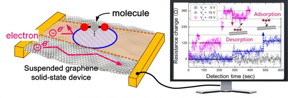 |
| A diagram of a graphene single molecular sensor (left) and the observed signal showing successful detection of single CO2 molecule adsorption / desorption events.
CREDIT: University of Southampton |
Abstract:
Scientists from the University of Southampton, in partnership with the Japan Advanced Institute of Science and Technology (JAIST), have developed a graphene-based sensor and switch that can detect harmful air pollution in the home with very low power consumption.
Atomically thin sensor detects harmful air pollution in the home
Southampton, UK | Posted on April 18th, 2016The sensor detects individual CO2 molecules and volatile organic compound (VOC) gas molecules found in building and interior materials, furniture and even household goods, which adversely affect our living in modern houses with good insulation.
These harmful chemical gases have low concentrations of ppb (parts per billion) levels and are extremely difficult to detect with current environmental sensor technology, which can only detect concentrations of parts per million (ppm).
In recent years, there has been an increase in health problems due to air pollution in personal living spaces, known as sick building syndrome (SBS), along with other conditions such as sick car and sick school syndromes.
The research group, led by Professor Hiroshi Mizuta, who holds a joint appointment at the University of Southampton and JAIST, and Dr Jian Sun and Assistant Professor Manoharan Muruganathan of JAIST, developed the sensor to detect individual CO2 molecules adsorbed (the bond of molecules from a gas to a surface) onto the suspended graphene (single atomic sheet of carbon atoms arranged in a honeycomb-like hexagonal crystal lattice structure) one by one by applying an electric field across the structure.
By monitoring the electrical resistance of the graphene beam, the adsorption and desorption (whereby a substance is released from or through a surface) processes of individual CO2 molecules onto the graphene were detected as 'quantised' changes in resistance (step-wise increase or decrease in resistance). In the study, published today in Science Advances, the journal of the American Association for the Advancement of Science (AAAS), a small volume of CO2 gas (equivalent to a concentration of approximately 30 ppb) was released and the detection time was only a few minutes.
Professor Mizuta said: "In contrast to the commercially available environmental monitoring tools, this extreme sensing technology enables us to realise significant miniaturisation, resulting in weight and cost reduction in addition to the remarkable improvement in the detection limit from the ppm levels to the ppb levels."
Research group members, Dr Harold Chong from Southampton and Dr Marek Schmidt and Dr Jian Sun of JAIST, have also recently developed graphene-based switches (published in the March issue of Nanoscale, the journal of the Royal Society of Chemistry) using a uniquely thin film developed at the University of Southampton.
The switches, which require remarkably low voltages (below three volts), can be used to power electronic components on demand, greatly improving the battery lifetime of personal electronic devices.
Professor Mizuta and the research group are now aiming to bring the two technologies together to create ultra-low-power environmental sensor systems that can detect single molecules.
####
For more information, please click here
Contacts:
Glenn Harris
44-023-805-93212
Copyright © University of Southampton
If you have a comment, please Contact us.Issuers of news releases, not 7th Wave, Inc. or Nanotechnology Now, are solely responsible for the accuracy of the content.
Bookmark:


| Related News Press |
News and information
 Quantum computer improves AI predictions April 17th, 2026
Flexible sensor gains sensitivity under pressure April 17th, 2026
A reusable chip for particulate matter sensing April 17th, 2026
Detecting vibrational quantum beating in the predissociation dynamics of SF6 using time-resolved photoelectron spectroscopy April 17th, 2026
2 Dimensional Materials
Flexible sensor gains sensitivity under pressure April 17th, 2026
MXene nanomaterials enter a new dimension Multilayer nanomaterial: MXene flakes created at Drexel University show new promise as 1D scrolls January 30th, 2026
ICFO researchers overcome long-standing bottleneck in single photon detection with twisted 2D materials August 8th, 2025
First real-time observation of two-dimensional melting process: Researchers at Mainz University unveil new insights into magnetic vortex structures August 8th, 2025
Thin films
Tiny nanosheets, big leap: A new sensor detects ethanol at ultra-low levels January 30th, 2026
Graphene/ Graphite
Electrifying results shed light on graphene foam as a potential material for lab grown cartilage June 6th, 2025
Breakthrough in proton barrier films using pore-free graphene oxide: Kumamoto University researchers achieve new milestone in advanced coating technologies September 13th, 2024
Possible Futures
A fundamentally new therapeutic approach to cystic fibrosis: Nanobody repairs cellular defect April 17th, 2026
UC Irvine physicists discover method to reverse ‘quantum scrambling’ : The work addresses the problem of information loss in quantum computing system April 17th, 2026
Sensors
Flexible sensor gains sensitivity under pressure April 17th, 2026
Tiny nanosheets, big leap: A new sensor detects ethanol at ultra-low levels January 30th, 2026
From sensors to smart systems: the rise of AI-driven photonic noses January 30th, 2026
Sensors innovations for smart lithium-based batteries: advancements, opportunities, and potential challenges August 8th, 2025
Discoveries
Quantum computer improves AI predictions April 17th, 2026
Flexible sensor gains sensitivity under pressure April 17th, 2026
A reusable chip for particulate matter sensing April 17th, 2026
Detecting vibrational quantum beating in the predissociation dynamics of SF6 using time-resolved photoelectron spectroscopy April 17th, 2026
Announcements
A fundamentally new therapeutic approach to cystic fibrosis: Nanobody repairs cellular defect April 17th, 2026
UC Irvine physicists discover method to reverse ‘quantum scrambling’ : The work addresses the problem of information loss in quantum computing system April 17th, 2026
Interviews/Book Reviews/Essays/Reports/Podcasts/Journals/White papers/Posters
A fundamentally new therapeutic approach to cystic fibrosis: Nanobody repairs cellular defect April 17th, 2026
UC Irvine physicists discover method to reverse ‘quantum scrambling’ : The work addresses the problem of information loss in quantum computing system April 17th, 2026
Environment
A reusable chip for particulate matter sensing April 17th, 2026
Researchers unveil a groundbreaking clay-based solution to capture carbon dioxide and combat climate change June 6th, 2025
 |
||
 |
||
| The latest news from around the world, FREE | ||
 |
||
|
|
||
| Premium Products | ||
 |
||
|
Only the news you want to read!
Learn More |
||
 |
||
|
Full-service, expert consulting
Learn More |
||
|
|
||