Home > Press > Crumpling approach enhances photodetectors' light responsivity
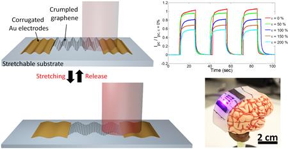 |
| Stretchable photodetector with enhanced, strain-tunable photoresponsivity was created by engineering the 2D graphene material into 3D structures, increasing the graphene’s areal density. Credit: University of Illinois College of Engineering |
Abstract:
Researchers from the University of Illinois at Urbana-Champaign have demonstrated a new approach to modifying the light absorption and stretchability of atomically thin two-dimensional (2D) materials by surface topographic engineering using only mechanical strain. The highly flexible system has future potential for wearable technology and integrated biomedical optical sensing technology when combined with flexible light-emitting diodes.
Crumpling approach enhances photodetectors' light responsivity
Posted on April 7th, 2016"Increasing graphene's low light absorption in visible range is an important prerequisite for its broad potential applications in photonics and sensing," explained SungWoo Nam, an assistant professor of mechanical science and engineering at Illinois. "This is the very first stretchable photodetector based exclusively on graphene with strain-tunable photoresponsivity and wavelength selectivity."
Graphene--an atomically thin layer of hexagonally bonded carbon atoms--has been extensively investigated in advanced photodetectors for its broadband absorption, high carrier mobility, and mechanical flexibility. Due to graphene's low optical absorptivity, graphene photodetector research so far has focused on hybrid systems to increase photoabsorption. However, such hybrid systems require a complicated integration process, and lead to reduced carrier mobility due to the heterogeneous interfaces.
According to Nam, the key element enabling increased absorption and stretchability requires engineering the two-dimensional material into three-dimensional (3D) "crumpled structures," increasing the graphene's areal density. The continuously undulating 3D surface induces an areal density increase to yield higher optical absorption per unit area, thereby improving photoresponsivity. Crumple density, height, and pitch are modulated by applied strain and the crumpling is fully reversible during cyclical stretching and release, introducing a new capability of strain-tunable photoabsorption enhancement and allowing for a highly responsive photodetector based on a single graphene layer.
"We achieved more than an order-of-magnitude enhancement of the optical extinction via the buckled 3D structure, which led to an approximately 400% enhancement in photoresponsivity," stated Pilgyu Kang, and first author of the paper, "Crumpled Graphene Photodetector with Enhanced, Strain-tunable and Wavelength-selective Photoresponsivity," appearing in the journal, Advanced Materials. "The new strain-tunable photoresponsivity resulted in a 100% modulation in photoresponsivity with a 200% applied strain. By integrating colloidal photonic crystal--a strain-tunable optomechanical filter--with the stretchable graphene photodetector, we also demonstrated a unique strain-tunable wavelength selectivity."
"This work demonstrates a robust approach for stretchable and flexible graphene photodetector devices," Nam added. "We are the first to report a stretchable photodetector with stretching capability to 200% of its original length and no limit on detection wavelength. Furthermore, our approach to enhancing photoabsorption by crumpled structures can be applied not only to graphene, but also to other emerging 2D materials."
###
In addition to Nam and Kang, study co-authors include Michael Cai Wang and Peter M. Knapp in the Department of Mechanical Science and Engineering at Illinois. The optical characterizations and partial device fabrication were carried out in the Frederick Seitz Materials Research Laboratory and the Micro and Nano Technology Laboratory at Illinois.
####
For more information, please click here
Contacts:
SungWoo Nam
217-300-0267
Copyright © University of Illinois College of Engineering
If you have a comment, please Contact us.Issuers of news releases, not 7th Wave, Inc. or Nanotechnology Now, are solely responsible for the accuracy of the content.
Bookmark:


| Related Links |
| Related News Press |
News and information
 Quantum computer improves AI predictions April 17th, 2026
Flexible sensor gains sensitivity under pressure April 17th, 2026
A reusable chip for particulate matter sensing April 17th, 2026
Detecting vibrational quantum beating in the predissociation dynamics of SF6 using time-resolved photoelectron spectroscopy April 17th, 2026
2 Dimensional Materials
Flexible sensor gains sensitivity under pressure April 17th, 2026
Graphene/ Graphite
Electrifying results shed light on graphene foam as a potential material for lab grown cartilage June 6th, 2025
Breakthrough in proton barrier films using pore-free graphene oxide: Kumamoto University researchers achieve new milestone in advanced coating technologies September 13th, 2024
Possible Futures
A fundamentally new therapeutic approach to cystic fibrosis: Nanobody repairs cellular defect April 17th, 2026
UC Irvine physicists discover method to reverse ‘quantum scrambling’ : The work addresses the problem of information loss in quantum computing system April 17th, 2026
Sensors
Flexible sensor gains sensitivity under pressure April 17th, 2026
Tiny nanosheets, big leap: A new sensor detects ethanol at ultra-low levels January 30th, 2026
From sensors to smart systems: the rise of AI-driven photonic noses January 30th, 2026
Sensors innovations for smart lithium-based batteries: advancements, opportunities, and potential challenges August 8th, 2025
Discoveries
Quantum computer improves AI predictions April 17th, 2026
Flexible sensor gains sensitivity under pressure April 17th, 2026
A reusable chip for particulate matter sensing April 17th, 2026
Detecting vibrational quantum beating in the predissociation dynamics of SF6 using time-resolved photoelectron spectroscopy April 17th, 2026
Announcements
A fundamentally new therapeutic approach to cystic fibrosis: Nanobody repairs cellular defect April 17th, 2026
UC Irvine physicists discover method to reverse ‘quantum scrambling’ : The work addresses the problem of information loss in quantum computing system April 17th, 2026
Interviews/Book Reviews/Essays/Reports/Podcasts/Journals/White papers/Posters
A fundamentally new therapeutic approach to cystic fibrosis: Nanobody repairs cellular defect April 17th, 2026
UC Irvine physicists discover method to reverse ‘quantum scrambling’ : The work addresses the problem of information loss in quantum computing system April 17th, 2026
Photonics/Optics/Lasers
Metasurfaces smooth light to boost magnetic sensing precision January 30th, 2026
From sensors to smart systems: the rise of AI-driven photonic noses January 30th, 2026
 |
||
 |
||
| The latest news from around the world, FREE | ||
 |
||
|
|
||
| Premium Products | ||
 |
||
|
Only the news you want to read!
Learn More |
||
 |
||
|
Full-service, expert consulting
Learn More |
||
|
|
||