Home > Press > Researchers developed manufacturing method for batteries with organic electrode materials
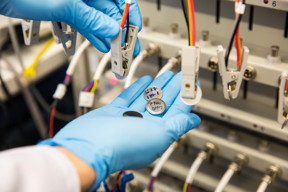 |
| Researchers tested the material on coin cells. CREDIT: Mikko Raskinen / Aalto University |
Abstract:
With people wanting to use smaller electronic devices, smaller energy storage systems are needed. Researchers of Aalto University in Finland have demonstrated the fabrication of electrochemically active organic lithium electrode thin films, which help make microbatteries more efficient than before. Researchers used a combined atomic/molecular layer deposition (ALD/MLD) technique, to prepare lithium terephthalate, a recently found anode material for a lithium-ion battery.
Researchers developed manufacturing method for batteries with organic electrode materials
Aalto, Finland | Posted on March 30th, 2016When microbatteries are manufatured, the key challenge is to make them able to store large amounts of energy in a small space. One way to improve the energy density is to manufacure the batteries based on three-dimensional microstructured architectures. This may increase the effective surface inside a battery- even dozens of times. However, the production of materials fit for these has proven to be very difficult.
- ALD is a great method for making battery materials fit for 3D microstructured architectures. Our method shows it is possible to even produce organic electrode materials by using ALD, which increases the opportunities to manufacture efficient microbatteries, says doctoral candidate Mikko Nisula from Aalto University.
The researchers' deposition process for Li-terephthalate is shown to comply well with the basic principles of ALD-type growth, including the sequential self-saturated surface reactions, which is a necessity when aiming at micro-lithium-ion devices with three-dimensional architectures. The as-deposited films are found to be crystalline across the deposition temperature range of 200?280 °C, which is a trait that is highly desired for an electrode material, but rather unusual for hybrid organic?inorganic thin films. An excellent rate capability is ascertained for the Li-terephthalate films, with no conductive additives required. The electrode performance can be further enhanced by depositing a thin protective LiPON solid-state electrolyte layer on top of Li-terephthalate. This yields highly stable structures with a capacity retention of over 97% after 200 charge/discharge cycles at 3.2 C.
The study about the method has now been published in the latest edition of Nano Letters.
####
For more information, please click here
Contacts:
Mikko Nisula
For more information:
Doctoral candidate
Mikko Nisula
Aalto University
Professor Maarit Karppinen
School of Chemical Technology
Aalto University
tel. +358 50 384 1726
Copyright © Aalto University
If you have a comment, please Contact us.Issuers of news releases, not 7th Wave, Inc. or Nanotechnology Now, are solely responsible for the accuracy of the content.
Bookmark:


| Related Links |
| Related News Press |
News and information
 Quantum computer improves AI predictions April 17th, 2026
Flexible sensor gains sensitivity under pressure April 17th, 2026
A reusable chip for particulate matter sensing April 17th, 2026
Detecting vibrational quantum beating in the predissociation dynamics of SF6 using time-resolved photoelectron spectroscopy April 17th, 2026
Thin films
Tiny nanosheets, big leap: A new sensor detects ethanol at ultra-low levels January 30th, 2026
Utilizing palladium for addressing contact issues of buried oxide thin film transistors April 5th, 2024
Understanding the mechanism of non-uniform formation of diamond film on tools: Paving the way to a dry process with less environmental impact March 24th, 2023
New study introduces the best graphite films: The work by Distinguished Professor Feng Ding at UNIST has been published in the October 2022 issue of Nature Nanotechnology November 4th, 2022
Discoveries
Quantum computer improves AI predictions April 17th, 2026
Flexible sensor gains sensitivity under pressure April 17th, 2026
A reusable chip for particulate matter sensing April 17th, 2026
Detecting vibrational quantum beating in the predissociation dynamics of SF6 using time-resolved photoelectron spectroscopy April 17th, 2026
Materials/Metamaterials/Magnetoresistance
First real-time observation of two-dimensional melting process: Researchers at Mainz University unveil new insights into magnetic vortex structures August 8th, 2025
Researchers unveil a groundbreaking clay-based solution to capture carbon dioxide and combat climate change June 6th, 2025
A 1960s idea inspires NBI researchers to study hitherto inaccessible quantum states June 6th, 2025
Institute for Nanoscience hosts annual proposal planning meeting May 16th, 2025
Announcements
A fundamentally new therapeutic approach to cystic fibrosis: Nanobody repairs cellular defect April 17th, 2026
UC Irvine physicists discover method to reverse ‘quantum scrambling’ : The work addresses the problem of information loss in quantum computing system April 17th, 2026
Interviews/Book Reviews/Essays/Reports/Podcasts/Journals/White papers/Posters
A fundamentally new therapeutic approach to cystic fibrosis: Nanobody repairs cellular defect April 17th, 2026
UC Irvine physicists discover method to reverse ‘quantum scrambling’ : The work addresses the problem of information loss in quantum computing system April 17th, 2026
Battery Technology/Capacitors/Generators/Piezoelectrics/Thermoelectrics/Energy storage
Decoding hydrogen‑bond network of electrolyte for cryogenic durable aqueous zinc‑ion batteries January 30th, 2026
COF scaffold membrane with gate‑lane nanostructure for efficient Li+/Mg2+ separation January 30th, 2026
MXene nanomaterials enter a new dimension Multilayer nanomaterial: MXene flakes created at Drexel University show new promise as 1D scrolls January 30th, 2026
 |
||
 |
||
| The latest news from around the world, FREE | ||
 |
||
|
|
||
| Premium Products | ||
 |
||
|
Only the news you want to read!
Learn More |
||
 |
||
|
Full-service, expert consulting
Learn More |
||
|
|
||