Home > Press > Engineering black gold, as light as the bones of birds
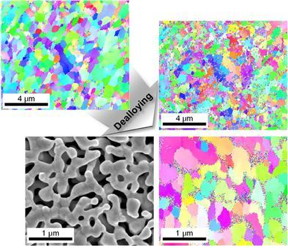 |
| These are SME images that show the formation of nanoporosity in free corrosion dealloying for gold samples. CREDIT: UNIST |
Abstract:
A team of Korean research team, led by Professor Ju-Young Kim (School of Materials Science and Engineering) of Ulsan National Institute of Science and Technology (UNIST), South Korea has recently announced that they have successfully developed a way to fabricate an ultralight, high-dense nanoporous gold (np-Au).
Engineering black gold, as light as the bones of birds
Ulsan, Korea | Posted on March 29th, 2016In a new paper, published in Nano Letters on March 22, the team reported that this newly developed material, which they have dubbed "Black Gold" is twice more solid and 30% lighter than standard gold.
According to Prof. Kim, "This particular nanoporous gold has a 100,000 times wider surface when compared to standard gold. Moreover, due to its chemically stablity, it is also harmless to humans."
The surfaces of np-Au are rough and the metal loses its shine and eventually turns black when they are at sizes less than 100 nanometres (nm). This is the reason that they are called "Black Gold".
In their study, the team investigated grain boundaries in nanocrystalline np-Au and found a way to overcome the weakening mechanisms of this material, thereby suggesting its usefulness.
The team used a ball milling technique to increase the flexural strength of the three gold-silver precursor alloys. Then, using free corrosion dealloying of silver from gold-silver alloys, they were able to achieve the nanoporous surface. According to the team, "The size of the pores can be controlled by the temperature and concentration of nitrate." Moreover, they also note that this crack-free nanoporous gold samples are reported to exhibit excellent durability in three-point bending tests.
Prof. Kim's team notes, "Ball-milled np-Au has a much greater density of two-dimensional defects than annealed and prestrained np-Au, where intergranular fracture is preferred." They continue, "Therefore, the probable existence of grain boundary opening in the highest tensile region is attributed to the flexural strength of np-Au."
They suggest that this newly developed technique can be also applied to many other metal, as the np-Au produced by this technique have shown increased strength and durability while still maintaining the good qualities of standard gold.
This means that this technique can be also used in other technologies, like catalytic-converting as observed by platinum, the automobile catalyst and palladium, the hydrogen sensor catalyst.
####
For more information, please click here
Contacts:
JooHyeon Heo
82-522-171-223
Copyright © Ulsan National Institute of Science and Technology (UNIST)
If you have a comment, please Contact us.Issuers of news releases, not 7th Wave, Inc. or Nanotechnology Now, are solely responsible for the accuracy of the content.
Bookmark:


| Related Links |
| Related News Press |
News and information
 Quantum computer improves AI predictions April 17th, 2026
Flexible sensor gains sensitivity under pressure April 17th, 2026
A reusable chip for particulate matter sensing April 17th, 2026
Detecting vibrational quantum beating in the predissociation dynamics of SF6 using time-resolved photoelectron spectroscopy April 17th, 2026
Chemistry
Projecting light to dispense liquids: A new route to ultra-precise microdroplets January 30th, 2026
From sensors to smart systems: the rise of AI-driven photonic noses January 30th, 2026
"Nanoreactor" cage uses visible light for catalytic and ultra-selective cross-cycloadditions October 3rd, 2025
Cambridge chemists discover simple way to build bigger molecules – one carbon at a time June 6th, 2025
Govt.-Legislation/Regulation/Funding/Policy
Quantum computer improves AI predictions April 17th, 2026
Metasurfaces smooth light to boost magnetic sensing precision January 30th, 2026
New imaging approach transforms study of bacterial biofilms August 8th, 2025
Possible Futures
A fundamentally new therapeutic approach to cystic fibrosis: Nanobody repairs cellular defect April 17th, 2026
UC Irvine physicists discover method to reverse ‘quantum scrambling’ : The work addresses the problem of information loss in quantum computing system April 17th, 2026
Sensors
Flexible sensor gains sensitivity under pressure April 17th, 2026
Tiny nanosheets, big leap: A new sensor detects ethanol at ultra-low levels January 30th, 2026
From sensors to smart systems: the rise of AI-driven photonic noses January 30th, 2026
Sensors innovations for smart lithium-based batteries: advancements, opportunities, and potential challenges August 8th, 2025
Materials/Metamaterials/Magnetoresistance
First real-time observation of two-dimensional melting process: Researchers at Mainz University unveil new insights into magnetic vortex structures August 8th, 2025
Researchers unveil a groundbreaking clay-based solution to capture carbon dioxide and combat climate change June 6th, 2025
A 1960s idea inspires NBI researchers to study hitherto inaccessible quantum states June 6th, 2025
Institute for Nanoscience hosts annual proposal planning meeting May 16th, 2025
Announcements
A fundamentally new therapeutic approach to cystic fibrosis: Nanobody repairs cellular defect April 17th, 2026
UC Irvine physicists discover method to reverse ‘quantum scrambling’ : The work addresses the problem of information loss in quantum computing system April 17th, 2026
Interviews/Book Reviews/Essays/Reports/Podcasts/Journals/White papers/Posters
A fundamentally new therapeutic approach to cystic fibrosis: Nanobody repairs cellular defect April 17th, 2026
UC Irvine physicists discover method to reverse ‘quantum scrambling’ : The work addresses the problem of information loss in quantum computing system April 17th, 2026
Automotive/Transportation
Decoding hydrogen‑bond network of electrolyte for cryogenic durable aqueous zinc‑ion batteries January 30th, 2026
Sensors innovations for smart lithium-based batteries: advancements, opportunities, and potential challenges August 8th, 2025
Simple algorithm paired with standard imaging tool could predict failure in lithium metal batteries August 8th, 2025
Grants/Sponsored Research/Awards/Scholarships/Gifts/Contests/Honors/Records
Quantum computer improves AI predictions April 17th, 2026
Detecting vibrational quantum beating in the predissociation dynamics of SF6 using time-resolved photoelectron spectroscopy April 17th, 2026
Metasurfaces smooth light to boost magnetic sensing precision January 30th, 2026
 |
||
 |
||
| The latest news from around the world, FREE | ||
 |
||
|
|
||
| Premium Products | ||
 |
||
|
Only the news you want to read!
Learn More |
||
 |
||
|
Full-service, expert consulting
Learn More |
||
|
|
||