Home > Press > Nanolight at the edge
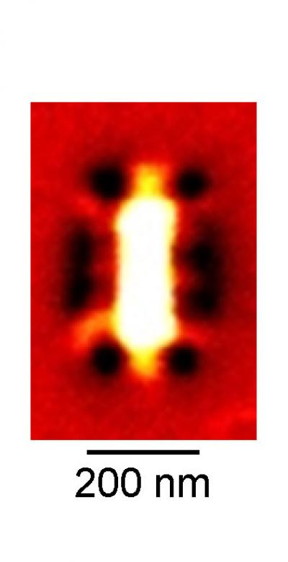 |
| Near-field image of a rectangle graphene nanoresonator. CREDIT: CIC nanoGUNE |
Abstract:
Researchers from CIC nanoGUNE, in collaboration with ICFO and Graphenea, have demonstrated how infrared light can be captured by nanostructures made of graphene. This happens when light couples to charge oscillations in the graphene. The resulting mixture of light and charge oscillations - called plasmon - can be squeezed into record-small volumes - millions times smaller than in conventional dielectric optical cavities. This process has been visualized by the researchers now, for the first time, with the help of a state-of the-art near-field microscope and explained by theory. Particularly, the researchers identified two types of plasmons - edge and sheet modes - propagating either along the sheet or along the sheet edges. The edge plasmons are unique for their ability to channel electromagnetic energy in one dimension. The work - funded by the EC Graphene Flagship and reported in Nature Photonics - opens new opportunities for ultra-small and efficient photodetectors, sensors and other photonic and optoelectronic nanodevices.
Nanolight at the edge
San Sebastian, Spain | Posted on March 22nd, 2016Graphene-based technologies enable extremely small optical nanodevices. The wavelength of light captured by a graphene sheet - a monolayer sheet of carbon atoms can be shortened by a factor of 100 compared to light propagating in free space. As a consequence, this light propagating along the graphene sheet - called graphene plasmon - requires much less space. For that reason, photonic devices can be made much smaller. The plasmonic field concentration can be further enhanced by fabricating graphene nanostructures acting as nanoresonators for the plasmons. The enhanced field have been already applied for enhanced infrared and terahertz photodetection or infrared vibrational sensing of molecules, among others.
"The development of efficient devices based on plasmonic graphene nanoresonators will critically depend on precise understanding and control of the plasmonic modes inside them" says Dr. Pablo Alonso-Gonzalez, (now at Oviedo University) who performed the real-space imaging of the graphene nanoresonators (disks and rectangles) with a near-field microscope. "We have been strongly impressed by the diversity of plasmonic contrasts observed in the near-field images" continues Dr. Alexey Nikitin, Ikerbasque Research Fellow at nanoGUNE, who developed the theory to identify the individual plasmon modes.
The research team has disentangled the individual plasmonic modes and separated them into two different classes. The first class of plasmons - "sheet plasmons" - can exist "inside" graphene nanostructures, extending over the whole area of graphene. Conversely, the second class of plasmons - "edge plasmons" -can exclusively propagate along the edges of graphene nanostructures, leading to whispering gallery modes in disk-shaped nanoresonators or Fabry-Perot resonances in graphene nanorectangles due to reflection at their corners. The edge plasmons are much better confined than the sheet plasmons and, most importantly, transfer the energy only in one dimension. The real-space images reveal dipolar edge modes with a mode volume that is 100 million times smaller that a cube of the free-space wavelength. The researchers also measured the dispersion (energy as a function of momentum) of the edge plasmons based on their near-field images, highlighting the shortened wavelength of edge plasmons compared to sheet plasmons. Thanks to their unique properties, edge plasmons could be a promising platform for coupling quantum dots or single molecules in future quantum opto-electronic devices.
"Our results also provide novel insights into the physics of near-field microscopy of graphene plasmons, which could be very useful for interpreting near-field images of other light-matter interactions in two-dimensional materials", adds Ikerbasque Research Professor Rainer Hillenbrand who led the project.
####
For more information, please click here
Contacts:
Irati Kortabitarte
34-943-363-040
Copyright © Elhuyar Fundazioa
If you have a comment, please Contact us.Issuers of news releases, not 7th Wave, Inc. or Nanotechnology Now, are solely responsible for the accuracy of the content.
Bookmark:


| Related Links |
| Related News Press |
News and information
 Quantum computer improves AI predictions April 17th, 2026
Flexible sensor gains sensitivity under pressure April 17th, 2026
A reusable chip for particulate matter sensing April 17th, 2026
Detecting vibrational quantum beating in the predissociation dynamics of SF6 using time-resolved photoelectron spectroscopy April 17th, 2026
Imaging
Simple algorithm paired with standard imaging tool could predict failure in lithium metal batteries August 8th, 2025
Physics
UC Irvine physicists discover method to reverse ‘quantum scrambling’ : The work addresses the problem of information loss in quantum computing system April 17th, 2026
Quantum computers simulate fundamental physics: shedding light on the building blocks of nature June 6th, 2025
A 1960s idea inspires NBI researchers to study hitherto inaccessible quantum states June 6th, 2025
Magnetism in new exotic material opens the way for robust quantum computers June 4th, 2025
Graphene/ Graphite
Electrifying results shed light on graphene foam as a potential material for lab grown cartilage June 6th, 2025
Possible Futures
A fundamentally new therapeutic approach to cystic fibrosis: Nanobody repairs cellular defect April 17th, 2026
UC Irvine physicists discover method to reverse ‘quantum scrambling’ : The work addresses the problem of information loss in quantum computing system April 17th, 2026
Optical computing/Photonic computing
ICFO researchers overcome long-standing bottleneck in single photon detection with twisted 2D materials August 8th, 2025
Programmable electron-induced color router array May 14th, 2025
Sensors
Flexible sensor gains sensitivity under pressure April 17th, 2026
Tiny nanosheets, big leap: A new sensor detects ethanol at ultra-low levels January 30th, 2026
From sensors to smart systems: the rise of AI-driven photonic noses January 30th, 2026
Sensors innovations for smart lithium-based batteries: advancements, opportunities, and potential challenges August 8th, 2025
Discoveries
Quantum computer improves AI predictions April 17th, 2026
Flexible sensor gains sensitivity under pressure April 17th, 2026
A reusable chip for particulate matter sensing April 17th, 2026
Detecting vibrational quantum beating in the predissociation dynamics of SF6 using time-resolved photoelectron spectroscopy April 17th, 2026
Materials/Metamaterials/Magnetoresistance
First real-time observation of two-dimensional melting process: Researchers at Mainz University unveil new insights into magnetic vortex structures August 8th, 2025
Researchers unveil a groundbreaking clay-based solution to capture carbon dioxide and combat climate change June 6th, 2025
A 1960s idea inspires NBI researchers to study hitherto inaccessible quantum states June 6th, 2025
Institute for Nanoscience hosts annual proposal planning meeting May 16th, 2025
Announcements
A fundamentally new therapeutic approach to cystic fibrosis: Nanobody repairs cellular defect April 17th, 2026
UC Irvine physicists discover method to reverse ‘quantum scrambling’ : The work addresses the problem of information loss in quantum computing system April 17th, 2026
Interviews/Book Reviews/Essays/Reports/Podcasts/Journals/White papers/Posters
A fundamentally new therapeutic approach to cystic fibrosis: Nanobody repairs cellular defect April 17th, 2026
UC Irvine physicists discover method to reverse ‘quantum scrambling’ : The work addresses the problem of information loss in quantum computing system April 17th, 2026
Tools
Metasurfaces smooth light to boost magnetic sensing precision January 30th, 2026
From sensors to smart systems: the rise of AI-driven photonic noses January 30th, 2026
Japan launches fully domestically produced quantum computer: Expo visitors to experience quantum computing firsthand August 8th, 2025
Photonics/Optics/Lasers
Metasurfaces smooth light to boost magnetic sensing precision January 30th, 2026
From sensors to smart systems: the rise of AI-driven photonic noses January 30th, 2026
Research partnerships
Lab to industry: InSe wafer-scale breakthrough for future electronics August 8th, 2025
HKU physicists uncover hidden order in the quantum world through deconfined quantum critical points April 25th, 2025
 |
||
 |
||
| The latest news from around the world, FREE | ||
 |
||
|
|
||
| Premium Products | ||
 |
||
|
Only the news you want to read!
Learn More |
||
 |
||
|
Full-service, expert consulting
Learn More |
||
|
|
||