Home > Press > Experiment shows magnetic chips could dramatically increase computing's energy efficiency
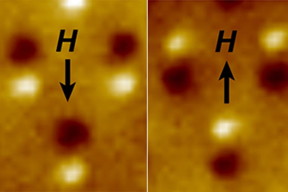 |
| Magnetic microscope image of three nanomagnetic computer bits. Each bit is a tiny bar magnet only 90 nanometers long. The microscope shows a bright spot at the "North" end and a dark spot at the "South" end of the magnet. The "H" arrow shows the direction of magnetic field applied to switch the direction of the magnets.
Image by Jeongmin Hong and Jeffrey Bokor |
Abstract:
In a breakthrough for energy-efficient computing, engineers at the University of California, Berkeley, have shown for the first time that magnetic chips can operate with the lowest fundamental level of energy dissipation possible under the laws of thermodynamics.
Experiment shows magnetic chips could dramatically increase computing's energy efficiency
Berkeley, CA | Posted on March 13th, 2016The findings, to be published Friday, March 11, 2016 in the peer-reviewed journal Science Advances, mean that dramatic reductions in power consumption are possible -- as much as one-millionth the amount of energy per operation used by transistors in modern computers.
This is critical for mobile devices, which demand powerful processors that can run for a day or more on small, lightweight batteries. On a larger, industrial scale, as computing increasingly moves into 'the cloud,' the electricity demands of the giant cloud data centers are multiplying, collectively taking an increasing share of the country's -- and world's -- electrical grid.
"We wanted to know how small we could shrink the amount of energy needed for computing," said senior author Jeffrey Bokor, a UC Berkeley professor of electrical engineering and computer sciences and a faculty scientist at the Lawrence Berkeley National Laboratory. "The biggest challenge in designing computers and, in fact, all our electronics today is reducing their energy consumption."
Lowering energy use is a relatively recent shift in focus in chip manufacturing after decades of emphasis on packing greater numbers of increasingly tiny and faster transistors onto chips.
"Making transistors go faster was requiring too much energy," said Bokor, who is also the deputy director the Center for Energy Efficient Electronics Science, a Science and Technology Center at UC Berkeley funded by the National Science Foundation. "The chips were getting so hot they'd just melt."
Researchers have been turning to alternatives to conventional transistors, which currently rely upon the movement of electrons to switch between 0s and 1s. Partly because of electrical resistance, it takes a fair amount of energy to ensure that the signal between the two states is clear and reliably distinguishable, and this results in excess heat.
Magnetic computing
Magnetic computing emerged as a promising candidate because the magnetic bits can be differentiated by direction, and it takes just as much energy to get the magnet to point left as it does to point right.
"These are two equal energy states, so we don't throw energy away creating a high and low energy," said Bokor.
Bokor teamed up with UC Berkeley postdoctoral researcher Jeongmin Hong, UC Berkeley graduate student Brian Lambson and Scott Dhuey at the Berkeley Lab's Molecular Foundry, where the nanomagnets used in the study were fabricated.
They experimentally tested and confirmed the Landauer limit, named after IBM Research Lab's Rolf Landauer, who in 1961 found that in any computer, each single bit operation must expend an absolute minimum amount of energy.
Landauer's discovery is based on the second law of thermodynamics, which states that as any physical system is transformed, going from a state of higher concentration to lower concentration, it gets increasingly disordered. That loss of order is called entropy, and it comes off as waste heat.
Landauer developed a formula to calculate this lowest limit of energy required for a computer operation. The result depends on the temperature of the computer; at room temperature, the limit amounts to about 3 zeptojoules, or one-hundredth the energy given up by a single atom when it emits one photon of light.
The UC Berkeley team used an innovative technique to measure the tiny amount of energy dissipation that resulted when they flipped a nanomagnetic bit. The researchers used a laser probe to carefully follow the direction that the magnet was pointing as an external magnetic field was used to rotate the magnet from "up" to "down" or vice versa.
They determined that it only took 15 millielectron volts of energy - the equivalent of 3 zeptojoules - to flip a magnetic bit at room temperature, effectively demonstrating the Landauer limit.
This is the first time that a practical memory bit could be manipulated and observed under conditions that would allow the Landauer limit to be reached, the authors said. Bokor and his team published a paper in 2011 that said this could theoretically be done, but it had not been demonstrated until now.
While this paper is a proof of principle, he noted that putting such chips into practical production will take more time. But the authors noted in the paper that "the significance of this result is that today's computers are far from the fundamental limit and that future dramatic reductions in power consumption are possible."
###
The National Science Foundation and the U.S. Department of Energy supported this research.
####
For more information, please click here
Contacts:
Sarah Yang
510-643-7741
Copyright © University of California, Berkeley
If you have a comment, please Contact us.Issuers of news releases, not 7th Wave, Inc. or Nanotechnology Now, are solely responsible for the accuracy of the content.
Bookmark:


| Related News Press |
News and information
 Quantum computer improves AI predictions April 17th, 2026
Flexible sensor gains sensitivity under pressure April 17th, 2026
A reusable chip for particulate matter sensing April 17th, 2026
Detecting vibrational quantum beating in the predissociation dynamics of SF6 using time-resolved photoelectron spectroscopy April 17th, 2026
Magnetism/Magnons
Metasurfaces smooth light to boost magnetic sensing precision January 30th, 2026
Researchers develop molecular qubits that communicate at telecom frequencies October 3rd, 2025
First real-time observation of two-dimensional melting process: Researchers at Mainz University unveil new insights into magnetic vortex structures August 8th, 2025
Magnetism in new exotic material opens the way for robust quantum computers June 4th, 2025
Govt.-Legislation/Regulation/Funding/Policy
Quantum computer improves AI predictions April 17th, 2026
Metasurfaces smooth light to boost magnetic sensing precision January 30th, 2026
New imaging approach transforms study of bacterial biofilms August 8th, 2025
Possible Futures
A fundamentally new therapeutic approach to cystic fibrosis: Nanobody repairs cellular defect April 17th, 2026
UC Irvine physicists discover method to reverse ‘quantum scrambling’ : The work addresses the problem of information loss in quantum computing system April 17th, 2026
Chip Technology
A reusable chip for particulate matter sensing April 17th, 2026
Metasurfaces smooth light to boost magnetic sensing precision January 30th, 2026
Discoveries
Quantum computer improves AI predictions April 17th, 2026
Flexible sensor gains sensitivity under pressure April 17th, 2026
A reusable chip for particulate matter sensing April 17th, 2026
Detecting vibrational quantum beating in the predissociation dynamics of SF6 using time-resolved photoelectron spectroscopy April 17th, 2026
Announcements
A fundamentally new therapeutic approach to cystic fibrosis: Nanobody repairs cellular defect April 17th, 2026
UC Irvine physicists discover method to reverse ‘quantum scrambling’ : The work addresses the problem of information loss in quantum computing system April 17th, 2026
Interviews/Book Reviews/Essays/Reports/Podcasts/Journals/White papers/Posters
A fundamentally new therapeutic approach to cystic fibrosis: Nanobody repairs cellular defect April 17th, 2026
UC Irvine physicists discover method to reverse ‘quantum scrambling’ : The work addresses the problem of information loss in quantum computing system April 17th, 2026
Energy
Sensors innovations for smart lithium-based batteries: advancements, opportunities, and potential challenges August 8th, 2025
Simple algorithm paired with standard imaging tool could predict failure in lithium metal batteries August 8th, 2025
Industrial
Tiny nanosheets, big leap: A new sensor detects ethanol at ultra-low levels January 30th, 2026
Quantum interference in molecule-surface collisions February 28th, 2025
Boron nitride nanotube fibers get real: Rice lab creates first heat-tolerant, stable fibers from wet-spinning process June 24th, 2022
 |
||
 |
||
| The latest news from around the world, FREE | ||
 |
||
|
|
||
| Premium Products | ||
 |
||
|
Only the news you want to read!
Learn More |
||
 |
||
|
Full-service, expert consulting
Learn More |
||
|
|
||