Home > Press > Atomic vibrations in nanomaterials
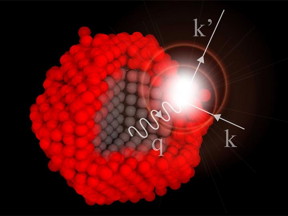 |
| Researchers at ETH have shown for the first time what happens to atomic vibrations when materials are nanosized and how this knowledge can be used to systematically engineer nanomaterials for different applications. Using both experiment, simulation, and theory, they explain how and why vibriations at the surface of a nanomaterial (q) can interact strongly with electrons (k and k'). CREDIT: Deniz Bozyigit / ETH Zurich |
Abstract:
All materials are made up of atoms, which vibrate. These vibrations, or 'phonons', are responsible, for example, for how electric charge and heat is transported in materials. Vibrations of metals, semiconductors, and insulators in are well studied; however, now materials are being nanosized to bring better performance to applications such as displays, sensors, batteries, and catalytic membranes. What happens to vibrations when a material is nanosized has until now not been understood.
Atomic vibrations in nanomaterials
Zurich, Switzerland | Posted on March 11th, 2016Soft Surfaces Vibrate Strongly
In a recent publication in Nature, ETH Professor Vanessa Wood and her colleagues explain what happens to atomic vibrations when materials are nanosized and how this knowledge can be used to systematically engineer nanomaterials for different applications.
The paper shows that when materials are made smaller than about 10 to 20 nanometers -- that is, 5,000 times thinner than a human air -- the vibrations of the outermost atomic layers on surface of the nanoparticle are large and play an important role in how this material behaves.
"For some applications, like catalysis, thermoelectrics, or superconductivity, these large vibrations may be good, but for other applications like LEDs or solar cells, these vibrations are undesirable," explains Wood.
Indeed, the paper explains why nanoparticle-based solar cells have until now not met their full promise. The researchers showed using both experiment and theory that surface vibrations interact with electrons to reduce the photocurrent in solar cells.
"Now that we have proven that surface vibrations are important, we can systematically design materials to suppress or enhance these vibrations," say Wood.
Improving Solar Cells
Wood's research group has worked for a long time on a particular type of nanomaterial -- colloidal nanocrystals -- semiconductors with a diameter of 2 to 10 nanometers. These materials are interesting because their optical and electrical properties are dependent on their size, which can be easily changed during their synthesis.
These materials are now used commercially as red- and green-light emitters in LED-based TVs and are being explored as possible materials for low cost, solution-processed solar cells. Researchers have noticed that placing certain atoms around the surface of the nanocrystal can improve the performance of solar cells. The reason why this worked had not been understood. The work published in the Nature paper now gives the answer: a hard shell of atoms can suppress the vibrations and their interaction with electrons. This means a higher photocurrent and a higher efficiency solar cell.
Big Science to Study the Nanoscale
Experiments were conducted in Professor Wood's labs at ETH Zurich and at the Swiss Spallation Neutron Source at the Paul Scherrer Institute. By observing how neutrons scatter off atoms in a material, it is possible to quantify how atoms in a material vibrate. To understand the neutron measurements, simulations of the atomic vibrations were run at the Swiss National Supercomputing Center (CSCS) in Lugano. Wood says, "without access to these large facilities, this work would not have been possible. We are incredibly fortunate here in Switzerland to have these world class facilities."
####
For more information, please click here
Contacts:
Prof. Vanessa Wood
41-446-326-654
Copyright © ETH Zurich
If you have a comment, please Contact us.Issuers of news releases, not 7th Wave, Inc. or Nanotechnology Now, are solely responsible for the accuracy of the content.
Bookmark:


| Related Links |
| Related News Press |
News and information
 Quantum computer improves AI predictions April 17th, 2026
Flexible sensor gains sensitivity under pressure April 17th, 2026
A reusable chip for particulate matter sensing April 17th, 2026
Detecting vibrational quantum beating in the predissociation dynamics of SF6 using time-resolved photoelectron spectroscopy April 17th, 2026
Superconductivity
MXene nanomaterials enter a new dimension Multilayer nanomaterial: MXene flakes created at Drexel University show new promise as 1D scrolls January 30th, 2026
Chemistry
Projecting light to dispense liquids: A new route to ultra-precise microdroplets January 30th, 2026
From sensors to smart systems: the rise of AI-driven photonic noses January 30th, 2026
"Nanoreactor" cage uses visible light for catalytic and ultra-selective cross-cycloadditions October 3rd, 2025
Cambridge chemists discover simple way to build bigger molecules – one carbon at a time June 6th, 2025
Single-atom catalysts change spin state when boosted by a magnetic field June 4th, 2025
Display technology/LEDs/SS Lighting/OLEDs
Spinel-type sulfide semiconductors to operate the next-generation LEDs and solar cells For solar-cell absorbers and green-LED source October 3rd, 2025
Govt.-Legislation/Regulation/Funding/Policy
Quantum computer improves AI predictions April 17th, 2026
Metasurfaces smooth light to boost magnetic sensing precision January 30th, 2026
New imaging approach transforms study of bacterial biofilms August 8th, 2025
Possible Futures
A fundamentally new therapeutic approach to cystic fibrosis: Nanobody repairs cellular defect April 17th, 2026
UC Irvine physicists discover method to reverse ‘quantum scrambling’ : The work addresses the problem of information loss in quantum computing system April 17th, 2026
Chip Technology
A reusable chip for particulate matter sensing April 17th, 2026
Metasurfaces smooth light to boost magnetic sensing precision January 30th, 2026
Sensors
Flexible sensor gains sensitivity under pressure April 17th, 2026
Tiny nanosheets, big leap: A new sensor detects ethanol at ultra-low levels January 30th, 2026
From sensors to smart systems: the rise of AI-driven photonic noses January 30th, 2026
Sensors innovations for smart lithium-based batteries: advancements, opportunities, and potential challenges August 8th, 2025
Discoveries
Quantum computer improves AI predictions April 17th, 2026
Flexible sensor gains sensitivity under pressure April 17th, 2026
A reusable chip for particulate matter sensing April 17th, 2026
Detecting vibrational quantum beating in the predissociation dynamics of SF6 using time-resolved photoelectron spectroscopy April 17th, 2026
Materials/Metamaterials/Magnetoresistance
First real-time observation of two-dimensional melting process: Researchers at Mainz University unveil new insights into magnetic vortex structures August 8th, 2025
Researchers unveil a groundbreaking clay-based solution to capture carbon dioxide and combat climate change June 6th, 2025
A 1960s idea inspires NBI researchers to study hitherto inaccessible quantum states June 6th, 2025
Institute for Nanoscience hosts annual proposal planning meeting May 16th, 2025
Announcements
A fundamentally new therapeutic approach to cystic fibrosis: Nanobody repairs cellular defect April 17th, 2026
UC Irvine physicists discover method to reverse ‘quantum scrambling’ : The work addresses the problem of information loss in quantum computing system April 17th, 2026
Interviews/Book Reviews/Essays/Reports/Podcasts/Journals/White papers/Posters
A fundamentally new therapeutic approach to cystic fibrosis: Nanobody repairs cellular defect April 17th, 2026
UC Irvine physicists discover method to reverse ‘quantum scrambling’ : The work addresses the problem of information loss in quantum computing system April 17th, 2026
Energy
Sensors innovations for smart lithium-based batteries: advancements, opportunities, and potential challenges August 8th, 2025
Simple algorithm paired with standard imaging tool could predict failure in lithium metal batteries August 8th, 2025
Battery Technology/Capacitors/Generators/Piezoelectrics/Thermoelectrics/Energy storage
Decoding hydrogen‑bond network of electrolyte for cryogenic durable aqueous zinc‑ion batteries January 30th, 2026
COF scaffold membrane with gate‑lane nanostructure for efficient Li+/Mg2+ separation January 30th, 2026
MXene nanomaterials enter a new dimension Multilayer nanomaterial: MXene flakes created at Drexel University show new promise as 1D scrolls January 30th, 2026
Solar/Photovoltaic
Spinel-type sulfide semiconductors to operate the next-generation LEDs and solar cells For solar-cell absorbers and green-LED source October 3rd, 2025
KAIST researchers introduce new and improved, next-generation perovskite solar cell November 8th, 2024
Groundbreaking precision in single-molecule optoelectronics August 16th, 2024
Development of zinc oxide nanopagoda array photoelectrode: photoelectrochemical water-splitting hydrogen production January 12th, 2024
 |
||
 |
||
| The latest news from around the world, FREE | ||
 |
||
|
|
||
| Premium Products | ||
 |
||
|
Only the news you want to read!
Learn More |
||
 |
||
|
Full-service, expert consulting
Learn More |
||
|
|
||