Home > Press > Flexible and transparent pressure sensor
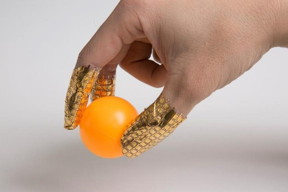 |
| The pressure sensors wrap around and conform to the shape of the fingers while still accurately measuring pressure distribution.
CREDIT: 2016 Someya Laboratory |
Abstract:
Healthcare practitioners may one day be able to physically screen for breast cancer using pressure-sensitive rubber gloves to detect tumors, owing to a transparent, bendable and sensitive pressure sensor newly developed by Japanese and American teams.
Flexible and transparent pressure sensor
Tokyo, Japan | Posted on January 25th, 2016Conventional pressure sensors are flexible enough to fit to soft surfaces such as human skin, but they cannot measure pressure changes accurately once they are twisted or wrinkled, making them unsuitable for use on complex and moving surfaces. Additionally, it is difficult to reduce them below 100 micrometers thickness because of limitations in current production methods.
To address these issues, an international team of researchers led by Dr. Sungwon Lee and Professor Takao Someya of the University of Tokyo's Graduate School of Engineering has developed a nanofiber-type pressure sensor that can measure pressure distribution of rounded surfaces such as an inflated balloon and maintain its sensing accuracy even when bent over a radius of 80 micrometers, equivalent to just twice the width of a human hair. The sensor is roughly 8 micrometers thick and can measure the pressure in 144 locations at once.
The device demonstrated in this study consists of organic transistors, electronic switches made from carbon and oxygen based organic materials, and a pressure sensitive nanofiber structure. Carbon nanotubes and graphene were added to an elastic polymer to create nanofibers with a diameter of 300 to 700 nanometers, which were then entangled with each other to form a transparent, thin and light porous structure.
"We've also tested the performance of our pressure sensor with an artificial blood vessel and found that it could detect small pressure changes and speed of pressure propagation," says Lee. He continues, "Flexible electronics have great potential for implantable and wearable devices. I realized that many groups are developing flexible sensors that can measure pressure but none of them are suitable for measuring real objects since they are sensitive to distortion. That was my main motivation and I think we have proposed an effective solution to this problem."
###
This work was conducted in collaboration with the research group of Professor Zhigang Suo at Harvard University, USA.
Collaborating institutions
Osaka University
Harvard University, USA
Funding
Japan Science and Technology Agency (JST) Exploratory Research for Advanced Technology (ERATO) Someya Bio-Harmonized Electronics Project
####
About University of Tokyo
The University of Tokyo is Japan's leading university and one of the world's top research universities. The vast research output of some 6,000 researchers is published in the world's top journals across the arts and sciences. Our vibrant student body of around 15,000 undergraduate and 15,000 graduate students includes over 2,000 international students. Find out more at www.u-tokyo.ac.jp/en/ or follow us on Twitter at @UTokyo_News_en.
For more information, please click here
Contacts:
Research contact
Professor Takao Someya
Department of Electrical Engineering and Information Systems
Graduate School of Engineering
The University of Tokyo, Hongo 7-3-1, Bunkyo-ku, Tokyo 113-8656, Japan
Tel: +81-3-5841-0411/6756
Fax: +81-3-5841-6709
Press officer contact
Graduate School of Engineering Public Relations Office
The University of Tokyo
The University of Tokyo, Hongo 7-3-1, Bunkyo-ku, Tokyo 113-8656, Japan
Tel: 03-5841-1790
Fax: 03-5841-0529
Copyright © University of Tokyo
If you have a comment, please Contact us.Issuers of news releases, not 7th Wave, Inc. or Nanotechnology Now, are solely responsible for the accuracy of the content.
Bookmark:


| Related Links |
 Graduate School of Engineering:
Someya Group Organic Transistor Lab:
ERATO Someya Bio-Harmonized Electronics Project:
| Related News Press |
News and information
Quantum computer improves AI predictions April 17th, 2026
Flexible sensor gains sensitivity under pressure April 17th, 2026
A reusable chip for particulate matter sensing April 17th, 2026
Detecting vibrational quantum beating in the predissociation dynamics of SF6 using time-resolved photoelectron spectroscopy April 17th, 2026
Cancer
New molecular technology targets tumors and simultaneously silences two ‘undruggable’ cancer genes August 8th, 2025
Ben-Gurion University of the Negev researchers several steps closer to harnessing patient's own T-cells to fight off cancer June 6th, 2025
Self-propelled protein-based nanomotors for enhanced cancer therapy by inducing ferroptosis June 6th, 2025
Robotics
Nanofibrous metal oxide semiconductor for sensory face November 8th, 2024
Femtosecond laser technique births "dancing microrobots": USTC's breakthrough in multi-material microfabrication August 11th, 2023
Govt.-Legislation/Regulation/Funding/Policy
Quantum computer improves AI predictions April 17th, 2026
Metasurfaces smooth light to boost magnetic sensing precision January 30th, 2026
New imaging approach transforms study of bacterial biofilms August 8th, 2025
Possible Futures
A fundamentally new therapeutic approach to cystic fibrosis: Nanobody repairs cellular defect April 17th, 2026
UC Irvine physicists discover method to reverse ‘quantum scrambling’ : The work addresses the problem of information loss in quantum computing system April 17th, 2026
Nanomedicine
A fundamentally new therapeutic approach to cystic fibrosis: Nanobody repairs cellular defect April 17th, 2026
New molecular technology targets tumors and simultaneously silences two ‘undruggable’ cancer genes August 8th, 2025
New imaging approach transforms study of bacterial biofilms August 8th, 2025
Electrifying results shed light on graphene foam as a potential material for lab grown cartilage June 6th, 2025
Discoveries
Quantum computer improves AI predictions April 17th, 2026
Flexible sensor gains sensitivity under pressure April 17th, 2026
A reusable chip for particulate matter sensing April 17th, 2026
Detecting vibrational quantum beating in the predissociation dynamics of SF6 using time-resolved photoelectron spectroscopy April 17th, 2026
Announcements
A fundamentally new therapeutic approach to cystic fibrosis: Nanobody repairs cellular defect April 17th, 2026
UC Irvine physicists discover method to reverse ‘quantum scrambling’ : The work addresses the problem of information loss in quantum computing system April 17th, 2026
Interviews/Book Reviews/Essays/Reports/Podcasts/Journals/White papers/Posters
A fundamentally new therapeutic approach to cystic fibrosis: Nanobody repairs cellular defect April 17th, 2026
UC Irvine physicists discover method to reverse ‘quantum scrambling’ : The work addresses the problem of information loss in quantum computing system April 17th, 2026
Grants/Sponsored Research/Awards/Scholarships/Gifts/Contests/Honors/Records
Quantum computer improves AI predictions April 17th, 2026
Detecting vibrational quantum beating in the predissociation dynamics of SF6 using time-resolved photoelectron spectroscopy April 17th, 2026
Metasurfaces smooth light to boost magnetic sensing precision January 30th, 2026
Research partnerships
Lab to industry: InSe wafer-scale breakthrough for future electronics August 8th, 2025
HKU physicists uncover hidden order in the quantum world through deconfined quantum critical points April 25th, 2025
 |
||
 |
||
| The latest news from around the world, FREE | ||
 |
||
|
|
||
| Premium Products | ||
 |
||
|
Only the news you want to read!
Learn More |
||
 |
||
|
Full-service, expert consulting
Learn More |
||
|
|
||