Home > Press > Graphene could take night-vision technology beyond 'Predator'
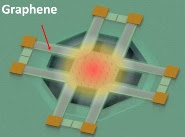 |
| A thermal sensor made out of graphene could lead to better night vision technology. Credit: American Chemical Society |
Abstract:
Movies such as 1987's "Predator," in which an alien who sees in the infrared hunts down Arnold Schwarzenegger and his team, introduced a generation of sci-fi fans to thermal imaging. Since then, heat-sensing devices have found many real-word applications but have remained relatively expensive and rigid. But a new development featuring graphene, reported in ACS' journal Nano Letters, could lead to a flexible, transparent and low-cost infrared vision system.
Graphene could take night-vision technology beyond 'Predator'
Washington, DC | Posted on November 4th, 2015The concept of humans -- or aliens -- having the power to see in the infrared to help fight enemies in the dark has been around for decades. Technology has allowed real-life military, police, firefighters and others to do their jobs successfully at night and in smoky conditions. It also helps manufacturers and building inspectors identify overheating equipment or circuits. But currently, many of these systems require cryogenic cooling to filter out background radiation, or "noise," and create a reliable image. This approach, however, complicates the design of these imaging devices, and adds to the cost and the unit's bulkiness. Tomás Palacios, Pablo Jarillo-Herrero and colleagues wanted to find a more practical solution.
The researchers integrated graphene with silicon microelectromechanical systems (known as MEMS) to make their device. Testing showed it could be used to detect a person's heat signature at room temperature without cryogenic cooling. In the future, advances could make the device even more versatile. The researchers say that a thermal sensor could be based on a single layer of graphene, which would make it transparent and flexible. Also, manufacturing could be simplified, which would bring costs down.
###
The authors acknowledge funding from the MIT/Army Institute for Soldier Nanotechnologies, the U.S. Army Research Laboratory, the Office of Naval Research, the Solid State Solar Thermal Energy Conversion Center (MIT), the MIT Center for Integrated Circuits and Systems, the Air Force Office of Scientific Research and the National Science Foundation.
####
About American Chemical Society
The American Chemical Society is a nonprofit organization chartered by the U.S. Congress. With more than 158,000 members, ACS is the world's largest scientific society and a global leader in providing access to chemistry-related research through its multiple databases, peer-reviewed journals and scientific conferences. Its main offices are in Washington, D.C., and Columbus, Ohio.
For more information, please click here
Contacts:
Michael Bernstein
202-872-6042
Tomás Palacios, Ph.D.
Department of Electrical Engineering and Computer Science
Massachusetts Institute of Technology
Cambridge, MA 02139
Pablo Jarillo-Herrero, Ph.D.
Department of Physics
Massachusetts Institute of Technology
Cambridge, MA 02139
Copyright © American Chemical Society
If you have a comment, please Contact us.Issuers of news releases, not 7th Wave, Inc. or Nanotechnology Now, are solely responsible for the accuracy of the content.
Bookmark:


| Related Links |
| Related News Press |
News and information
 Quantum computer improves AI predictions April 17th, 2026
Flexible sensor gains sensitivity under pressure April 17th, 2026
A reusable chip for particulate matter sensing April 17th, 2026
Detecting vibrational quantum beating in the predissociation dynamics of SF6 using time-resolved photoelectron spectroscopy April 17th, 2026
Imaging
Simple algorithm paired with standard imaging tool could predict failure in lithium metal batteries August 8th, 2025
Graphene/ Graphite
Electrifying results shed light on graphene foam as a potential material for lab grown cartilage June 6th, 2025
Breakthrough in proton barrier films using pore-free graphene oxide: Kumamoto University researchers achieve new milestone in advanced coating technologies September 13th, 2024
Govt.-Legislation/Regulation/Funding/Policy
Quantum computer improves AI predictions April 17th, 2026
Metasurfaces smooth light to boost magnetic sensing precision January 30th, 2026
New imaging approach transforms study of bacterial biofilms August 8th, 2025
Discoveries
Quantum computer improves AI predictions April 17th, 2026
Flexible sensor gains sensitivity under pressure April 17th, 2026
A reusable chip for particulate matter sensing April 17th, 2026
Detecting vibrational quantum beating in the predissociation dynamics of SF6 using time-resolved photoelectron spectroscopy April 17th, 2026
Announcements
A fundamentally new therapeutic approach to cystic fibrosis: Nanobody repairs cellular defect April 17th, 2026
UC Irvine physicists discover method to reverse ‘quantum scrambling’ : The work addresses the problem of information loss in quantum computing system April 17th, 2026
Interviews/Book Reviews/Essays/Reports/Podcasts/Journals/White papers/Posters
A fundamentally new therapeutic approach to cystic fibrosis: Nanobody repairs cellular defect April 17th, 2026
UC Irvine physicists discover method to reverse ‘quantum scrambling’ : The work addresses the problem of information loss in quantum computing system April 17th, 2026
Military
Quantum engineers ‘squeeze’ laser frequency combs to make more sensitive gas sensors January 17th, 2025
Chainmail-like material could be the future of armor: First 2D mechanically interlocked polymer exhibits exceptional flexibility and strength January 17th, 2025
Single atoms show their true color July 5th, 2024
NRL charters Navy’s quantum inertial navigation path to reduce drift April 5th, 2024
Grants/Sponsored Research/Awards/Scholarships/Gifts/Contests/Honors/Records
Quantum computer improves AI predictions April 17th, 2026
Detecting vibrational quantum beating in the predissociation dynamics of SF6 using time-resolved photoelectron spectroscopy April 17th, 2026
Metasurfaces smooth light to boost magnetic sensing precision January 30th, 2026
 |
||
 |
||
| The latest news from around the world, FREE | ||
 |
||
|
|
||
| Premium Products | ||
 |
||
|
Only the news you want to read!
Learn More |
||
 |
||
|
Full-service, expert consulting
Learn More |
||
|
|
||