Home > Press > Hot stuff: Magnetic domain walls - First measurement of the thermoelectric properties of a single magnetic domain wall
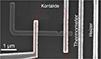 |
| Bent magnetic nanowire made of a nickel/iron alloy. The heating wire (right) generates a temperature difference between the electric contacts of the nanowire. If a magnetic wall is captured at the indentation, the thermoelectric voltage measured between the contacts changes. CREDIT: PTB |
Abstract:
Magnetic nanostructures - or rather: the interaction between charge, spin and current flow as a function of a temperature gradient in such structures - this is what the fast growing research area named "spin caloritronics" deals with. And this area of research has already come up with a number of newly discovered interesting effects and promising applications. Scientists from the Physikalisch-Technische Bundesanstalt (PTB) have, for the first time, succeeded in measuring the thermoelectric properties of a single magnetic domain wall. The results have been published in the current issue of the renowned scientific journal Physical Review B and have even been emphasized as an "Editors' Suggestion". Magnetic domain walls occur in all macroscopic and nanoscale magnetic materials and components. This is the reason why the fact that not only the magnetic and electric properties, but also - for the first time - the thermoelectric properties of these fundamental magnetic structures can be detected and described, is important for a whole series of applications.
Hot stuff: Magnetic domain walls - First measurement of the thermoelectric properties of a single magnetic domain wall
Braunschweig, Germany | Posted on October 15th, 2015As early as in 1821, physicist Thomas Johann Seebeck discovered that a temperature difference between the two ends of a metallic wire generates an electric voltage between the ends of this wire. Today, this so-called "Seebeck effect" is used, for example, in thermocouples to directly convert waste heat into electric energy. The size of the electric voltage generated hereby depends not only on the electric, but also on the magnetic properties of the material. Thus, in a ferromagnetic material (such as iron), the Seebeck coefficient changes when the magnetization is turned around in an external magnetic field. This behavior is also called the "magneto-Seebeck effect".
At PTB, the thermoelectric properties of single magnetic nanowires have now been investigated in detail for the first time. If, in a magnetic nanowire, two differently poled areas come into contact with each other, a magnetic domain wall occurs in the transition area. Hereby, the presence or absence of the domain wall manifests itself by a change in the electric resistance of the wire which can be measured via electric contacts.
The recent investigations have shown for the first time that the presence or absence of the domain wall also leads to a measurable change in the thermoelectric voltage generated by the wire. For this purpose, the experiments carried out consisted in heating one side of the wire with an electric heater and in measuring the Seebeck voltage via two contacts (see figure). An indentation in the wire allowed the scientists to capture exactly one single magnetic domain wall between the contacts and to determine the resulting difference in the Seebeck voltage. It turned out that the domain wall's magneto-Seebeck effect leads to an increase in the total thermoelectric voltage measured in the nanowire.
Magnetic domain walls occur in all macroscopic and nanoscale magnetic materials and components. The results, which have now been published, allowed not only the magnetic and electric properties, but also the thermoelectric properties of these fundamental magnetic structures to be detected and described.
####
For more information, please click here
Contacts:
Dr. Patryk Krzysteczko
49-053-159-22525
Copyright © Physikalisch-Technische Bundesanstalt (PTB)
If you have a comment, please Contact us.Issuers of news releases, not 7th Wave, Inc. or Nanotechnology Now, are solely responsible for the accuracy of the content.
Bookmark:


| Related Links |
| Related News Press |
News and information
 Quantum computer improves AI predictions April 17th, 2026
Flexible sensor gains sensitivity under pressure April 17th, 2026
A reusable chip for particulate matter sensing April 17th, 2026
Detecting vibrational quantum beating in the predissociation dynamics of SF6 using time-resolved photoelectron spectroscopy April 17th, 2026
Magnetism/Magnons
Metasurfaces smooth light to boost magnetic sensing precision January 30th, 2026
Researchers develop molecular qubits that communicate at telecom frequencies October 3rd, 2025
First real-time observation of two-dimensional melting process: Researchers at Mainz University unveil new insights into magnetic vortex structures August 8th, 2025
Magnetism in new exotic material opens the way for robust quantum computers June 4th, 2025
Chip Technology
A reusable chip for particulate matter sensing April 17th, 2026
Metasurfaces smooth light to boost magnetic sensing precision January 30th, 2026
Discoveries
Quantum computer improves AI predictions April 17th, 2026
Flexible sensor gains sensitivity under pressure April 17th, 2026
A reusable chip for particulate matter sensing April 17th, 2026
Detecting vibrational quantum beating in the predissociation dynamics of SF6 using time-resolved photoelectron spectroscopy April 17th, 2026
Announcements
A fundamentally new therapeutic approach to cystic fibrosis: Nanobody repairs cellular defect April 17th, 2026
UC Irvine physicists discover method to reverse ‘quantum scrambling’ : The work addresses the problem of information loss in quantum computing system April 17th, 2026
Interviews/Book Reviews/Essays/Reports/Podcasts/Journals/White papers/Posters
A fundamentally new therapeutic approach to cystic fibrosis: Nanobody repairs cellular defect April 17th, 2026
UC Irvine physicists discover method to reverse ‘quantum scrambling’ : The work addresses the problem of information loss in quantum computing system April 17th, 2026
Battery Technology/Capacitors/Generators/Piezoelectrics/Thermoelectrics/Energy storage
Decoding hydrogen‑bond network of electrolyte for cryogenic durable aqueous zinc‑ion batteries January 30th, 2026
COF scaffold membrane with gate‑lane nanostructure for efficient Li+/Mg2+ separation January 30th, 2026
MXene nanomaterials enter a new dimension Multilayer nanomaterial: MXene flakes created at Drexel University show new promise as 1D scrolls January 30th, 2026
 |
||
 |
||
| The latest news from around the world, FREE | ||
 |
||
|
|
||
| Premium Products | ||
 |
||
|
Only the news you want to read!
Learn More |
||
 |
||
|
Full-service, expert consulting
Learn More |
||
|
|
||