Home > Press > Rice news release: Smaller is better for nanotube analysis: Rice University's variance spectroscopy technique advances nanoparticle analysis
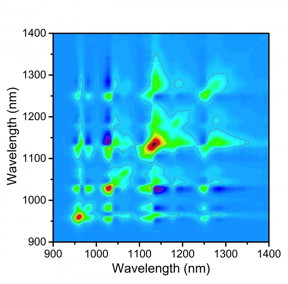 |
| A covariance matrix produced with a new technique at Rice University maps fluorescence signals from various species of single-walled carbon nanotubes that are beginning to aggregate in a sample. The matrix allows researchers to know which types of nanotubes (identified by their fluorescence spectra) have aggregated and in what amounts, in this case after four hours in solution. CREDIT: Weisman Lab/Rice University |
Abstract:
In a great example of "less is more," Rice University scientists have developed a powerful method to analyze carbon nanotubes in solution.
Rice news release: Smaller is better for nanotube analysis: Rice University's variance spectroscopy technique advances nanoparticle analysis
Houston, TX | Posted on September 30th, 2015The researchers' variance spectroscopy technique zooms in on small regions in dilute nanotube solutions to take quick spectral snapshots. By analyzing the composition of nanotubes in each snapshot and comparing the similarities and differences over a few thousand snapshots, the researchers gain new information about the types, numbers and properties of the nanoparticles in the solution.
The process is detailed in an open-access paper in the American Chemical Society's Journal of Physical Chemistry Letters this month.
Rice chemist Bruce Weisman, a pioneer in the field of spectroscopy who led the discovery and interpretation of near-infrared fluorescence from semiconducting carbon nanotubes, expects variance spectroscopy to become a valuable tool for researchers who study nanoscale materials.
Carbon nanotubes are hollow cylinders of pure carbon that are typically grown in a furnace. There are dozens of different types of nanotubes and the physical properties and potential uses vary for each type. There is no practical way yet to grow just one type, so they often need to be sorted by physical or chemical means. Weisman said variance spectroscopy could help characterize nanotube samples in the ongoing drive to sort and separate specific types for electronic and optical applications.
The Weisman lab tested its custom rig on dispersed samples of single-wall carbon nanotubes grown at Rice. The researchers captured fluorescence spectra from a few thousand distinct small regions. Statistical variations among these spectra revealed the numbers of nanotubes of different types and how strongly each type emits light. Further data analysis gave "dissected" spectra of each type, free of interference from others in the mixed sample.
"As we focus our attention on smaller and smaller volumes of the sample, the averaged-out, uniform behavior you see on the macroscopic scale starts to break down, and we see effects from the particulate nature of matter," he said.
"At that point, there are random fluctuations in the numbers of particles within the observed volume. What we're doing is analyzing the resulting random fluctuations in spectra to learn about how many particles of each type are present and whether they're aggregated with each other.
"An analogy might be looking at fans in a football stadium wearing their teams' colors," Weisman said. "If you stand way back and look at the whole crowd, all you can figure out is the overall ratio of Rice fans to Texas fans. But if you zoom in and analyze row by row, you're going to see clusters of Rice fans and clusters of Texas fans and learn how each group aggregates together. That gives you extra insights about the crowd that you could never get from the big view.
"It's similar with nanotubes," he said. "We look at a sample that has a variety of structures and learn more about the properties of individual components. It's a spectroscopic dissection of a complex mixture to get information that would be much more difficult to get with any other method."
Weisman said the technique also helps address nanotubes' annoying tendency to clump together. "When you're trying to use a separation method to sort them out, you can't do it effectively if they're stuck together," Weisman said. "If you want type A and they're stuck to type B, then you're wasting your separation effort. But variance spectroscopy provides a very sensitive way to tell whether particles of different types are actually traveling together."
Weisman expects variance spectroscopy can be extended to analyze many nanoscale materials, like gold nanoparticles and quantum dots, using different spectroscopic probes. "When you make nanomaterials, there is generally some variation in particle sizes that gives a corresponding variation in the spectral properties," he said. "Our variance method can be used with such systems to take a look inside."
###
Co-authors of the paper are Rice alumnus Jason Streit, research scientist Sergei Bachilo, and graduate students Stephen Sanchez and Ching-Wei Lin. Weisman is a professor of chemistry and of materials science and nanoengineering.
The National Science Foundation and the Welch Foundation supported the research.
####
About Rice University
Located on a 300-acre forested campus in Houston, Rice University is consistently ranked among the nation's top 20 universities by U.S. News & World Report. Rice has highly respected schools of Architecture, Business, Continuing Studies, Engineering, Humanities, Music, Natural Sciences and Social Sciences and is home to the Baker Institute for Public Policy. With 3,888 undergraduates and 2,610 graduate students, Rice's undergraduate student-to-faculty ratio is 6-to-1. Its residential college system builds close-knit communities and lifelong friendships, just one reason why Rice is ranked No. 1 for best quality of life and for lots of race/class interaction by the Princeton Review. Rice is also rated as a best value among private universities by Kiplinger's Personal Finance.
Follow Rice News and Media Relations via Twitter @RiceUNews
For more information, please click here
Contacts:
David Ruth
713-348-6327
Mike Williams
713-348-6728
Copyright © Rice University
If you have a comment, please Contact us.Issuers of news releases, not 7th Wave, Inc. or Nanotechnology Now, are solely responsible for the accuracy of the content.
Bookmark:


| Related Links |
 Read the open-access paper at:
Wiess School of Natural Sciences:
| Related News Press |
News and information
Quantum computer improves AI predictions April 17th, 2026
Flexible sensor gains sensitivity under pressure April 17th, 2026
A reusable chip for particulate matter sensing April 17th, 2026
Detecting vibrational quantum beating in the predissociation dynamics of SF6 using time-resolved photoelectron spectroscopy April 17th, 2026
Chemistry
Projecting light to dispense liquids: A new route to ultra-precise microdroplets January 30th, 2026
From sensors to smart systems: the rise of AI-driven photonic noses January 30th, 2026
"Nanoreactor" cage uses visible light for catalytic and ultra-selective cross-cycloadditions October 3rd, 2025
Cambridge chemists discover simple way to build bigger molecules – one carbon at a time June 6th, 2025
Govt.-Legislation/Regulation/Funding/Policy
Quantum computer improves AI predictions April 17th, 2026
Metasurfaces smooth light to boost magnetic sensing precision January 30th, 2026
New imaging approach transforms study of bacterial biofilms August 8th, 2025
Nanotubes/Buckyballs/Fullerenes/Nanorods/Nanostrings/Nanosheets
Tiny nanosheets, big leap: A new sensor detects ethanol at ultra-low levels January 30th, 2026
Enhancing power factor of p- and n-type single-walled carbon nanotubes April 25th, 2025
Chainmail-like material could be the future of armor: First 2D mechanically interlocked polymer exhibits exceptional flexibility and strength January 17th, 2025
Innovative biomimetic superhydrophobic coating combines repair and buffering properties for superior anti-erosion December 13th, 2024
Discoveries
Quantum computer improves AI predictions April 17th, 2026
Flexible sensor gains sensitivity under pressure April 17th, 2026
A reusable chip for particulate matter sensing April 17th, 2026
Detecting vibrational quantum beating in the predissociation dynamics of SF6 using time-resolved photoelectron spectroscopy April 17th, 2026
Announcements
A fundamentally new therapeutic approach to cystic fibrosis: Nanobody repairs cellular defect April 17th, 2026
UC Irvine physicists discover method to reverse ‘quantum scrambling’ : The work addresses the problem of information loss in quantum computing system April 17th, 2026
Interviews/Book Reviews/Essays/Reports/Podcasts/Journals/White papers/Posters
A fundamentally new therapeutic approach to cystic fibrosis: Nanobody repairs cellular defect April 17th, 2026
UC Irvine physicists discover method to reverse ‘quantum scrambling’ : The work addresses the problem of information loss in quantum computing system April 17th, 2026
Tools
Metasurfaces smooth light to boost magnetic sensing precision January 30th, 2026
From sensors to smart systems: the rise of AI-driven photonic noses January 30th, 2026
Japan launches fully domestically produced quantum computer: Expo visitors to experience quantum computing firsthand August 8th, 2025
Grants/Sponsored Research/Awards/Scholarships/Gifts/Contests/Honors/Records
Quantum computer improves AI predictions April 17th, 2026
Detecting vibrational quantum beating in the predissociation dynamics of SF6 using time-resolved photoelectron spectroscopy April 17th, 2026
Metasurfaces smooth light to boost magnetic sensing precision January 30th, 2026
 |
||
 |
||
| The latest news from around the world, FREE | ||
 |
||
|
|
||
| Premium Products | ||
 |
||
|
Only the news you want to read!
Learn More |
||
 |
||
|
Full-service, expert consulting
Learn More |
||
|
|
||