Home > Press > 'Seeing' molecular interactions could give boost to organic electronics
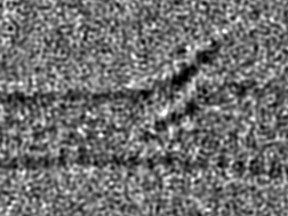 |
| High-resolution transmission electron microscopy can be used to visualize a certain type of organic molecular interaction at the atomic level. CREDIT: Kyoto University's Institute for Integrated Cell-Material Sciences (iCeMS) |
Abstract:
Organic materials are increasingly being applied in cutting-edge technologies. Organic semiconductors, for example, are being used to develop paper-thin, plastic LED screens.
'Seeing' molecular interactions could give boost to organic electronics
Kyoto, Japan | Posted on July 28th, 2015Materials scientists need to understand the structures and physical properties of organic materials at the atomic level to optimize the efficiency and increase the life span of devices that incorporate them.
Previously used techniques for this purpose have had their limitations although high-resolution transmission electron microscopy (HR-TEM) has recently successfully been used to visualize the structures, movements and reactions of single, small organic molecules.
Now, for the first time, a team of researchers from Kyoto University's Institute for Integrated Cell-Material Sciences (iCeMS) and Japan's National Institute of Advanced Industrial Science and Technology together with colleagues from Finland's Tampere University of Technology has successfully used HR-TEM to visualize a certain type of organic molecular interaction at the atomic level.
They linked pyrene, a hydrocarbon composed of four flat benzene rings, to a single-walled carbon nanotube that the researchers used as a scaffold for this purpose. They then used HR-TEM to see the link.
"This same methodology can be used to study any organic molecules that contain an aryl group," says Tomokazu Umeyama, the study's lead investigator. An aryl group is a group of atoms derived from benzene by removing a hydrogen atom. "The methodology has the potential to provide indispensible information regarding molecular interactions," he says.
###
The study was published on July 15, 2015 in Nature Communications.
####
For more information, please click here
Contacts:
Tomoka Aiyama
81-757-539-755
Copyright © Institute for Integrated Cell-Material Sciences, Kyoto Unive
If you have a comment, please Contact us.Issuers of news releases, not 7th Wave, Inc. or Nanotechnology Now, are solely responsible for the accuracy of the content.
Bookmark:


| Related News Press |
News and information
 Quantum computer improves AI predictions April 17th, 2026
Flexible sensor gains sensitivity under pressure April 17th, 2026
A reusable chip for particulate matter sensing April 17th, 2026
Detecting vibrational quantum beating in the predissociation dynamics of SF6 using time-resolved photoelectron spectroscopy April 17th, 2026
Chemistry
Projecting light to dispense liquids: A new route to ultra-precise microdroplets January 30th, 2026
From sensors to smart systems: the rise of AI-driven photonic noses January 30th, 2026
"Nanoreactor" cage uses visible light for catalytic and ultra-selective cross-cycloadditions October 3rd, 2025
Cambridge chemists discover simple way to build bigger molecules – one carbon at a time June 6th, 2025
Single-atom catalysts change spin state when boosted by a magnetic field June 4th, 2025
Display technology/LEDs/SS Lighting/OLEDs
Spinel-type sulfide semiconductors to operate the next-generation LEDs and solar cells For solar-cell absorbers and green-LED source October 3rd, 2025
Nanotubes/Buckyballs/Fullerenes/Nanorods/Nanostrings/Nanosheets
Tiny nanosheets, big leap: A new sensor detects ethanol at ultra-low levels January 30th, 2026
Enhancing power factor of p- and n-type single-walled carbon nanotubes April 25th, 2025
Chainmail-like material could be the future of armor: First 2D mechanically interlocked polymer exhibits exceptional flexibility and strength January 17th, 2025
Innovative biomimetic superhydrophobic coating combines repair and buffering properties for superior anti-erosion December 13th, 2024
Discoveries
Quantum computer improves AI predictions April 17th, 2026
Flexible sensor gains sensitivity under pressure April 17th, 2026
A reusable chip for particulate matter sensing April 17th, 2026
Detecting vibrational quantum beating in the predissociation dynamics of SF6 using time-resolved photoelectron spectroscopy April 17th, 2026
Announcements
A fundamentally new therapeutic approach to cystic fibrosis: Nanobody repairs cellular defect April 17th, 2026
UC Irvine physicists discover method to reverse ‘quantum scrambling’ : The work addresses the problem of information loss in quantum computing system April 17th, 2026
Interviews/Book Reviews/Essays/Reports/Podcasts/Journals/White papers/Posters
A fundamentally new therapeutic approach to cystic fibrosis: Nanobody repairs cellular defect April 17th, 2026
UC Irvine physicists discover method to reverse ‘quantum scrambling’ : The work addresses the problem of information loss in quantum computing system April 17th, 2026
 |
||
 |
||
| The latest news from around the world, FREE | ||
 |
||
|
|
||
| Premium Products | ||
 |
||
|
Only the news you want to read!
Learn More |
||
 |
||
|
Full-service, expert consulting
Learn More |
||
|
|
||