Home > Press > Emergence of a 'devil's staircase' in a spin-valve system
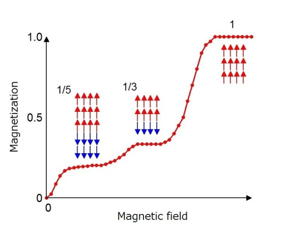 |
| The material exhibits distinct magnetization plateau connected with different spin configurations. |
Abstract:
Complex magnetic structures are at the heart of promising new materials for devices in "spintronics", a field of research aiming at more energy efficient data storage and processing. A prominent example is the so-called spin valve, where the magnitude of the electrical current passing through a device is very sensitively dependent on its magnetic configuration. These configurations can be readily controlled by a magnetic field in artificial layer systems, resulting in the giant magnetoresistance effect (GMR), a discovery rewarded with the 2007 Noble price in physics to Albert Fert and Peter Grünberg.
Emergence of a 'devil's staircase' in a spin-valve system
Berlin, Germany | Posted on July 1st, 2015Cobalt oxides: complex magnetism
While classical GMR systems are composed of metallic layers, complex oxides often intrinsically provide layered structures with alternating magnetic configurations that can act as spin valves. Cobalt oxides are a class of materials that can exhibit complex magnetic order that changes with increasing magnetic field, as for example indicated by distinct plateaux in the magnetization curve.
Magnetic structures mapped
A Japanese team of researchers led by the group of Associate Professor Hiroki Wada at the University of Tokyo has been successful in characterizing the magnetic structures of the complex cobalt oxide SrCo6O11 using the high-field diffractometer of BESSY II. Synthesis of new materials often results in tiny samples, and the crystals studied here had a diameter of only 0.2 mm. With the very high sensitivity of resonant diffraction, a core competence at the UE46_PGM1 beamline of BESSY II, they managed to observe a fascinating type of spin order in the samples that are hardly visible by the bare eye. This order is called devil's staircase, characterizing a phenomenon, where a pletora, in principle even an infinite number, of so-called commensurate superstructures - magnetic configurations in the present case - can be realized by tuning an external parameter, e.g., a magnetic field.
New options with a Devil's staircase
This exceeds the characteristic of a spin valve and may open new paths in spintronics. The research was carried out in close cooperation with German scientists from the Institut für Festkörper-und Werkstoffforschung Dresden and HZB. The results are now published in Physical Review Letters.
####
For more information, please click here
Contacts:
Dr. Eugen Weschke
Copyright © Helmholtz-Zentrum Berlin für Materialien und Energie
If you have a comment, please Contact us.Issuers of news releases, not 7th Wave, Inc. or Nanotechnology Now, are solely responsible for the accuracy of the content.
Bookmark:


| Related Links |
| Related News Press |
News and information
 Quantum computer improves AI predictions April 17th, 2026
Flexible sensor gains sensitivity under pressure April 17th, 2026
A reusable chip for particulate matter sensing April 17th, 2026
Detecting vibrational quantum beating in the predissociation dynamics of SF6 using time-resolved photoelectron spectroscopy April 17th, 2026
Spintronics
Quantum materials: Electron spin measured for the first time June 9th, 2023
Chip Technology
A reusable chip for particulate matter sensing April 17th, 2026
Metasurfaces smooth light to boost magnetic sensing precision January 30th, 2026
Memory Technology
Researchers tackle the memory bottleneck stalling quantum computing October 3rd, 2025
First real-time observation of two-dimensional melting process: Researchers at Mainz University unveil new insights into magnetic vortex structures August 8th, 2025
Utilizing palladium for addressing contact issues of buried oxide thin film transistors April 5th, 2024
Discoveries
Quantum computer improves AI predictions April 17th, 2026
Flexible sensor gains sensitivity under pressure April 17th, 2026
A reusable chip for particulate matter sensing April 17th, 2026
Detecting vibrational quantum beating in the predissociation dynamics of SF6 using time-resolved photoelectron spectroscopy April 17th, 2026
Announcements
A fundamentally new therapeutic approach to cystic fibrosis: Nanobody repairs cellular defect April 17th, 2026
UC Irvine physicists discover method to reverse ‘quantum scrambling’ : The work addresses the problem of information loss in quantum computing system April 17th, 2026
Interviews/Book Reviews/Essays/Reports/Podcasts/Journals/White papers/Posters
A fundamentally new therapeutic approach to cystic fibrosis: Nanobody repairs cellular defect April 17th, 2026
UC Irvine physicists discover method to reverse ‘quantum scrambling’ : The work addresses the problem of information loss in quantum computing system April 17th, 2026
 |
||
 |
||
| The latest news from around the world, FREE | ||
 |
||
|
|
||
| Premium Products | ||
 |
||
|
Only the news you want to read!
Learn More |
||
 |
||
|
Full-service, expert consulting
Learn More |
||
|
|
||