Home > Press > Researchers analyze the structure of bird feathers to create hues without dye
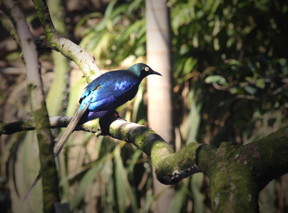 |
| This African Starling displays its vibrant, iridescent structural colors produced by ordered melanosomes. CREDIT: Courtesy of Liliana D'Alba |
Abstract:
Imagine a favorite T-shirt that does not dull with time, or a car that never needs a new coat of paint. A study done at The University of Akron may be able to make this a reality in the near future. Research performed at UA sought to recreate structural color patterns found in bird feathers to generate color without the timely and outdated use of pigments and dyes. Structural color should never diminish in hue and could even potentially be altered at someone's preference.
Researchers analyze the structure of bird feathers to create hues without dye
Akron, OH | Posted on June 8th, 2015UA associate professor of biology, Dr. Matthew Shawkey, his colleague Dr. Ali Dhinojwala, Morton Professor of Polymer Science, and Ming Xiao, graduate student, recently published a paper in a joint project with the University of California, San Diego. Shawkey and his team sought to produce synthetic particles that mimic the tiny packets of melanin found in feathers.
These tiny packets of synthetic melanin produce structural color, like in a bird's feather, when they are packed into layers. Structural color occurs through the interaction of light with materials that have patterns on a tiny scale, which reflect light to make some wavelengths brighter and others darker.
The discoveries published in the journal ACS Nano reflect a milestone in biomimicry research. These findings are just the beginning in a growing field that seeks to improve human life by imitating the success of natural designs and methods.
Structural color in particular has many potential functions. According to Dhinojwala, 'One could think about applications as sensors, photo-protectors, and even perhaps an approach to create a wide range of colors without using any pigments,' he says.
Shawkey praises the benefits of structural color, saying, 'Pigments are both financially and environmentally costly, and can only change color by fading. Structural colors can, in theory, be produced from more common, environmentally friendly materials and could potentially be changed depending on the environment or your whims.'
####
For more information, please click here
Contacts:
Denise Henry
330-972-6477
Copyright © University of Akron
If you have a comment, please Contact us.Issuers of news releases, not 7th Wave, Inc. or Nanotechnology Now, are solely responsible for the accuracy of the content.
Bookmark:


| Related News Press |
News and information
 Quantum computer improves AI predictions April 17th, 2026
Flexible sensor gains sensitivity under pressure April 17th, 2026
A reusable chip for particulate matter sensing April 17th, 2026
Detecting vibrational quantum beating in the predissociation dynamics of SF6 using time-resolved photoelectron spectroscopy April 17th, 2026
Sensors
Flexible sensor gains sensitivity under pressure April 17th, 2026
Tiny nanosheets, big leap: A new sensor detects ethanol at ultra-low levels January 30th, 2026
From sensors to smart systems: the rise of AI-driven photonic noses January 30th, 2026
Sensors innovations for smart lithium-based batteries: advancements, opportunities, and potential challenges August 8th, 2025
Discoveries
Quantum computer improves AI predictions April 17th, 2026
Flexible sensor gains sensitivity under pressure April 17th, 2026
A reusable chip for particulate matter sensing April 17th, 2026
Detecting vibrational quantum beating in the predissociation dynamics of SF6 using time-resolved photoelectron spectroscopy April 17th, 2026
Materials/Metamaterials/Magnetoresistance
First real-time observation of two-dimensional melting process: Researchers at Mainz University unveil new insights into magnetic vortex structures August 8th, 2025
Researchers unveil a groundbreaking clay-based solution to capture carbon dioxide and combat climate change June 6th, 2025
A 1960s idea inspires NBI researchers to study hitherto inaccessible quantum states June 6th, 2025
Institute for Nanoscience hosts annual proposal planning meeting May 16th, 2025
Announcements
A fundamentally new therapeutic approach to cystic fibrosis: Nanobody repairs cellular defect April 17th, 2026
UC Irvine physicists discover method to reverse ‘quantum scrambling’ : The work addresses the problem of information loss in quantum computing system April 17th, 2026
Interviews/Book Reviews/Essays/Reports/Podcasts/Journals/White papers/Posters
A fundamentally new therapeutic approach to cystic fibrosis: Nanobody repairs cellular defect April 17th, 2026
UC Irvine physicists discover method to reverse ‘quantum scrambling’ : The work addresses the problem of information loss in quantum computing system April 17th, 2026
Automotive/Transportation
Decoding hydrogen‑bond network of electrolyte for cryogenic durable aqueous zinc‑ion batteries January 30th, 2026
Sensors innovations for smart lithium-based batteries: advancements, opportunities, and potential challenges August 8th, 2025
Simple algorithm paired with standard imaging tool could predict failure in lithium metal batteries August 8th, 2025
Textiles/Clothing
Protective equipment with graphene nanotubes meets the strictest ESD safety standards March 25th, 2022
Polymer fibers with graphene nanotubes make it possible to heat hard-to-reach, complex-shaped items February 11th, 2022
Flexible material shows potential for use in fabrics to heat, cool July 3rd, 2020
Photonics/Optics/Lasers
Metasurfaces smooth light to boost magnetic sensing precision January 30th, 2026
From sensors to smart systems: the rise of AI-driven photonic noses January 30th, 2026
 |
||
 |
||
| The latest news from around the world, FREE | ||
 |
||
|
|
||
| Premium Products | ||
 |
||
|
Only the news you want to read!
Learn More |
||
 |
||
|
Full-service, expert consulting
Learn More |
||
|
|
||