Home > Press > QLEDs meet wearable devices: Korean scientists develop ultra-thin deformable QLEDs in the wearable platform
 |
Abstract:
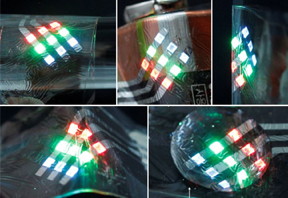
The scientific team, from the Institute for Basic Science (IBS) and Seoul National University, has developed an ultra-thin wearable quantum dot light emitting diodes (QLEDs). The electronic tattoo is based on current quantum dot light emitting diode (QLED) technology. Colloidal quantum dot (QLED's) have attracted great attention as next generation displays. The quantum dots (QDs) have unique properties such as the color tunability, photo/air stability, and are printability on various substrates. The device is paper thin and can be applied to human skin like a sticker.
QLEDs meet wearable devices: Korean scientists develop ultra-thin deformable QLEDs in the wearable platform
Daejeon, Korea | Posted on June 3rd, 2015The team developed the high performance red, green, and blue QLED array, whose resolutions approach 2,500 pixels per inch. This resolution is far superior to other light emitting devices and displays on the market today including ones used in the latest smartphones. The technique is readily scalable over large area. Devices are adaptable to deformed states and thereby built on the unconventional curvilinear substrates including surfaces of various objects. Further mechanical deformations, such as stretching or wrinkling, are also adopted in this technology, which enables QLEDs on the human skin. This breakthrough highlights new possibilities for integrating high-definition full color displays in wearable electronics.
####
For more information, please click here
Contacts:
Sunny Kim
82-428-788-135
Copyright © Institute for Basic Science (IBS)
If you have a comment, please Contact us.Issuers of news releases, not 7th Wave, Inc. or Nanotechnology Now, are solely responsible for the accuracy of the content.
Bookmark:


| Related Links |
| Related News Press |
News and information
 Quantum computer improves AI predictions April 17th, 2026
Flexible sensor gains sensitivity under pressure April 17th, 2026
A reusable chip for particulate matter sensing April 17th, 2026
Detecting vibrational quantum beating in the predissociation dynamics of SF6 using time-resolved photoelectron spectroscopy April 17th, 2026
Flexible Electronics
Flexible sensor gains sensitivity under pressure April 17th, 2026
Flexible electronics integrated with paper-thin structure for use in space January 17th, 2025
Display technology/LEDs/SS Lighting/OLEDs
Spinel-type sulfide semiconductors to operate the next-generation LEDs and solar cells For solar-cell absorbers and green-LED source October 3rd, 2025
Discoveries
Quantum computer improves AI predictions April 17th, 2026
Flexible sensor gains sensitivity under pressure April 17th, 2026
A reusable chip for particulate matter sensing April 17th, 2026
Detecting vibrational quantum beating in the predissociation dynamics of SF6 using time-resolved photoelectron spectroscopy April 17th, 2026
Announcements
A fundamentally new therapeutic approach to cystic fibrosis: Nanobody repairs cellular defect April 17th, 2026
UC Irvine physicists discover method to reverse ‘quantum scrambling’ : The work addresses the problem of information loss in quantum computing system April 17th, 2026
Interviews/Book Reviews/Essays/Reports/Podcasts/Journals/White papers/Posters
A fundamentally new therapeutic approach to cystic fibrosis: Nanobody repairs cellular defect April 17th, 2026
UC Irvine physicists discover method to reverse ‘quantum scrambling’ : The work addresses the problem of information loss in quantum computing system April 17th, 2026
Textiles/Clothing
Protective equipment with graphene nanotubes meets the strictest ESD safety standards March 25th, 2022
Polymer fibers with graphene nanotubes make it possible to heat hard-to-reach, complex-shaped items February 11th, 2022
Flexible material shows potential for use in fabrics to heat, cool July 3rd, 2020
 |
||
 |
||
| The latest news from around the world, FREE | ||
 |
||
|
|
||
| Premium Products | ||
 |
||
|
Only the news you want to read!
Learn More |
||
 |
||
|
Full-service, expert consulting
Learn More |
||
|
|
||