Home > Press > Physicists precisely measure interaction between atoms and carbon surfaces
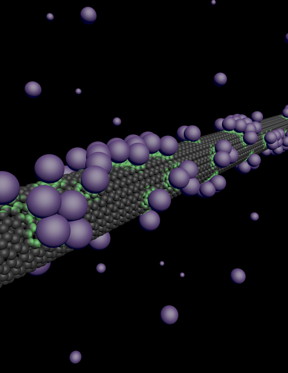 |
| This is an illustration of atoms sticking to a carbon nanotube, affecting the electrons in its surface. CREDIT: David Cobden and students at the University of Washington |
Abstract:
Physicists at the University of Washington have conducted the most precise and controlled measurements yet of the interaction between the atoms and molecules that comprise air and the type of carbon surface used in battery electrodes and air filters -- key information for improving those technologies.
Physicists precisely measure interaction between atoms and carbon surfaces
Seattle, WA | Posted on May 28th, 2015A team led by David Cobden, UW professor of physics, used a carbon nanotube -- a seamless, hollow graphite structure a million times thinner than a drinking straw -- acting as a transistor to study what happens when gas atoms come into contact with the nanotube's surface. Their findings were published in May in the journal Nature Physics.
Cobden said he and co-authors found that when an atom or molecule sticks to the nanotube a tiny fraction of the charge of one electron is transferred to its surface, resulting in a measurable change in electrical resistance.
"This aspect of atoms interacting with surfaces has never been detected unambiguously before," Cobden said. "When many atoms are stuck to the miniscule tube at the same time, the measurements reveal their collective dances, including big fluctuations that occur on warming analogous to the boiling of water."
Lithium batteries involve lithium atoms sticking and transferring charges to carbon electrodes, and in activated charcoal filters, molecules stick to the carbon surface to be removed, Cobden explained.
"Various forms of carbon, including nanotubes, are considered for hydrogen or other fuel storage because they have a huge internal surface area for the fuel molecules to stick to. However, these technological situations are extremely complex and difficult to do precise, clear-cut measurements on."
This work, he said, resulted in the most precise and controlled measurements of these interactions ever made, "and will allow scientists to learn new things about the interplay of atoms and molecules with a carbon surface," important for improving technologies including batteries, electrodes and air filters.
###
Co-authors were Oscar Vilches, professor emeritus of physics, doctoral students Hao-Chun Lee and research associate Boris Dzyubenko, all of the UW. The research was funded by the National Science Foundation.
####
For more information, please click here
Contacts:
Peter Kelley
206-543-2580
David Cobden
206-543-2686
Copyright © University of Washington
If you have a comment, please Contact us.Issuers of news releases, not 7th Wave, Inc. or Nanotechnology Now, are solely responsible for the accuracy of the content.
Bookmark:


| Related News Press |
News and information
 Quantum computer improves AI predictions April 17th, 2026
Flexible sensor gains sensitivity under pressure April 17th, 2026
A reusable chip for particulate matter sensing April 17th, 2026
Detecting vibrational quantum beating in the predissociation dynamics of SF6 using time-resolved photoelectron spectroscopy April 17th, 2026
Govt.-Legislation/Regulation/Funding/Policy
Quantum computer improves AI predictions April 17th, 2026
Metasurfaces smooth light to boost magnetic sensing precision January 30th, 2026
New imaging approach transforms study of bacterial biofilms August 8th, 2025
Nanotubes/Buckyballs/Fullerenes/Nanorods/Nanostrings/Nanosheets
Tiny nanosheets, big leap: A new sensor detects ethanol at ultra-low levels January 30th, 2026
Enhancing power factor of p- and n-type single-walled carbon nanotubes April 25th, 2025
Chainmail-like material could be the future of armor: First 2D mechanically interlocked polymer exhibits exceptional flexibility and strength January 17th, 2025
Innovative biomimetic superhydrophobic coating combines repair and buffering properties for superior anti-erosion December 13th, 2024
Discoveries
Quantum computer improves AI predictions April 17th, 2026
Flexible sensor gains sensitivity under pressure April 17th, 2026
A reusable chip for particulate matter sensing April 17th, 2026
Detecting vibrational quantum beating in the predissociation dynamics of SF6 using time-resolved photoelectron spectroscopy April 17th, 2026
Materials/Metamaterials/Magnetoresistance
First real-time observation of two-dimensional melting process: Researchers at Mainz University unveil new insights into magnetic vortex structures August 8th, 2025
Researchers unveil a groundbreaking clay-based solution to capture carbon dioxide and combat climate change June 6th, 2025
A 1960s idea inspires NBI researchers to study hitherto inaccessible quantum states June 6th, 2025
Institute for Nanoscience hosts annual proposal planning meeting May 16th, 2025
Announcements
A fundamentally new therapeutic approach to cystic fibrosis: Nanobody repairs cellular defect April 17th, 2026
UC Irvine physicists discover method to reverse ‘quantum scrambling’ : The work addresses the problem of information loss in quantum computing system April 17th, 2026
Interviews/Book Reviews/Essays/Reports/Podcasts/Journals/White papers/Posters
A fundamentally new therapeutic approach to cystic fibrosis: Nanobody repairs cellular defect April 17th, 2026
UC Irvine physicists discover method to reverse ‘quantum scrambling’ : The work addresses the problem of information loss in quantum computing system April 17th, 2026
Battery Technology/Capacitors/Generators/Piezoelectrics/Thermoelectrics/Energy storage
Decoding hydrogen‑bond network of electrolyte for cryogenic durable aqueous zinc‑ion batteries January 30th, 2026
COF scaffold membrane with gate‑lane nanostructure for efficient Li+/Mg2+ separation January 30th, 2026
MXene nanomaterials enter a new dimension Multilayer nanomaterial: MXene flakes created at Drexel University show new promise as 1D scrolls January 30th, 2026
 |
||
 |
||
| The latest news from around the world, FREE | ||
 |
||
|
|
||
| Premium Products | ||
 |
||
|
Only the news you want to read!
Learn More |
||
 |
||
|
Full-service, expert consulting
Learn More |
||
|
|
||