Home > Press > Unique microscopic images provide new insights into ionic liquids
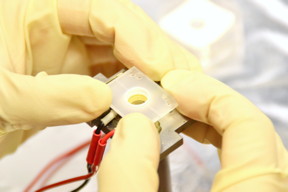 |
| The researchers use a special sample holder to investigate the ionic liquids under the microscope. Photo/Copyright: Denis Schimmelpfennig |
Abstract:
To directly observe chemical processes in unusual, new materials is a scientific dream, made possible by modern microscopy methods: researchers at Kiel University have, for the first time, captured video images of the attachment of molecules in an ionic liquid onto a submerged electrode. The images from the nanoscale world provide detailed information on the way in which chemical components reorganise when a voltage is applied. New findings based on this information may lead to improved batteries and more energy efficient coating technology or solar engineering.
Unique microscopic images provide new insights into ionic liquids
Kiel, Germany | Posted on April 28th, 2015Ionic liquids are organic salt melts, which may even be fluid at room temperature, although they contain no water. It is exactly this point that makes them so interesting for numerous experiments and industrial processes. This is because water is electrolytically dissociated at electrodes even at small voltages, which blankets and hinders other, technically important, electrochemical reactions. In addition, the water molecules encase the ions and interfere in numerous chemical processes. In ionic liquids, which consist of ions only, completely new reactions are therefore possible.
Ionic liquids have been a hot field of research in recent years, leading to the discovery of a whole range of new compounds. Their technological applications are manifold: As electrolytes in batteries, fuel cells or dye solar cells and as a galvanic bath for the deposition of thin aluminium coatings or semi-conductor materials. The fact that they operate at room temperature makes them easier to handle for numerous applications and saves energy on top.
However, at present almost no data are available on how electrochemical reactions in ionic liquids operate at the molecular level or how the molecules are arranged on the surface of the electrode. While in aqueous liquids this has been studied for decades by modern microscopy methods, similar studies in ionic liquids have been largely unsuccessful: “The molecules often simply move too fast for conventional instruments”, says Professor Olaf Magnussen of Kiel University. Using a self-built scanning tunnelling microscope his team was now able to track down this mystery.
Video sequences recorded by Magnussen's co-worker Dr Rui Wen reveal how the liquid's molecules, less than a nanometre in size, react when a voltage is applied to a gold electrode. If the surface is uncharged, the molecules display a response typical for liquids: they are disordered and highly mobile. As the voltage increases the molecules lay down flat on the surface and form rows, before they finally reorient to an erect arrangement. At the same time, they become less and less mobile. “The images are unique and help us to develop theories to better describe the electrode processes in ionic liquids”, says physicist Magnussen. “This is important not only for basic research, but also for concrete applications.”
To allow her to research at Kiel University, Rui Wen applied for a scholarship from the Alexander von Humboldt Foundation and the project was successfully approved. “The special microscopy method really attracted me to Kiel”, says Wen. In the two years she has been in Kiel Rui Wen, hailing from China, has investigated a whole range of ionic liquids, among others liquids with BMP ions, the topic of the recently published study. Battery researchers, in particular, are interested in BMP.
The Kiel research results may lead to a better understanding of ionic liquids and allow them to be tailored for more environmentally friendly production processes. For Rui Wen personally, the investigations have already paid off: She recently received an offer to establish her own working group at the Chinese Academy of Sciences in Beijing.
Full bibliographic information
Potential-dependent Adlayer Structure and Dynamics at the Ionic Liquid
/ Au(111) Interface: A Molecular Scale In Situ Video-STM study. Rui Wen, Björn Rahn, and Olaf. M. Magnussen. Angew. Chem. Int, Ed. DOI: 10.1002/anie.201501715
Potentialabhängige Struktur und Dynamik molekularer Adschichten an der Grenzfläche zwischen ionischen Flüssigkeiten und Au(111): Eine in situ Video-STM Studie. Rui Wen, Björn Rahn, and Olaf. M. Magnussen. Angew. Chem. DOI: 10.1002/ange.201501715
####
For more information, please click here
Contacts:
Boris Pawlowski
Copyright © AlphaGalileo
If you have a comment, please Contact us.Issuers of news releases, not 7th Wave, Inc. or Nanotechnology Now, are solely responsible for the accuracy of the content.
Bookmark:


| Related Links |
| Related News Press |
News and information
 Quantum computer improves AI predictions April 17th, 2026
Flexible sensor gains sensitivity under pressure April 17th, 2026
A reusable chip for particulate matter sensing April 17th, 2026
Detecting vibrational quantum beating in the predissociation dynamics of SF6 using time-resolved photoelectron spectroscopy April 17th, 2026
Imaging
Simple algorithm paired with standard imaging tool could predict failure in lithium metal batteries August 8th, 2025
First real-time observation of two-dimensional melting process: Researchers at Mainz University unveil new insights into magnetic vortex structures August 8th, 2025
Thin films
Tiny nanosheets, big leap: A new sensor detects ethanol at ultra-low levels January 30th, 2026
Announcements
A fundamentally new therapeutic approach to cystic fibrosis: Nanobody repairs cellular defect April 17th, 2026
UC Irvine physicists discover method to reverse ‘quantum scrambling’ : The work addresses the problem of information loss in quantum computing system April 17th, 2026
Interviews/Book Reviews/Essays/Reports/Podcasts/Journals/White papers/Posters
A fundamentally new therapeutic approach to cystic fibrosis: Nanobody repairs cellular defect April 17th, 2026
UC Irvine physicists discover method to reverse ‘quantum scrambling’ : The work addresses the problem of information loss in quantum computing system April 17th, 2026
Tools
Metasurfaces smooth light to boost magnetic sensing precision January 30th, 2026
From sensors to smart systems: the rise of AI-driven photonic noses January 30th, 2026
Japan launches fully domestically produced quantum computer: Expo visitors to experience quantum computing firsthand August 8th, 2025
Energy
Sensors innovations for smart lithium-based batteries: advancements, opportunities, and potential challenges August 8th, 2025
Simple algorithm paired with standard imaging tool could predict failure in lithium metal batteries August 8th, 2025
Battery Technology/Capacitors/Generators/Piezoelectrics/Thermoelectrics/Energy storage
Decoding hydrogen‑bond network of electrolyte for cryogenic durable aqueous zinc‑ion batteries January 30th, 2026
COF scaffold membrane with gate‑lane nanostructure for efficient Li+/Mg2+ separation January 30th, 2026
MXene nanomaterials enter a new dimension Multilayer nanomaterial: MXene flakes created at Drexel University show new promise as 1D scrolls January 30th, 2026
Fuel Cells
Deciphering local microstrain-induced optimization of asymmetric Fe single atomic sites for efficient oxygen reduction August 8th, 2025
Current and Future Developments in Nanomaterials and Carbon Nanotubes: Applications of Nanomaterials in Energy Storage and Electronics October 28th, 2022
Solar/Photovoltaic
Spinel-type sulfide semiconductors to operate the next-generation LEDs and solar cells For solar-cell absorbers and green-LED source October 3rd, 2025
KAIST researchers introduce new and improved, next-generation perovskite solar cell November 8th, 2024
Groundbreaking precision in single-molecule optoelectronics August 16th, 2024
Development of zinc oxide nanopagoda array photoelectrode: photoelectrochemical water-splitting hydrogen production January 12th, 2024
 |
||
 |
||
| The latest news from around the world, FREE | ||
 |
||
|
|
||
| Premium Products | ||
 |
||
|
Only the news you want to read!
Learn More |
||
 |
||
|
Full-service, expert consulting
Learn More |
||
|
|
||