Home > Press > Printing Silicon on Paper, with Lasers
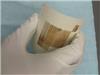 |
| Printed silicon on paper Caption: High-moiblity polysilicon layer was directly formed on paper by coating liquid silicon, which was annealed by pulsed laser-light. Credit: R. Ishihara, M. Trifunovic/TUDelft |
Abstract:
In seeking to develop the next generation of micro-electronic transistors, researchers have long sought to find the next best thing to replace silicon. To this end, a wealth of recent research into fully flexible electronic circuitry has focused on various organic and metal-oxide ink materials, which often lack all the favorable electronic properties of silicon but offer superior "printability."
Printing Silicon on Paper, with Lasers
Washington, DC | Posted on April 21st, 2015Recently, a group of researchers at Delft University of Technology, in the Netherlands, has pioneered a method that allows silicon itself, in the polycrystalline form used in circuitry, to be produced directly on a substrate from liquid silicon ink with a single laser pulse -- potentially ousting its pale usurpers.
The capacity for printing silicon ink onto substrates has existed for some time, but necessitated a 350° C thermal annealing step -- far too hot for many of the flexible surfaces that made production appealing in the first place. The researcher's new method completely bypasses this step, transforming the liquid silicon directly into polysilicon. They discuss their research this week in Applied Physics Letters, from AIP Publishing.
"It was very simple," said Ryoichi Ishihara, the professor who led the research team at Delft University of Technology, with collaborators at the Japan Advanced Institute of Science and Technology in Ishikawa, Japan.
"We coated liquid polysilane directly on paper by doctor-blading, or skimming it by a blade directly in oxygen free environment. Then we annealed the layer with an excimer-laser [a conventional tool used for manufacturing smartphone displays]. And it worked," Ishihara said.
The laser blast only lasted a few tens of nanoseconds, leaving the paper completely intact. In testing its conductive performance, Ishihara and his colleagues found that thin-film transistors using the laser-printed layer exhibited mobilities as high as those of conventional poly-silicon conductors.
The most immediate application of this printing capacity is in wearable electronics, as it allows for the production of fast, low-power and flexible transistors at a remarkably low cost. Ishihara believes the future of the project, which involves improving the production process of the thin-film transistors to include additional non-silicon layers, will hold a wealth of possible further applications.
"The process can be expanded to biomedical sensor and solar-cell areas," Ishihara said, "and will also realize stretchable - and even edible - electronics!"
####
About American Institute of Physics (AIP)
Applied Physics Letters features concise, rapid reports on significant new findings in applied physics. The journal covers new experimental and theoretical research on applications of physics phenomena related to all branches of science, engineering, and modern technology.apl.aip.org
For more information, please click here
Contacts:
Zhengzheng Zhang
For More Information:
Jason Socrates Bardi
+1 240-535-4954
@jasonbardi
Copyright © AlphaGalileo
If you have a comment, please Contact us.Issuers of news releases, not 7th Wave, Inc. or Nanotechnology Now, are solely responsible for the accuracy of the content.
Bookmark:


| Related Links |
 Full bibliographic information
| Related News Press |
News and information
Quantum computer improves AI predictions April 17th, 2026
Flexible sensor gains sensitivity under pressure April 17th, 2026
A reusable chip for particulate matter sensing April 17th, 2026
Detecting vibrational quantum beating in the predissociation dynamics of SF6 using time-resolved photoelectron spectroscopy April 17th, 2026
Flexible Electronics
Flexible sensor gains sensitivity under pressure April 17th, 2026
Possible Futures
A fundamentally new therapeutic approach to cystic fibrosis: Nanobody repairs cellular defect April 17th, 2026
UC Irvine physicists discover method to reverse ‘quantum scrambling’ : The work addresses the problem of information loss in quantum computing system April 17th, 2026
Chip Technology
A reusable chip for particulate matter sensing April 17th, 2026
Metasurfaces smooth light to boost magnetic sensing precision January 30th, 2026
Discoveries
Quantum computer improves AI predictions April 17th, 2026
Flexible sensor gains sensitivity under pressure April 17th, 2026
A reusable chip for particulate matter sensing April 17th, 2026
Detecting vibrational quantum beating in the predissociation dynamics of SF6 using time-resolved photoelectron spectroscopy April 17th, 2026
Announcements
A fundamentally new therapeutic approach to cystic fibrosis: Nanobody repairs cellular defect April 17th, 2026
UC Irvine physicists discover method to reverse ‘quantum scrambling’ : The work addresses the problem of information loss in quantum computing system April 17th, 2026
Interviews/Book Reviews/Essays/Reports/Podcasts/Journals/White papers/Posters
A fundamentally new therapeutic approach to cystic fibrosis: Nanobody repairs cellular defect April 17th, 2026
UC Irvine physicists discover method to reverse ‘quantum scrambling’ : The work addresses the problem of information loss in quantum computing system April 17th, 2026
Energy
Sensors innovations for smart lithium-based batteries: advancements, opportunities, and potential challenges August 8th, 2025
Simple algorithm paired with standard imaging tool could predict failure in lithium metal batteries August 8th, 2025
Solar/Photovoltaic
Spinel-type sulfide semiconductors to operate the next-generation LEDs and solar cells For solar-cell absorbers and green-LED source October 3rd, 2025
KAIST researchers introduce new and improved, next-generation perovskite solar cell November 8th, 2024
Groundbreaking precision in single-molecule optoelectronics August 16th, 2024
Development of zinc oxide nanopagoda array photoelectrode: photoelectrochemical water-splitting hydrogen production January 12th, 2024
Printing/Lithography/Inkjet/Inks/Bio-printing/Dyes
Presenting: Ultrasound-based printing of 3D materials—potentially inside the body December 8th, 2023
Simple ballpoint pen can write custom LEDs August 11th, 2023
Disposable electronics on a simple sheet of paper October 7th, 2022
 |
||
 |
||
| The latest news from around the world, FREE | ||
 |
||
|
|
||
| Premium Products | ||
 |
||
|
Only the news you want to read!
Learn More |
||
 |
||
|
Full-service, expert consulting
Learn More |
||
|
|
||