Home > Press > Cobalt film a clean-fuel find: Rice University discovery is efficient, robust at drawing hydrogen and oxygen from water
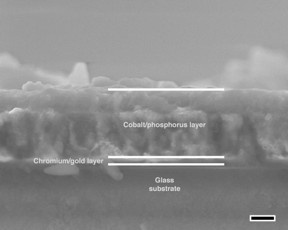 |
| A side view of a porous cobalt phosphide/phosphate thin film was created at Rice University. The robust film could replace expensive metals like platinum in water-electrolysis devices that produce hydrogen and oxygen for fuel cells. The scale bar equals 500 nanometers. CREDIT:Tour Group/Rice University |
Abstract:
A cobalt-based thin film serves double duty as a new catalyst that produces both hydrogen and oxygen from water to feed fuel cells, according to scientists at Rice University.
Cobalt film a clean-fuel find: Rice University discovery is efficient, robust at drawing hydrogen and oxygen from water
Houston, TX | Posted on April 15th, 2015The inexpensive, highly porous material invented by the Rice lab of chemist James Tour may have advantages as a catalyst for the production of hydrogen via water electrolysis. A single film far thinner than a hair can be used as both the anode and cathode in an electrolysis device.
The researchers led by Rice postdoctoral researcher Yang Yang reported their discovery today in Advanced Materials.
They determined their cobalt film is much better at producing hydrogen than most state-of-the-art materials and is competitive with (and much cheaper than) commercial platinum catalysts. They reported the catalyst also produced an oxygen evolution reaction comparable to current materials.
"It is amazing that in water-splitting, the same material can make both hydrogen and oxygen," Tour said. "Usually materials make one or the other, but not both."
The researchers suggested applying alternating current from wind or solar energy sources to cobalt-based electrolysis could be an environmentally friendly source of hydrogen and oxygen.
"Here we can just alternate the current from positive to negative and back again, and hydrogen and oxygen are made with the same material," Tour said. "And the material itself is very easy to make." He said manufacturing the film is inexpensive and scalable.
The lab fabricated the 500-nanometer films by anodyzing a cobalt film electrodeposited on a substrate. The assembly was then baked for two hours in a phosphorus vapor that converted it to a cobalt/phosphide/phosphate thin film without damaging its porous structure.
The material proved to be robust in both durability tests and in acidic and alkaline conditions, Tour said.
###
Graduate students Huilong Fei and Gedeng Ruan are co-authors of the paper.
Tour is the T.T. and W.F. Chao Chair in Chemistry as well as a professor of materials science and nanoengineering and of computer science and a member of Rice's Richard E. Smalley Institute for Nanoscale Science and Technology.
The Air Force Office of Scientific Research and its Multidisciplinary University Research Initiative supported the research.
####
About Rice University
Located on a 300-acre forested campus in Houston, Rice University is consistently ranked among the nation's top 20 universities by U.S. News & World Report. Rice has highly respected schools of Architecture, Business, Continuing Studies, Engineering, Humanities, Music, Natural Sciences and Social Sciences and is home to the Baker Institute for Public Policy. With 3,888 undergraduates and 2,610 graduate students, Rice's undergraduate student-to-faculty ratio is 6-to-1. Its residential college system builds close-knit communities and lifelong friendships, just one reason why Rice is ranked among some of the top schools for best quality of life by the Princeton Review and for best value among private universities by Kiplinger's Personal Finance.
Follow Rice News and Media Relations via Twitter @RiceUNews
For more information, please click here
Contacts:
David Ruth
713-348-6327
Copyright © Rice University
If you have a comment, please Contact us.Issuers of news releases, not 7th Wave, Inc. or Nanotechnology Now, are solely responsible for the accuracy of the content.
Bookmark:


| Related Links |
 Wiess School of Natural Sciences:
| Related News Press |
News and information
Quantum computer improves AI predictions April 17th, 2026
Flexible sensor gains sensitivity under pressure April 17th, 2026
A reusable chip for particulate matter sensing April 17th, 2026
Detecting vibrational quantum beating in the predissociation dynamics of SF6 using time-resolved photoelectron spectroscopy April 17th, 2026
Thin films
Tiny nanosheets, big leap: A new sensor detects ethanol at ultra-low levels January 30th, 2026
Utilizing palladium for addressing contact issues of buried oxide thin film transistors April 5th, 2024
Understanding the mechanism of non-uniform formation of diamond film on tools: Paving the way to a dry process with less environmental impact March 24th, 2023
New study introduces the best graphite films: The work by Distinguished Professor Feng Ding at UNIST has been published in the October 2022 issue of Nature Nanotechnology November 4th, 2022
Govt.-Legislation/Regulation/Funding/Policy
Quantum computer improves AI predictions April 17th, 2026
Metasurfaces smooth light to boost magnetic sensing precision January 30th, 2026
New imaging approach transforms study of bacterial biofilms August 8th, 2025
Discoveries
Quantum computer improves AI predictions April 17th, 2026
Flexible sensor gains sensitivity under pressure April 17th, 2026
A reusable chip for particulate matter sensing April 17th, 2026
Detecting vibrational quantum beating in the predissociation dynamics of SF6 using time-resolved photoelectron spectroscopy April 17th, 2026
Materials/Metamaterials/Magnetoresistance
First real-time observation of two-dimensional melting process: Researchers at Mainz University unveil new insights into magnetic vortex structures August 8th, 2025
Researchers unveil a groundbreaking clay-based solution to capture carbon dioxide and combat climate change June 6th, 2025
A 1960s idea inspires NBI researchers to study hitherto inaccessible quantum states June 6th, 2025
Institute for Nanoscience hosts annual proposal planning meeting May 16th, 2025
Announcements
A fundamentally new therapeutic approach to cystic fibrosis: Nanobody repairs cellular defect April 17th, 2026
UC Irvine physicists discover method to reverse ‘quantum scrambling’ : The work addresses the problem of information loss in quantum computing system April 17th, 2026
Interviews/Book Reviews/Essays/Reports/Podcasts/Journals/White papers/Posters
A fundamentally new therapeutic approach to cystic fibrosis: Nanobody repairs cellular defect April 17th, 2026
UC Irvine physicists discover method to reverse ‘quantum scrambling’ : The work addresses the problem of information loss in quantum computing system April 17th, 2026
Military
Quantum engineers ‘squeeze’ laser frequency combs to make more sensitive gas sensors January 17th, 2025
Chainmail-like material could be the future of armor: First 2D mechanically interlocked polymer exhibits exceptional flexibility and strength January 17th, 2025
Single atoms show their true color July 5th, 2024
NRL charters Navy’s quantum inertial navigation path to reduce drift April 5th, 2024
Energy
Sensors innovations for smart lithium-based batteries: advancements, opportunities, and potential challenges August 8th, 2025
Simple algorithm paired with standard imaging tool could predict failure in lithium metal batteries August 8th, 2025
Automotive/Transportation
Decoding hydrogen‑bond network of electrolyte for cryogenic durable aqueous zinc‑ion batteries January 30th, 2026
Sensors innovations for smart lithium-based batteries: advancements, opportunities, and potential challenges August 8th, 2025
Simple algorithm paired with standard imaging tool could predict failure in lithium metal batteries August 8th, 2025
Fuel Cells
Deciphering local microstrain-induced optimization of asymmetric Fe single atomic sites for efficient oxygen reduction August 8th, 2025
Current and Future Developments in Nanomaterials and Carbon Nanotubes: Applications of Nanomaterials in Energy Storage and Electronics October 28th, 2022
 |
||
 |
||
| The latest news from around the world, FREE | ||
 |
||
|
|
||
| Premium Products | ||
 |
||
|
Only the news you want to read!
Learn More |
||
 |
||
|
Full-service, expert consulting
Learn More |
||
|
|
||