Home > Press > First proof of isolated attosecond pulse generation at the carbon K-edge
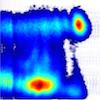 |
| This image shows an attosecond emission steering with CEP phase. CREDIT: ICFO |
Abstract:
In a recent study, "Spatiotemporal isolation of attosecond pulses in the soft X-ray water window " published in Nature Communications by the Attoscience and Ultrafast Optics Group, led by ICREA Professor at ICFO Jens Biegert, the generation of isolated attosecond pulses at the carbon K-edge at 284 eV (4.4 nm), within the water window range, was achieved.
First proof of isolated attosecond pulse generation at the carbon K-edge
Barcelona, Spain | Posted on March 20th, 2015Carbon is one of the most abundant elements in the Universe and the building block of life on earth. It is a fundamental element for both organic compounds, such as cells, lipids, carbohydrates, as well as inorganic compounds, such as those used to fabricate carbon nanotubes, graphene, organic electronics and light harvesting devices.
The availability of attosecond duration (1as=10-18s) soft X-ray pulses means that one can follow electronic motion in real time and with element specificity, i.e. at the carbon edge. The time scales permit imaging the triggering events behind bond formation and breaking, the flow of energy in organic solar cells or energy storage devices, or the inner workings of ultrafast magnetic devices or superconductors. Such capability is key for designing new transformational materials with high efficiency or for the development of petahertz electronics.
Until now and after a decade of continuous research and development, attoscience has culminated in the generation of isolated attosecond pulses at photon energies below 120 eV, due to the stringent requirements concerning laser sources. Now, the Attoscience and Ultrafast Optics Group, led by ICREA Professor at ICFO Jens Biegert, has been able to take a considerable step forward by demonstrating, for the first time, the generation of the isolated attosecond pulses at the carbon K-edge at 284 eV (4.4 nm), in the soft X-ray water window. With their experimental setup, they were able to create these ultra-short pulses with pulse duration below 400as and a bandwidth supporting a 30-as pulse duration.
The water window refers to the fact that water is transparent to soft X-rays in the range between 530 eV/2.34 nm (K-absorption edge of oxygen) and 280 eV /4.4nm (K-absorption edge of carbon), while other elements are absorbing. Aside from the incredible attosecond time resolution, the table top realization at ICFO would permit soft X-ray microscopy on the atomic level of carbon containing compounds inside living compounds and specimens.
####
About ICFO-The Institute of Photonic Sciences
ICFO-The Institute of Photonic Sciences was created in 2002 by the government of Catalonia and the Technical University of Catalonia as a centre of research excellence devoted to the science and technologies of light with a triple mission: to conduct frontier research, train the next generation of scientists, and provide knowledge and technology transfer. Today, it is one of the top research centres worldwide in its category as measured by international rankings.
Research at ICFO targets the forefront of science and technology based on light with programs directed at applications in Health, Renewable Energies, Information Technologies, Security and Industrial processes, among others. The institute hosts 300 professionals based in a dedicated building situated in the Mediterranean Technology Park in the metropolitan area of Barcelona.
ICFO participates in a large number of projects and international networks of excellence and is host to the NEST program which is financed by Fundación Privada Cellex Barcelona.
For more information, please click here
Contacts:
Alina Hirschmann
34-935-542-246
Copyright © ICFO-The Institute of Photonic Sciences
If you have a comment, please Contact us.Issuers of news releases, not 7th Wave, Inc. or Nanotechnology Now, are solely responsible for the accuracy of the content.
Bookmark:


| Related Links |
 Research group led by ICREA Prof. at ICFO Jens Biegert:
| Related News Press |
News and information
Quantum computer improves AI predictions April 17th, 2026
Flexible sensor gains sensitivity under pressure April 17th, 2026
A reusable chip for particulate matter sensing April 17th, 2026
Detecting vibrational quantum beating in the predissociation dynamics of SF6 using time-resolved photoelectron spectroscopy April 17th, 2026
Chemistry
Projecting light to dispense liquids: A new route to ultra-precise microdroplets January 30th, 2026
From sensors to smart systems: the rise of AI-driven photonic noses January 30th, 2026
"Nanoreactor" cage uses visible light for catalytic and ultra-selective cross-cycloadditions October 3rd, 2025
Cambridge chemists discover simple way to build bigger molecules – one carbon at a time June 6th, 2025
Single-atom catalysts change spin state when boosted by a magnetic field June 4th, 2025
Videos/Movies
ICFO researchers overcome long-standing bottleneck in single photon detection with twisted 2D materials August 8th, 2025
New X-ray imaging technique to study the transient phases of quantum materials December 29th, 2022
Nanotubes/Buckyballs/Fullerenes/Nanorods/Nanostrings/Nanosheets
Tiny nanosheets, big leap: A new sensor detects ethanol at ultra-low levels January 30th, 2026
Enhancing power factor of p- and n-type single-walled carbon nanotubes April 25th, 2025
Chainmail-like material could be the future of armor: First 2D mechanically interlocked polymer exhibits exceptional flexibility and strength January 17th, 2025
Innovative biomimetic superhydrophobic coating combines repair and buffering properties for superior anti-erosion December 13th, 2024
Discoveries
Quantum computer improves AI predictions April 17th, 2026
Flexible sensor gains sensitivity under pressure April 17th, 2026
A reusable chip for particulate matter sensing April 17th, 2026
Detecting vibrational quantum beating in the predissociation dynamics of SF6 using time-resolved photoelectron spectroscopy April 17th, 2026
Announcements
A fundamentally new therapeutic approach to cystic fibrosis: Nanobody repairs cellular defect April 17th, 2026
UC Irvine physicists discover method to reverse ‘quantum scrambling’ : The work addresses the problem of information loss in quantum computing system April 17th, 2026
Interviews/Book Reviews/Essays/Reports/Podcasts/Journals/White papers/Posters
A fundamentally new therapeutic approach to cystic fibrosis: Nanobody repairs cellular defect April 17th, 2026
UC Irvine physicists discover method to reverse ‘quantum scrambling’ : The work addresses the problem of information loss in quantum computing system April 17th, 2026
 |
||
 |
||
| The latest news from around the world, FREE | ||
 |
||
|
|
||
| Premium Products | ||
 |
||
|
Only the news you want to read!
Learn More |
||
 |
||
|
Full-service, expert consulting
Learn More |
||
|
|
||