Home > Press > Gold nanoparticle chains confine light to the nanoscale
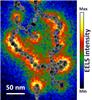 |
| EELS image showing the spatial distribution of electrons confined along a chain of gold nanoparticles. © E. Dujardin (CEMES, CNRS) |
Abstract:
A multidisciplinary team at the Centre d'Elaboration de Matériaux et d'Etudes Structurales (CEMES, CNRS), working in collaboration with physicists in Singapore and chemists in Bristol (UK), have shown that crystalline gold nanoparticles aligned and then fused into long chains can be used to confine light energy down to the nanometer scale while allowing its long-range propagation. Their work was published online on the website of Nature Materials on 26 October.
Gold nanoparticle chains confine light to the nanoscale
Paris, France | Posted on October 31st, 2014Light can be used to transmit information. This property is, for instance, used in fiber optics, and provides an interesting alternative to microelectronics1. Using light increases transmission rates and reduces the energy loss caused by heating when an electrical signal is used. However, several obstacles remain to be overcome, in particular that of miniaturization: optical fiber makes it difficult to confine light within volumes of less than a micrometer (10-6 meters).
Electrons move freely through metals and sometimes begin to oscillate collectively on their surface under the effect of light, as in noble metals such as gold and silver. The properties of such collective oscillations, known as plasmons, have in the past twenty years paved the way for subwavelength (i.e. less than one micrometer) confinement of light energy. By transmitting the energy carried by photons to moving electrons it is possible to transport information in structures narrower than optical fibers. To reach even greater confinement, plasmonics2 is now focusing on the optical properties of crystalline nanoparticles. The smooth crystalline surface prevents disturbing the electron oscillations and reduces energy losses. Exploiting the properties of such nanoparticles should therefore make it possible to simultaneously achieve confinements in the nanometer region and the long-range transport of information.
In this study, the researchers showed that when gold nanoparticles with a ten-nanometer diameter are lined up in a chain, the plasmons they carry generate specific oscillations that are conducive to highly confined propagation. However, energy is lost with each passage between two nanoparticles. Although this characteristic can be exploited for certain applications that require highly localized heat sources, especially in medicine, it is not conducive to long-range propagation.
The researchers therefore carefully fused the nano-beads by focusing a high-energy electron beam on them, thus forming a continuous crystalline network. They observed that energy loss was reduced and that the plasmons were free to oscillate over very long distances, while remaining confined within the diameter of the nanoparticles. Within this bead string, which is a mere ten nanometers wide, information can travel as far as 4000 nanometers.
Another challenge successfully met in this study was to map, with exceptional precision, the electron oscillations observed at the surface of the nanoparticle chain. The different types of motion of the plasmons were characterized using a microscopy technique called electron energy-loss spectroscopy (EELS), whose very fine spatial and spectral resolution enabled the researchers to propose a new theoretical model of plasmon behavior. Simulations based on this model reproduce the experiments with unprecedented accuracy.
This work, which was the result of a long-term collaboration with teams in Bristol and Singapore, could lead to extreme miniaturization of light guidance and open the way to applications for sensors, for instance in photovoltaics, and in telecommunications.
(1) In microelectronics information is transmitted via an electrical signal.
(2) The science that studies the collective properties of electrons at the surface of a metal.
Full bibliographic information
Multimodal Plasmonics in Fused Colloidal Networks, A. Teulle, M. Bosman, C. Girard, K. L. Gurunatha, M. Li, S. Mann, E. Dujardin, Nature Materials, published on line 26 October 2014.
DOI: 10.1038/NMAT4114
####
About CNRS (Délégation Paris Michel-Ange)
The Centre National de la Recherche Scientifique (National Center for Scientific Research) is a public organization under the responsibility of the French Ministry of Higher Education and Research.
For more information, please click here
Contacts:
CNRS researcher
Erik Dujardin
T +33 (0)5 62 25 78 38
CNRS Press Office
Lucie Debroux
T +33 (0)1 44 96 51 51
Julien Guillaume
+ 33 1 44 96 51 51
Copyright © AlphaGalileo
If you have a comment, please Contact us.Issuers of news releases, not 7th Wave, Inc. or Nanotechnology Now, are solely responsible for the accuracy of the content.
Bookmark:


| Related News Press |
News and information
 Quantum computer improves AI predictions April 17th, 2026
Flexible sensor gains sensitivity under pressure April 17th, 2026
A reusable chip for particulate matter sensing April 17th, 2026
Detecting vibrational quantum beating in the predissociation dynamics of SF6 using time-resolved photoelectron spectroscopy April 17th, 2026
Wireless/telecommunications/RF/Antennas/Microwaves
Researchers develop molecular qubits that communicate at telecom frequencies October 3rd, 2025
HKUST researchers develop new integration technique for efficient coupling of III-V and silicon February 16th, 2024
Govt.-Legislation/Regulation/Funding/Policy
Quantum computer improves AI predictions April 17th, 2026
Metasurfaces smooth light to boost magnetic sensing precision January 30th, 2026
New imaging approach transforms study of bacterial biofilms August 8th, 2025
Sensors
Flexible sensor gains sensitivity under pressure April 17th, 2026
Tiny nanosheets, big leap: A new sensor detects ethanol at ultra-low levels January 30th, 2026
From sensors to smart systems: the rise of AI-driven photonic noses January 30th, 2026
Sensors innovations for smart lithium-based batteries: advancements, opportunities, and potential challenges August 8th, 2025
Discoveries
Quantum computer improves AI predictions April 17th, 2026
Flexible sensor gains sensitivity under pressure April 17th, 2026
A reusable chip for particulate matter sensing April 17th, 2026
Detecting vibrational quantum beating in the predissociation dynamics of SF6 using time-resolved photoelectron spectroscopy April 17th, 2026
Announcements
A fundamentally new therapeutic approach to cystic fibrosis: Nanobody repairs cellular defect April 17th, 2026
UC Irvine physicists discover method to reverse ‘quantum scrambling’ : The work addresses the problem of information loss in quantum computing system April 17th, 2026
Energy
Sensors innovations for smart lithium-based batteries: advancements, opportunities, and potential challenges August 8th, 2025
Simple algorithm paired with standard imaging tool could predict failure in lithium metal batteries August 8th, 2025
Photonics/Optics/Lasers
Metasurfaces smooth light to boost magnetic sensing precision January 30th, 2026
From sensors to smart systems: the rise of AI-driven photonic noses January 30th, 2026
Solar/Photovoltaic
Spinel-type sulfide semiconductors to operate the next-generation LEDs and solar cells For solar-cell absorbers and green-LED source October 3rd, 2025
KAIST researchers introduce new and improved, next-generation perovskite solar cell November 8th, 2024
Groundbreaking precision in single-molecule optoelectronics August 16th, 2024
Development of zinc oxide nanopagoda array photoelectrode: photoelectrochemical water-splitting hydrogen production January 12th, 2024
 |
||
 |
||
| The latest news from around the world, FREE | ||
 |
||
|
|
||
| Premium Products | ||
 |
||
|
Only the news you want to read!
Learn More |
||
 |
||
|
Full-service, expert consulting
Learn More |
||
|
|
||