Home > Press > Imaging electric charge propagating along microbial nanowires
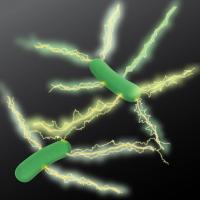 |
| UMass Amherst researchers recently provided stronger evidence than ever before to support their claim that the microbe Geobacter produces tiny electrical wires, called microbial nanowires, along which electric charges propagate just as they do in carbon nanotubes, a highly conductive man-made material.
Credit: UMass Amherst |
Abstract:
The claim by UMass Amherst researchers that the microbe Geobacter produces tiny electrical wires has been mired in controversy for a decade, but a new collaborative study provides stronger evidence than ever to support their claims.
Imaging electric charge propagating along microbial nanowires
Amherst. MA | Posted on October 20th, 2014The claim by microbiologist Derek Lovley and colleagues at the University of Massachusetts Amherst that the microbe Geobacter produces tiny electrical wires, called microbial nanowires, has been mired in controversy for a decade, but the researchers say a new collaborative study provides stronger evidence than ever to support their claims.
UMass Amherst physicists working with Lovley and colleagues report in the current issue of Nature Nanotechnology that they've used a new imaging technique, electrostatic force microscopy (EFM), to resolve the biological debate with evidence from physics, showing that electric charges do indeed propagate along microbial nanowires just as they do in carbon nanotubes, a highly conductive man-made material.
Physicists Nikhil Malvankar and Sibel Ebru Yalcin, with physics professor Mark Tuominen, confirmed the discovery using EFM, a technique that can show how electrons move through materials. "When we injected electrons at one spot in the microbial nanowires, the whole filament lit up as the electrons propagated through the nanowire," says Malvankar.
Yalcin, now at Pacific Northwest National Lab, adds, "This is the same response that you would see in a carbon nanotube or other highly conductive synthetic nanofilaments. Even the charge densities are comparable. This is the first time that EFM has been applied to biological proteins. It offers many new opportunities in biology."
Lovley says the ability of electric current to flow through microbial nanowires has important environmental and practical implications. "Microbial species electrically communicate through these wires, sharing energy in important processes such as the conversion of wastes to methane gas. The nanowires permit Geobacter to live on iron and other metals in the soil, significantly changing soil chemistry and playing an important role in environmental cleanup. Microbial nanowires are also key components in the ability of Geobacter to produce electricity, a novel capability that is being adapted to engineer microbial sensors and biological computing devices."
He acknowledges that there has been substantial skepticism that Geobacter's nanowires, which are protein filaments, could conduct electrons like a wire, a phenomenon known as metallic-like conductivity. "Skepticism is good in science, it makes you work harder to evaluate whether what you are proposing is correct," Lovley points out. "It's always easier to understand something if you can see it. Drs. Malvankar and Yalcin came up with a way to visualize charge propagation along the nanowires that is so elegant even a biologist like me can easily grasp the mechanism."
Biologists have known for years that in biological materials, electrons typically move by hopping along discrete biochemical stepping-stones that can hold the individual electrons. By contrast, electrons in microbial nanowires are delocalized, not associated with just one molecule. This is known as metallic-like conductivity because the electrons are conducted in a manner similar to a copper wire.
Malvankar, who provided the first evidence for the metallic-like conductivity of the microbial nanowires in Lovley and Tuominen's labs in 2011, says, "Metallic-like conductivity of the microbial nanowires seemed clear from how it changed with different temperature or pH, but there were still many doubters, especially among biologists."
To add more support to their hypothesis, Lovley's lab genetically altered the structure of the nanowires, removing the aromatic amino acids that provide the delocalized electrons necessary for metallic-like conductivity, winning over more skeptics. But EFM provides the final, key evidence, Malvankar says.
"Our imaging shows that charges flow along the microbial nanowires even though they are proteins, still in their native state attached to the cells. Seeing is believing. To be able to visualize the charge propagation in the nanowires at a molecular level is very satisfying. I expect this technique to have an especially important future impact on the many areas where physics and biology intersect." he adds.
Tuominen says, "This discovery not only puts forward an important new principle in biology but also in materials science. Natural amino acids, when arranged correctly, can propagate charges similar to molecular conductors such as carbon nanotubes. It opens exciting opportunities for protein-based nanoelectronics that was not possible before."
Lovley and colleagues' microbial nanowires are a potential "green" electronics component, made from renewable, non-toxic materials. They also represent a new part in the growing field of synthetic biology, he says. "Now that we understand better how the nanowires work, and have demonstrated that they can be genetically manipulated, engineering 'electric microbes' for a diversity of applications seems possible."
One application currently being developed is making Geobacter into electronic sensors to detect environmental contaminants. Another is Geobacter-based microbiological computers. This work was supported by the Office of Naval Research, the U.S. Department of Energy and the National Science Foundation.
####
For more information, please click here
Contacts:
Janet Lathrop
413-545-0444
Copyright © University of Massachusetts at Amherst
If you have a comment, please Contact us.Issuers of news releases, not 7th Wave, Inc. or Nanotechnology Now, are solely responsible for the accuracy of the content.
Bookmark:


| Related News Press |
News and information
 Quantum computer improves AI predictions April 17th, 2026
Flexible sensor gains sensitivity under pressure April 17th, 2026
A reusable chip for particulate matter sensing April 17th, 2026
Detecting vibrational quantum beating in the predissociation dynamics of SF6 using time-resolved photoelectron spectroscopy April 17th, 2026
Govt.-Legislation/Regulation/Funding/Policy
Quantum computer improves AI predictions April 17th, 2026
Metasurfaces smooth light to boost magnetic sensing precision January 30th, 2026
New imaging approach transforms study of bacterial biofilms August 8th, 2025
Possible Futures
A fundamentally new therapeutic approach to cystic fibrosis: Nanobody repairs cellular defect April 17th, 2026
UC Irvine physicists discover method to reverse ‘quantum scrambling’ : The work addresses the problem of information loss in quantum computing system April 17th, 2026
Chip Technology
A reusable chip for particulate matter sensing April 17th, 2026
Metasurfaces smooth light to boost magnetic sensing precision January 30th, 2026
Nanotubes/Buckyballs/Fullerenes/Nanorods/Nanostrings/Nanosheets
Tiny nanosheets, big leap: A new sensor detects ethanol at ultra-low levels January 30th, 2026
Enhancing power factor of p- and n-type single-walled carbon nanotubes April 25th, 2025
Chainmail-like material could be the future of armor: First 2D mechanically interlocked polymer exhibits exceptional flexibility and strength January 17th, 2025
Innovative biomimetic superhydrophobic coating combines repair and buffering properties for superior anti-erosion December 13th, 2024
Sensors
Flexible sensor gains sensitivity under pressure April 17th, 2026
Tiny nanosheets, big leap: A new sensor detects ethanol at ultra-low levels January 30th, 2026
From sensors to smart systems: the rise of AI-driven photonic noses January 30th, 2026
Sensors innovations for smart lithium-based batteries: advancements, opportunities, and potential challenges August 8th, 2025
Nanoelectronics
Lab to industry: InSe wafer-scale breakthrough for future electronics August 8th, 2025
Interdisciplinary: Rice team tackles the future of semiconductors Multiferroics could be the key to ultralow-energy computing October 6th, 2023
Key element for a scalable quantum computer: Physicists from Forschungszentrum Jülich and RWTH Aachen University demonstrate electron transport on a quantum chip September 23rd, 2022
Reduced power consumption in semiconductor devices September 23rd, 2022
Discoveries
Quantum computer improves AI predictions April 17th, 2026
Flexible sensor gains sensitivity under pressure April 17th, 2026
A reusable chip for particulate matter sensing April 17th, 2026
Detecting vibrational quantum beating in the predissociation dynamics of SF6 using time-resolved photoelectron spectroscopy April 17th, 2026
Announcements
A fundamentally new therapeutic approach to cystic fibrosis: Nanobody repairs cellular defect April 17th, 2026
UC Irvine physicists discover method to reverse ‘quantum scrambling’ : The work addresses the problem of information loss in quantum computing system April 17th, 2026
Military
Quantum engineers ‘squeeze’ laser frequency combs to make more sensitive gas sensors January 17th, 2025
Chainmail-like material could be the future of armor: First 2D mechanically interlocked polymer exhibits exceptional flexibility and strength January 17th, 2025
Single atoms show their true color July 5th, 2024
NRL charters Navy’s quantum inertial navigation path to reduce drift April 5th, 2024
Environment
A reusable chip for particulate matter sensing April 17th, 2026
Researchers unveil a groundbreaking clay-based solution to capture carbon dioxide and combat climate change June 6th, 2025
 |
||
 |
||
| The latest news from around the world, FREE | ||
 |
||
|
|
||
| Premium Products | ||
 |
||
|
Only the news you want to read!
Learn More |
||
 |
||
|
Full-service, expert consulting
Learn More |
||
|
|
||