Home > Press > Twisted graphene chills out: When two sheets of graphene are stacked in a special way, it is possible to cool down the graphene with a laser instead of heating it up, University of Manchester researchers have shown
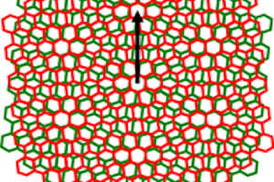 |
| The special graphene cools down when laser light is shone on it |
Abstract:
In an article published in Nano Letters, a multi-national team of scientists including Dr Aravind Vijayaraghavan from Manchester, Professor Ado Jorio from Belo Horizonte in Brazil and Professor Lukas Novotny from Zurich have shown how laser light interacts with a special kind of graphene to cool it down. This would make it possible to make electronic devices of graphene run cooler and faster simply by shining a laser on it.
Twisted graphene chills out: When two sheets of graphene are stacked in a special way, it is possible to cool down the graphene with a laser instead of heating it up, University of Manchester researchers have shown
Manchester, UK | Posted on September 22nd, 2014In their experiment, the scientists used two stacked sheets of graphene, but with one sheet rotated by 11.3° with respect to the other. Lasers are commonly used to make things hotter, to burn them or even to melt metal. But this so called ‘twisted bi-layer graphene' has very unique properties. At special combinations of twist angle and laser energy, the exact opposite happens.
Dr Vijayaraghavan, who leads the Nano-functional Materials Group, explains "In any material, heat is stored in the vibrations of atoms; in a hot material, atoms are vibrating faster than in a colder material. When a laser of a specific energy (colour) is shone on this twisted graphene, the particles of light in the laser (called photons) will absorb the vibration energy of the atoms, thereby cooling the system down."
Nick Clark, a PhD student in Vijayaraghavan's group, describes how this special graphene is produced. "When we make graphene flakes using sticky tape, some flakes have edges which are straight, giving an indication of the direction the atoms are oriented in. We identify two such flakes, and then line them up so that the straight edges are at a fixed angle. The angle we need to produce depends on the colour of the laser light we will be using."
According to Dr Vijayaraghavan, this new discovery has tremendous technological implications. He adds "As you might have experienced, if a computer chips runs fast, it gets very hot. This will also be true for future computer chips that might be made with graphene. If it is possible to cool down the chip, then it can run faster. Currently, people use air conditioning, cold water or even liquid nitrogen to keep their computers cool. A future graphene computer might be cooled by shining a laser on it."
The paper, Optical-phonon resonances with saddle-point excitons in twisted-bilayer graphene by A Jorio, M Kasperczyk, N Clark, E Neu, P Maletinsky, A Vijayaraghavan, and L Novotny appears in Nano Letters (10.1021/nl502412g) on 16/09/2014, and is the result of a collaboration involving researchers from Manchester, Belo Horizonte, Zurich and Basel.
####
For more information, please click here
Contacts:
Daniel Cochlin
Graphene Communications and Marketing Manager
The University of Manchester
0161 275 8382
07917 506158
www.graphene.manchester.ac.uk
www.manchester.ac.uk
Twitter: @UoMGraphene
Copyright © University of Manchester
If you have a comment, please Contact us.Issuers of news releases, not 7th Wave, Inc. or Nanotechnology Now, are solely responsible for the accuracy of the content.
Bookmark:


| Related News Press |
News and information
 Quantum computer improves AI predictions April 17th, 2026
Flexible sensor gains sensitivity under pressure April 17th, 2026
A reusable chip for particulate matter sensing April 17th, 2026
Detecting vibrational quantum beating in the predissociation dynamics of SF6 using time-resolved photoelectron spectroscopy April 17th, 2026
Graphene/ Graphite
Electrifying results shed light on graphene foam as a potential material for lab grown cartilage June 6th, 2025
Breakthrough in proton barrier films using pore-free graphene oxide: Kumamoto University researchers achieve new milestone in advanced coating technologies September 13th, 2024
Chip Technology
A reusable chip for particulate matter sensing April 17th, 2026
Metasurfaces smooth light to boost magnetic sensing precision January 30th, 2026
Discoveries
Quantum computer improves AI predictions April 17th, 2026
Flexible sensor gains sensitivity under pressure April 17th, 2026
A reusable chip for particulate matter sensing April 17th, 2026
Detecting vibrational quantum beating in the predissociation dynamics of SF6 using time-resolved photoelectron spectroscopy April 17th, 2026
Announcements
A fundamentally new therapeutic approach to cystic fibrosis: Nanobody repairs cellular defect April 17th, 2026
UC Irvine physicists discover method to reverse ‘quantum scrambling’ : The work addresses the problem of information loss in quantum computing system April 17th, 2026
Interviews/Book Reviews/Essays/Reports/Podcasts/Journals/White papers/Posters
A fundamentally new therapeutic approach to cystic fibrosis: Nanobody repairs cellular defect April 17th, 2026
UC Irvine physicists discover method to reverse ‘quantum scrambling’ : The work addresses the problem of information loss in quantum computing system April 17th, 2026
Photonics/Optics/Lasers
Metasurfaces smooth light to boost magnetic sensing precision January 30th, 2026
From sensors to smart systems: the rise of AI-driven photonic noses January 30th, 2026
 |
||
 |
||
| The latest news from around the world, FREE | ||
 |
||
|
|
||
| Premium Products | ||
 |
||
|
Only the news you want to read!
Learn More |
||
 |
||
|
Full-service, expert consulting
Learn More |
||
|
|
||