Home > Press > Graphene surfaces on photonic racetracks
 |
| Graphene biochemical sensors could become reality |
Abstract:
Graphene could enable new kind of photonics-based chemical sensors and photo-detectors, University of Manchester researchers have shown.
Graphene surfaces on photonic racetracks
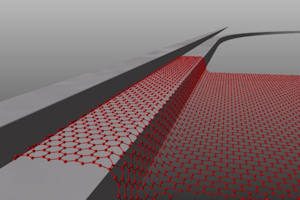
Manchester, UK | Posted on August 2nd, 2014In an article published in Optics Express, scientists from The University of Manchester describe how graphene can be wrapped around a silicon wire, or waveguide, and modify the transmission of light through it.
Just as information can be carried by electrons in metal wires in a microchip, photons of light can carry information through silicon waveguides to form a photonic microchip. Photonic microchips are often regarded as the future of computer processing and telecommunications because of the vastly increased speeds of operation and bandwidth enhancements.
Perhaps more surprisingly, they are also finding applications as highly sensitive bio-chemical sensor devices.
In this work led by University of Manchester scientists Dr Aravind Vijayaraghavan and Dr Iain Crowe in collaboration with scientists from University of Southampton, graphene coatings have been applied to what are known as ‘racetrack resonators' - waveguide loops shaped like oval racetracks - to form a potentially novel device architecture.
Dr Vijayaraghavan explains: "When light travels around such a racetrack, some of the light ‘leaks' out of the waveguide surface, and this ‘evanescent field' can be used for chemical sensing applications. A coating of graphene on the surface of a waveguide can be used to add further capability to such a sensor, such as making it more sensitive and selective.
"In this paper, we have calculated how much light is absorbed by the graphene when it coats the waveguide, and recommend optimum conditions for the graphene coating to serve as a sensor enhancement layer."
Dr Crowe added: "The addition of the graphene layer to our silicon waveguide dramatically alters the way the light is guided through the device meaning that the light will interact even more strongly with surface deposited molecules, when employed in a sensor device.
"This strong interaction between the light and the graphene layer means that the device could also be used to improve the detection of light itself, at very low levels and across a broad range of frequencies when employed in a device known as a ‘photo-detector'.
Notes for editors
The paper ‘Determination of the quasi-TE mode (in-plane) graphene linear absorption coefficient via integration with silicon-on-insulator racetrack cavity resonators' by Iain F Crowe, Nicholas Clark, Siham Hussein, Brian Towlson, Eric Whittaker, Milan M Milosevic, Frederic Y Gardes, Goran Z Mashanovich, Matthew P Halsall, and Aravind Vijayaraghavan is available on request from the Press Office.
Dr Vijayaraghavan is available for interview on request
####
For more information, please click here
Contacts:
Daniel Cochlin
Graphene Communications and Marketing Manager
The University of Manchester
0161 275 8382
07917 506158
www.graphene.manchester.ac.uk
www.manchester.ac.uk
Twitter: @UoMGraphene
Copyright © University of Manchester
If you have a comment, please Contact us.Issuers of news releases, not 7th Wave, Inc. or Nanotechnology Now, are solely responsible for the accuracy of the content.
Bookmark:


| Related News Press |
News and information
 Quantum computer improves AI predictions April 17th, 2026
Flexible sensor gains sensitivity under pressure April 17th, 2026
A reusable chip for particulate matter sensing April 17th, 2026
Detecting vibrational quantum beating in the predissociation dynamics of SF6 using time-resolved photoelectron spectroscopy April 17th, 2026
Graphene/ Graphite
Electrifying results shed light on graphene foam as a potential material for lab grown cartilage June 6th, 2025
Breakthrough in proton barrier films using pore-free graphene oxide: Kumamoto University researchers achieve new milestone in advanced coating technologies September 13th, 2024
Sensors
Flexible sensor gains sensitivity under pressure April 17th, 2026
Tiny nanosheets, big leap: A new sensor detects ethanol at ultra-low levels January 30th, 2026
From sensors to smart systems: the rise of AI-driven photonic noses January 30th, 2026
Sensors innovations for smart lithium-based batteries: advancements, opportunities, and potential challenges August 8th, 2025
Discoveries
Quantum computer improves AI predictions April 17th, 2026
Flexible sensor gains sensitivity under pressure April 17th, 2026
A reusable chip for particulate matter sensing April 17th, 2026
Detecting vibrational quantum beating in the predissociation dynamics of SF6 using time-resolved photoelectron spectroscopy April 17th, 2026
Announcements
A fundamentally new therapeutic approach to cystic fibrosis: Nanobody repairs cellular defect April 17th, 2026
UC Irvine physicists discover method to reverse ‘quantum scrambling’ : The work addresses the problem of information loss in quantum computing system April 17th, 2026
Interviews/Book Reviews/Essays/Reports/Podcasts/Journals/White papers/Posters
A fundamentally new therapeutic approach to cystic fibrosis: Nanobody repairs cellular defect April 17th, 2026
UC Irvine physicists discover method to reverse ‘quantum scrambling’ : The work addresses the problem of information loss in quantum computing system April 17th, 2026
Photonics/Optics/Lasers
Metasurfaces smooth light to boost magnetic sensing precision January 30th, 2026
From sensors to smart systems: the rise of AI-driven photonic noses January 30th, 2026
 |
||
 |
||
| The latest news from around the world, FREE | ||
 |
||
|
|
||
| Premium Products | ||
 |
||
|
Only the news you want to read!
Learn More |
||
 |
||
|
Full-service, expert consulting
Learn More |
||
|
|
||