Home > Press > Tiny DNA pyramids enter bacteria easily -- and deliver a deadly payload
 |
Abstract:
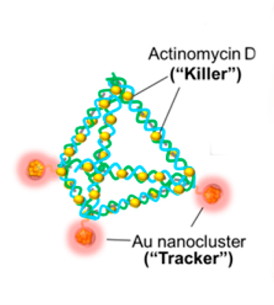
Bacterial infections usually announce themselves with pain and fever but often can be defeated with antibiotics — and then there are those that are sneaky and hard to beat. Now, scientists have built a new weapon against such pathogens in the form of tiny DNA pyramids. Published in the journal ACS Applied Materials & Interfaces, their study found the nanopyramids can flag bacteria and kill more of them than medicine alone.
Tiny DNA pyramids enter bacteria easily -- and deliver a deadly payload
Washington, DC | Posted on July 9th, 2014David Leong, Jianping Xie and colleagues note that some infectious pathogens can lie in wait, undetectable in the human body or in places that antibiotics have a hard time accessing. Engineered nanomedicine offers a new way to deliver drugs directly into bacterial cells, but the carriers developed so far pose problems such as toxicity. So Leong's team decided to use DNA to build a better, safer drug-delivery tool.
They made little pyramids out of DNA that were so small that thousands could fit in the period at the end of this sentence. Then, they attached gold nanomaterials as fluorescent tags and also packaged the drug actinomycin D (AMD) into the struts of the DNA pyramids. In tests on the common bacteria Escherichia coli and Staphylococcus aureus, the scientists tracked the nanopyramids as they entered the cells and released the drug payload. This killed 65 percent of the S. aureus and 48 percent of the E. coli, compared to 42 percent and 14 percent with AMD alone.
The authors acknowledge funding from the Ministry of Education, Singapore.
####
About American Chemical Society
The American Chemical Society is a nonprofit organization chartered by the U.S. Congress. With more than 161,000 members, ACS is the world's largest scientific society and a global leader in providing access to chemistry-related research through its multiple databases, peer-reviewed journals and scientific conferences. Its main offices are in Washington, D.C., and Columbus, Ohio.
For more information, please click here
Contacts:
Michael Bernstein
202-872-6042
Jianping Xie, Ph.D.
Department of Chemical and Biomolecular Engineering
National University of Singapore
Singapore 117585
Phone: +65-65161067
or
David T. Leong, Ph.D.
Department of Chemical and Biomolecular Engineering
and NUS Graduate School for Integrative Science and Engineering
National University of Singapore
Singapore 117456
Phone: +65-65167262
Copyright © American Chemical Society
If you have a comment, please Contact us.Issuers of news releases, not 7th Wave, Inc. or Nanotechnology Now, are solely responsible for the accuracy of the content.
Bookmark:


| Related Links |
| Related News Press |
News and information
 Quantum computer improves AI predictions April 17th, 2026
Flexible sensor gains sensitivity under pressure April 17th, 2026
A reusable chip for particulate matter sensing April 17th, 2026
Detecting vibrational quantum beating in the predissociation dynamics of SF6 using time-resolved photoelectron spectroscopy April 17th, 2026
Govt.-Legislation/Regulation/Funding/Policy
Quantum computer improves AI predictions April 17th, 2026
Metasurfaces smooth light to boost magnetic sensing precision January 30th, 2026
New imaging approach transforms study of bacterial biofilms August 8th, 2025
Nanomedicine
A fundamentally new therapeutic approach to cystic fibrosis: Nanobody repairs cellular defect April 17th, 2026
New molecular technology targets tumors and simultaneously silences two ‘undruggable’ cancer genes August 8th, 2025
New imaging approach transforms study of bacterial biofilms August 8th, 2025
Electrifying results shed light on graphene foam as a potential material for lab grown cartilage June 6th, 2025
Discoveries
Quantum computer improves AI predictions April 17th, 2026
Flexible sensor gains sensitivity under pressure April 17th, 2026
A reusable chip for particulate matter sensing April 17th, 2026
Detecting vibrational quantum beating in the predissociation dynamics of SF6 using time-resolved photoelectron spectroscopy April 17th, 2026
Announcements
A fundamentally new therapeutic approach to cystic fibrosis: Nanobody repairs cellular defect April 17th, 2026
UC Irvine physicists discover method to reverse ‘quantum scrambling’ : The work addresses the problem of information loss in quantum computing system April 17th, 2026
Interviews/Book Reviews/Essays/Reports/Podcasts/Journals/White papers/Posters
A fundamentally new therapeutic approach to cystic fibrosis: Nanobody repairs cellular defect April 17th, 2026
UC Irvine physicists discover method to reverse ‘quantum scrambling’ : The work addresses the problem of information loss in quantum computing system April 17th, 2026
Nanobiotechnology
A fundamentally new therapeutic approach to cystic fibrosis: Nanobody repairs cellular defect April 17th, 2026
New molecular technology targets tumors and simultaneously silences two ‘undruggable’ cancer genes August 8th, 2025
New imaging approach transforms study of bacterial biofilms August 8th, 2025
Electrifying results shed light on graphene foam as a potential material for lab grown cartilage June 6th, 2025
Alliances/Trade associations/Partnerships/Distributorships
Chicago Quantum Exchange welcomes six new partners highlighting quantum technology solutions, from Chicago and beyond September 23rd, 2022
University of Illinois Chicago joins Brookhaven Lab's Quantum Center June 10th, 2022
 |
||
 |
||
| The latest news from around the world, FREE | ||
 |
||
|
|
||
| Premium Products | ||
 |
||
|
Only the news you want to read!
Learn More |
||
 |
||
|
Full-service, expert consulting
Learn More |
||
|
|
||