Home > Press > Snowballs to soot: The clumping density of many things seems to be a standard
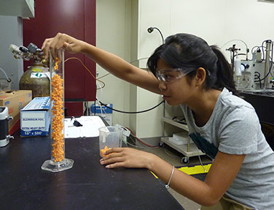 |
| High school student Jessica Young checking the packing density of random aggregates of plastic spheres in a cylinder. Young's work as a summer intern at NIST contributed to a paper arguing that rigid aggregates like those she's testing tend to clump together at roughly the same density regardless of scale, from microscopic soot to large comets. Credit: Baum/NIST |
Abstract:
Particles of soot floating through the air and comets hurtling through space have at least one thing in common: 0.36. That, reports a research group at the National Institute of Standards and Technology (NIST), is the measure of how dense they will get under normal conditions, and it's a value that seems to be constant for similar aggregates across an impressively wide size range from nanometers to tens of meters.*
Snowballs to soot: The clumping density of many things seems to be a standard
Gaithersburg, MD | Posted on June 10th, 2014NIST hopes the results will help in the development of future measurement standards to aid climate researchers and others who need to measure and understand the behavior of aerosols like carbon soot in the atmosphere.
Soot comes mostly from combustion and is considered the second biggest driver of global warming, according to NIST chemist Christopher Zangmeister. It is made up of small round particles of carbon about 10 or 20 nanometers across. The particles stick together randomly in short chains and clumps of a half dozen or more spheres. These, in turn, clump loosely together to form larger, loose aggregates of 10 or more which over a few hours will compact into a somewhat tighter ball which is atmospheric soot.
The interesting question for chemists studying carbon aerosols is how tight? How dense? Among other things, the answer relates to the balance of climate effects from soot: heating from light absorption versus cooling from light reflection.
The maximum packing density of objects is a classic problem in mathematics, which has been fully solved for only the simplest cases. The assumed density in models of atmospheric soot is 0.74, which is the maximum packing density of perfect spheres, such as billiard balls, in a given space. But when Zangmeister's team made measurements of the packing density of actual soot particles, the figure they got was 0.36. "We figured, man, we've got to be wrong, we're off by a factor of two," Zangmeister recalls, but "a bunch more measurements" convinced them that 0.36 was correct. Why?
Enter the summer help. Two students, one in college and one in high school, who were working with Zangmeister's group last summer were set to the task of modeling the packing question with little 6 mm plastic spheres sold for pellet guns. They glued thousands of random combinations of spheres together in clumps of from 1 to 12 spheres, and then filled every available size of graduated cylinders and hollow spheres with their assemblies, over and over, and over.
Their charted results, as a function of clump size, form a curve that levels off at … 0.36.
It gets better. Inspired by a book on the solar system he was reading with his son, Zangmeister checked NASA's literature. Comets are formed very much the same way as soot particles, except out of dust and ice, and they're a lot bigger. NASA's measurements on a collection of 20 comets estimate that packing density at between 0.2 and 0.4. So 0.36 may be an all-purpose value.**
NIST's interest in the nature of soot particles is driven by a desire to imitate them, according to Zangmeister. "It's amazing how much uncertainty there is in optical measurements of particles in the atmosphere. The reason for this uncertainty is rooted in something really important to NIST: there are no real methods for calibrations. You can calibrate any CO2 measurement using one of our Standard Reference Materials for CO2 in air, but there's no such thing as a bottle of standard aerosol or a standard aerosol generator. That's really at the heart of what we're trying to do: make a black material that simulates carbon that you can put into an aerosol and know it will come out the same way every time. It's a real materials chemistry project."
The agency is working with the National Research Council of Canada and Environment Canada on the project.
###
*C.D. Zangmeister, J.G. Radney, L.T. Dockery, J.T. Young, X. Ma, R. You and M.R. Zachariah., The packing density of rigid aggregates is independent of scale. PNAS Early Edition. Published online June 9, 2014. doi:10.1073/pnas.1403768111.
**0.36 is also very close to the reported values for compacted silicon dioxide monomers (ceramics industry) and pharmaceutical powders made from "microscale random aggregates."
####
About National Institute of Standards and Technology (NIST)
The National Institute of Standards and Technology (NIST) is an agency of the U.S. Department of Commerce.
For more information, please click here
Contacts:
Michael Baum
301-975-2763
Copyright © National Institute of Standards and Technology (NIST)
If you have a comment, please Contact us.Issuers of news releases, not 7th Wave, Inc. or Nanotechnology Now, are solely responsible for the accuracy of the content.
Bookmark:


| Related News Press |
News and information
 Quantum computer improves AI predictions April 17th, 2026
Flexible sensor gains sensitivity under pressure April 17th, 2026
A reusable chip for particulate matter sensing April 17th, 2026
Detecting vibrational quantum beating in the predissociation dynamics of SF6 using time-resolved photoelectron spectroscopy April 17th, 2026
Chemistry
Projecting light to dispense liquids: A new route to ultra-precise microdroplets January 30th, 2026
From sensors to smart systems: the rise of AI-driven photonic noses January 30th, 2026
"Nanoreactor" cage uses visible light for catalytic and ultra-selective cross-cycloadditions October 3rd, 2025
Cambridge chemists discover simple way to build bigger molecules – one carbon at a time June 6th, 2025
Single-atom catalysts change spin state when boosted by a magnetic field June 4th, 2025
Laboratories
Researchers develop molecular qubits that communicate at telecom frequencies October 3rd, 2025
Govt.-Legislation/Regulation/Funding/Policy
Quantum computer improves AI predictions April 17th, 2026
Metasurfaces smooth light to boost magnetic sensing precision January 30th, 2026
New imaging approach transforms study of bacterial biofilms August 8th, 2025
Discoveries
Quantum computer improves AI predictions April 17th, 2026
Flexible sensor gains sensitivity under pressure April 17th, 2026
A reusable chip for particulate matter sensing April 17th, 2026
Detecting vibrational quantum beating in the predissociation dynamics of SF6 using time-resolved photoelectron spectroscopy April 17th, 2026
Announcements
A fundamentally new therapeutic approach to cystic fibrosis: Nanobody repairs cellular defect April 17th, 2026
UC Irvine physicists discover method to reverse ‘quantum scrambling’ : The work addresses the problem of information loss in quantum computing system April 17th, 2026
Interviews/Book Reviews/Essays/Reports/Podcasts/Journals/White papers/Posters
A fundamentally new therapeutic approach to cystic fibrosis: Nanobody repairs cellular defect April 17th, 2026
UC Irvine physicists discover method to reverse ‘quantum scrambling’ : The work addresses the problem of information loss in quantum computing system April 17th, 2026
Environment
A reusable chip for particulate matter sensing April 17th, 2026
Researchers unveil a groundbreaking clay-based solution to capture carbon dioxide and combat climate change June 6th, 2025
Aerospace/Space
Decoding hydrogen‑bond network of electrolyte for cryogenic durable aqueous zinc‑ion batteries January 30th, 2026
ICFO researchers overcome long-standing bottleneck in single photon detection with twisted 2D materials August 8th, 2025
Onion-like nanoparticles found in aircraft exhaust May 14th, 2025
Research partnerships
Lab to industry: InSe wafer-scale breakthrough for future electronics August 8th, 2025
HKU physicists uncover hidden order in the quantum world through deconfined quantum critical points April 25th, 2025
 |
||
 |
||
| The latest news from around the world, FREE | ||
 |
||
|
|
||
| Premium Products | ||
 |
||
|
Only the news you want to read!
Learn More |
||
 |
||
|
Full-service, expert consulting
Learn More |
||
|
|
||